 English
 Lietuvių
 Latviešu
 Eesti
 Polski
 Русский
 Українська
 Deutsch
 Nederlands
 Čeština
 Slovenčina
 Svenska
 Norsk
 Dansk
 Suomi


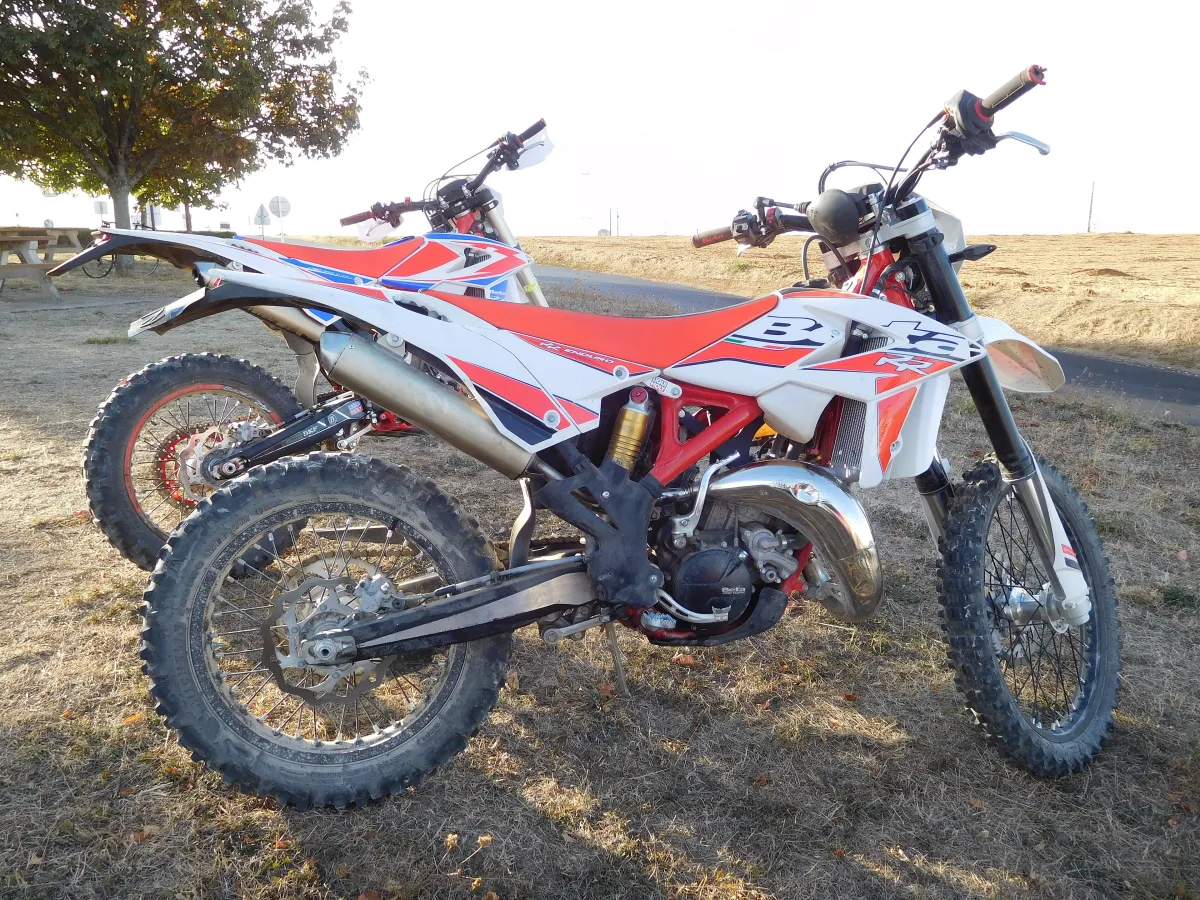
Beta RR: enduro motorcycles — 2T and 4T versions, what to know when buying
Beta RR — the Italian manufacturer Beta's enduro motorcycle line, produced since 2005 with two-stroke and four-stroke engines. We review the versions, engines, and what to check when buying used.






Beta RR in brief
RR — Beta's main enduro series: lightweight, high-ground clearance motorcycles designed for riding through forests, trails, and off-road. They have road-ready versions with lights and gauges, but are mainly intended for off-road use.
The Beta RR is renowned for its excellent price-to-quality ratio and is praised by experienced riders for being lightweight, easy to handle motorcycles with a predictable engine character. The used market in Lithuania is quite small.
Versions — what's the difference
The RR series includes two-stroke (125, 200, 250, 300 cm³) and four-stroke (350, 390, 430, 480 cm³) versions. There are also 'RR Racing' sport versions with higher-spec equipment.
The newer two-stroke models use electronic oil injection rather than mixing oil with petrol. Always check the exact version and year using the frame number.
Engines and gearbox
Two-stroke engines are lighter, simpler, and more lively, ideal for tough off-road conditions, but require more maintenance. Four-stroke engines are quieter, smoother, and less polluting, but are heavier and more expensive to service.
The gearbox is manual, with several gears (usually 5 or 6). Most versions have electric start.
What to check when buying a used RR
Enduro motorcycles are used in tough conditions, so check the frame, forks, and suspension for impacts and oil leaks. Inspect the chain, sprockets, and brakes.
On two-strokes, check the cylinder and piston condition (compression), on four-strokes — the valve and engine oil change history. Listen for even engine operation.
Ask for the service history and find out how many hours the engine has run. Check the air filter and cooling system.


Trim levels
Specific trim levels vary by year, so we provide general versions.
RR 2T
Two-strokesTwo-stroke enduro models (125–300 cm³).
- Lightweight construction
- Often — electronic oil injection in newer ones
- Different displacements
RR 4T
Four-strokesFour-stroke enduro models (350–480 cm³).
- Smoother power delivery
- Quieter engine
- Heavier than two-strokes
Comparison of engine types
| RR 2T | RR 4T | |
|---|---|---|
| Who it's for | Tough on the wallet and best for experienced drivers | Versatile driving |
| Weight | Lighter | Heavier |
| Maintenance | More frequent | Less often, but more expensive |
| Price in the used market (relatively) | €€ | €€ |
Twin-cylinders are best for experienced drivers and those tough on the wallet. Four-cylinders are more versatile and suit those who value even power delivery.
Pros
- Light and easy to handle
- Good value for money
- A wide range of engines
- Suitable for both road and off-road
Cons
- Requires regular maintenance
- Rare in Lithuania, limited parts availability
- Used examples often worn out
Frequently asked questions
Can RR models be used on roads?
Some versions have the equipment needed for road use, but this depends on the specific model and registration. Always check the documents.
Which engine is better — two-stroke or four-stroke?
Two-strokes are lighter and more lively, ideal for tough off-road, while four-strokes are smoother and more versatile. The choice depends on experience and purpose.
Is RR suitable for beginners?
Smaller displacement versions (125 or 200 cm³) might be suitable, but generally, these are enduro motorcycles that require experience.
Updated 2026-10-21 · Trim levels and equipment vary by market and model year — check the equipment of the specific car. · Translated automatically


