 English
 Lietuvių
 Latviešu
 Eesti
 Polski
 Русский
 Українська
 Deutsch
 Nederlands
 Čeština
 Slovenčina
 Svenska
 Norsk
 Dansk
 Suomi


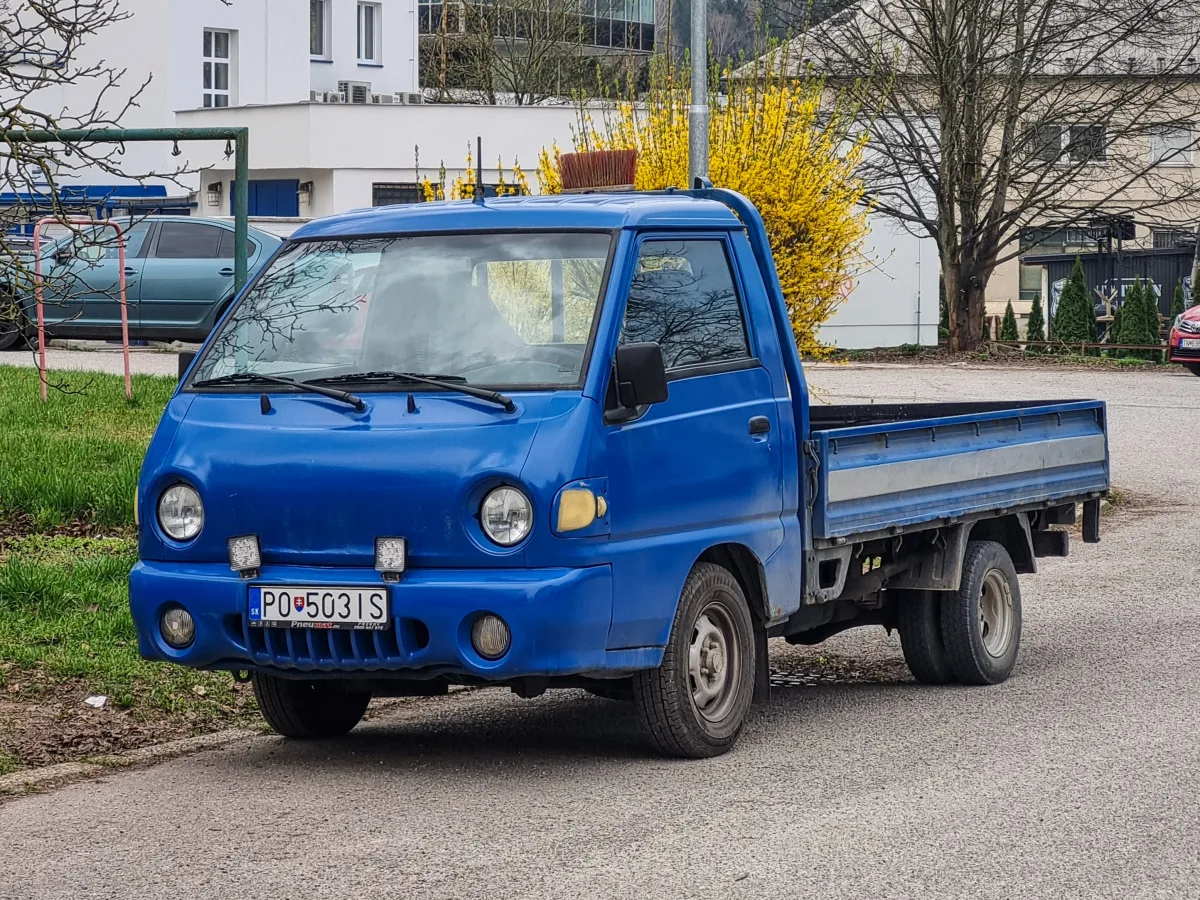
Hyundai Porter: light commercial vehicle, generations and buying
The Hyundai Porter is a small South Korean commercial vehicle that has been in production since 1977. It is extremely popular in Korea as a workhorse for small businesses. In Lithuania, you'll find the occasional imported example, so we'll take a look at the essentials and what to check.






Porter in brief
The Porter is a small four-wheel truck with an open cargo bed, designed for local hauling in both urban and rural settings. Its primary market is South Korea, where it consistently ranks among the best-selling vehicles.
In Europe, similar models were sold under the H-100 name. The current generation, known as the Porter II, has been in production since 2004 and has undergone several updates.
Which version to choose
The key factor is the type of cab and cargo bed. There is a standard cab, an extended cab, and a double cab version that accommodates more passengers. Specialized body styles are also available (e.g., a refrigerated unit or van).
Since 2019, an electric Porter has been available in Korea. You'll rarely encounter one in Lithuania, so the choice usually comes down to diesel cab variants.
Engines and transmissions
The Porter II typically comes with a 2.5-litre turbodiesel engine with direct injection. The transmission is manual, usually with 5 speeds.
The drivetrain is rear-wheel drive, often with dual rear wheels. The electric version features a battery pack of around 58 kWh.
What to check when buying a used Porter
Like any workhorse, the Porter is often put through its paces. Check the body frame and load bed for signs of rust, wear and tear, and repair work.
Start the cold engine: smoke or noise indicates trouble. Check the clutch, brakes, and suspension, especially if the vehicle has been heavily loaded. For an imported car from Korea, check the documentation.


Trim levels
Names may vary by market; below are the cabin variants most commonly encountered.
Standard Cab
Porter IIThe base two-seater cabin.
- Two seating positions
- The largest load area
- The most affordable option
Super Cab
Porter IIExtended cabin with additional space.
- Extra room behind the seats
- Wider interior
- Slightly smaller load bed
Double Cab
Porter IIDouble cabin for passengers.
- Often comes with 5 seating positions
- A smaller load platform
- Ideal for a small business or family
Cab comparison
| Standard Cab | Super Cab | Double Cab | |
|---|---|---|---|
| Who it's for | For loads | More space for the driver | For passengers and loads |
| Seating | 2–3 | 2–3 | 5 |
| Load platform | Longest | Average | Shortest |
| Engine | 2.5 turbodiesel | 2.5 turbodiesel | 2.5 turbodiesel |
| Price in the used market (relatively) | € | € | €€ |
If you primarily need to haul cargo, go for the Standard Cab. If you often drive with passengers, choose the Double Cab.
Pros
- Simple, affordable maintenance
- Short turning radius and compact dimensions
- Low running costs
- Electric version for city driving
Cons
- Less comfort than in modern pickups
- Rare in Lithuania, parts may take time to arrive
- Simpler safety features than in modern cars
Frequently asked questions
Is the Porter sold in Europe?
Similar Hyundai commercial vehicles in Europe are sold under different names. The Porter is most often imported from South Korea.
What engine does the Porter have?
Most commonly, a 2.5-litre turbodiesel. You can find the exact power output in the vehicle's documents.
Is there an electric Porter?
Yes, since 2019, an electric version with around a 58 kWh battery has been sold in Korea. It's very rarely seen in Lithuania.
Updated 2026-10-14 · Trim levels and equipment vary by market and model year — check the equipment of the specific car. · Translated automatically


