 English
 Lietuvių
 Latviešu
 Eesti
 Polski
 Русский
 Українська
 Deutsch
 Nederlands
 Čeština
 Slovenčina
 Svenska
 Norsk
 Dansk
 Suomi


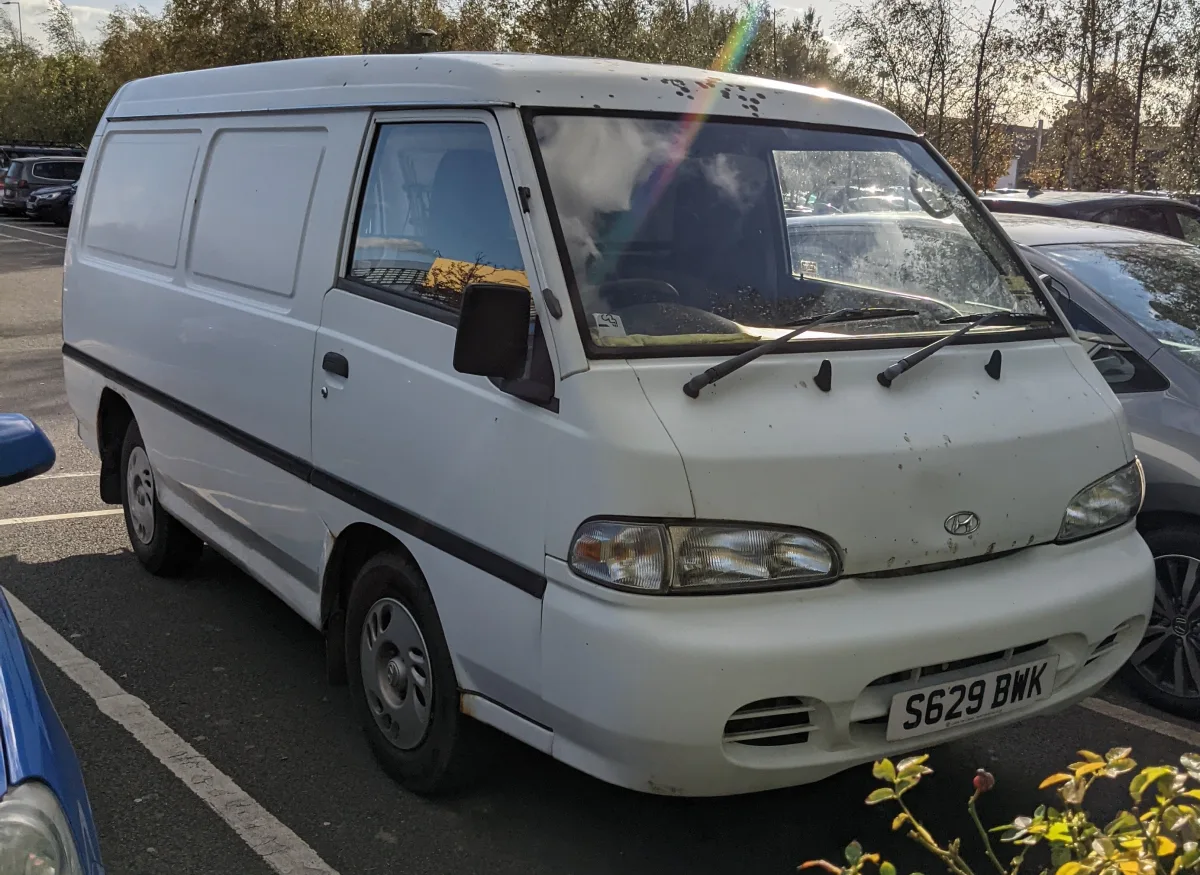
Hyundai H-100: generations, engines, and what to check when buying
Hyundai H-100 (1993–2004) — a compact commercial van and minibus with a design closely related to the Mitsubishi L300. In this article, we review the H-100 generations, engines, and what to check when buying a used H-100.






H-100 at a glance
The H-100 was a simple and economical commercial vehicle designed for small businesses and passenger transport. Its design is closely linked to the Mitsubishi L300, so these vehicles share many similarities.
The most common body styles are the van and minibus, with some markets also offering a chassis cab version. Today, the H-100 is rarely seen in Lithuania, mostly appearing in imported car listings.
Which version to choose
The H-100 was produced for a decade, so all versions belong to roughly the same era. The choice mainly depends on the body style, length, and engine.
If you need a vehicle for work, opt for a van with a clean history. If you're looking for a passenger vehicle, check that the seats have proper anchor points and that the vehicle is registered as a passenger car.
Engines and transmissions
The H-100 was equipped with a roughly 2.5-litre diesel engine known for its simplicity and longevity. In some markets, petrol engines were also available.
The transmission is usually manual. Due to its modest power, the vehicle is well-suited to city driving and local roads, but it quickly reaches its limits on highways.
What to check when buying a used H-100
Inspect the body: look for dents, wheel arches, the floor, rear doors, and the front screen. Corrosion is common, especially on imports from countries where salt is used on the roads in winter.
Start the engine cold: there should be no excessive smoking or leaks. Check the gearbox, brakes, suspension, and steering system, as these wear out when working under load.
Ensure the documents are in order and the chassis number matches the one recorded. Finding parts can take time, so check their availability in advance.


Body styles
Trims vary by market and year, so we outline the main body styles.
Furgonas
1993–2004Enclosed cargo area for commercial use.
- Practical cargo space
- Often — sliding side doors and a rear door
- Suitable for small businesses
Mikroautobusas
1993–2004Passenger version with seats and windows.
- More seating capacity
- Often — sliding side doors
- Suitable for families and passenger transport
Platforma
Some vehiclesOpen cargo platform.
- Quick loading
- Simple construction
- Suitable for construction and agricultural work
Kemperio ar perdirbtos versijos
Often convertedLiving or special-purpose versions.
- Tailored for specific purposes
- Often includes a sleeping area
- Ideal for travellers
H-100 version comparison
| Furgonas | Mikroautobusas | Platforma | |
|---|---|---|---|
| Who it's for | For cargo | For passengers | For open cargo |
| Body | Closed | With windows and seats | Open |
| Usage | Simple and cheap | Simple and cheap | Simple and cheap |
| Price in the used market (relatively) | € | € | € |
For most buyers, the simplest choice is a van or minibus with a clean history. Choose the platform only for specific tasks.
Pros
- Simple construction
- Economical and cheap
- Practical cargo compartment
- Ideal for small businesses
Cons
- Due to age, rust is often found
- Comfort and safety features are basic
- Finding parts can take time
Frequently asked questions
Is the H-100 related to the Mitsubishi L300?
Yes, the H-100 shares much of its design with the Mitsubishi L300, so there are plenty of similarities between them.
What engine does the H-100 have?
The most commonly used engine is a 2.5-litre diesel. Other engine choices depend on the market.
Is the H-100 reliable?
A simple design is often seen as an advantage, but this is an old car, so it depends a lot on the previous owner's maintenance and any rust.
Updated 2026-10-21 · Trim levels and equipment vary by market and model year — check the equipment of the specific car. · Translated automatically


