 English
 Lietuvių
 Latviešu
 Eesti
 Polski
 Русский
 Українська
 Deutsch
 Nederlands
 Čeština
 Slovenčina
 Svenska
 Norsk
 Dansk
 Suomi


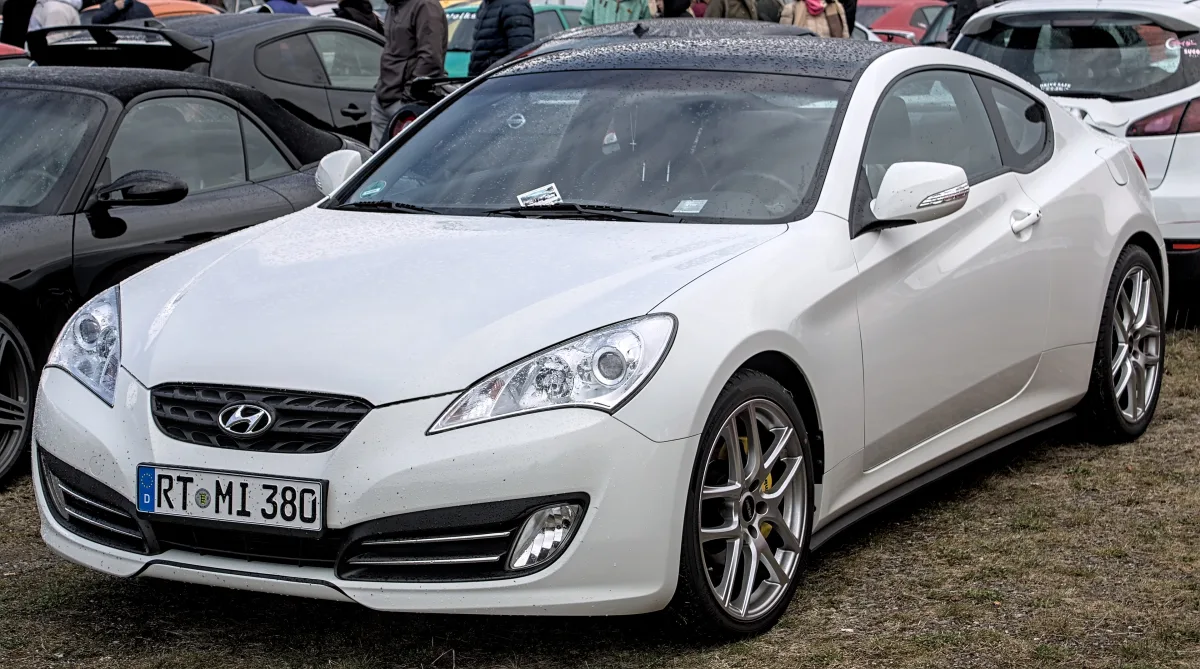
Hyundai Genesis Coupe: turbo and V6 versions, which to choose
Hyundai Genesis Coupe — rear-wheel-drive sports coupe, produced 2008–2016. Buyers were drawn to its Nissan 370Z-like price and powerful engine options. We explore the differences between the 2.0 turbo and 3.8 V6, trims, and what to check when buying.






Genesis Coupe in brief
The Genesis Coupe was Hyundai's attempt to offer a genuine sports car with rear-wheel drive. It wasn't widely sold in Europe, so in Lithuania, you'll mostly find cars from the US or Korea.
A two-door coupe with a short rear seat is more suited to the driver than passengers. Main rivals — Nissan 370Z, Ford Mustang, and Subaru BRZ.
Which version to choose
There are two main engine lines: 2.0 turbo and 3.8 V6. The 2.0T is lighter, more economical, and popular for tuning, while the 3.8 V6 is more powerful and quieter, but heavier.
The 2013 update brought a fresher look, improved engine power, and an 8-speed automatic gearbox. If possible, opt for the updated version.
Engines and gearboxes
Until 2013, the 2.0 turbo engine produced around 210 hp, and after the update, around 275 hp. The 3.8 V6 initially reached around 300–310 hp, and after the update with direct injection, around 350 hp.
The gearbox is a 6-speed manual or automatic (previously 5 or 6-speed, later 8-speed). Some versions have a limited-slip differential.
What to check when buying a used Genesis Coupe
These cars are often tuned and used for spirited driving. Check out the modifications: ECU programming, exhaust system, turbo, lower suspension. Thoughtless tuning can destroy the engine.
Inspect the subframe and manual gearbox shifts, clutch, tire wear (asymmetric wear can indicate poor alignment), turbo oil leaks. For a car imported from the USA, check its history via the VIN.


Trim levels
Trim names vary by market; in the USA, the R-Spec, Track, Grand Touring, and Ultimate are offered.
R-Spec
2008–2016A more basic, performance-oriented version.
- Often — manual transmission
- Less comfort equipment
- Lighter weight
Track
2008–2016The sporty version with additional brake and suspension components.
- Often — 19-inch wheels
- Often — Brembo brakes (3.8)
- Often — limited-slip differential
Grand Touring
2008–2016A more comfort-oriented version with plenty of equipment.
- Often — leather interior
- Often — navigation and sound system
- Often — heated seats
Ultimate
2008–2016Top-of-the-range trim
- Often — full comfort equipment
- Often — luxurious trim
- Often — more safety systems
Trim comparison
| R-Spec | Track | Grand Touring | Ultimate | |
|---|---|---|---|---|
| Who it suits | For driving pleasure | For sporty driving | For everyday comfort | For maximum equipment |
| Wheels (most often) | 18 col. | 19 col. | 19 col. | 19 col. |
| Interior | Base | Sport | Single | Single, full kit |
| Engine | 2.0T or 3.8 | 2.0T or 3.8 | 3.8 | 3.8 |
| Price in the used market (relatively) | € | €€ | €€ | €€€ |
If you're after genuine driving pleasure, go for the R-Spec or Track with a manual gearbox. For comfort, the Grand Touring is the way to go.
Pros
- Rear-wheel drive and sporty character
- Powerful engine options
- A good price compared to competitors
- A wide range of tuning options
Cons
- Not officially sold in Europe
- Many cars tuned and used for sport
- Small rear seats
Frequently asked questions
Does the Genesis Coupe have rear-wheel drive?
Yes, all models have rear-wheel drive. It's one of the car's main selling points.
Which engine is better: the 2.0T or the 3.8?
It depends on your needs. The 2.0T is lighter and better for tuning, while the 3.8 V6 is more powerful and smoother, but heavier.
Is the Genesis Coupe reliable?
In many cases, yes, if it's been properly maintained. The biggest risk is previous tuning or sport driving modifications.
Updated 2026-10-14 · Trim levels and equipment vary by market and model year — check the equipment of the specific car. · Translated automatically


