 English
 Lietuvių
 Latviešu
 Eesti
 Polski
 Русский
 Українська
 Deutsch
 Nederlands
 Čeština
 Slovenčina
 Svenska
 Norsk
 Dansk
 Suomi


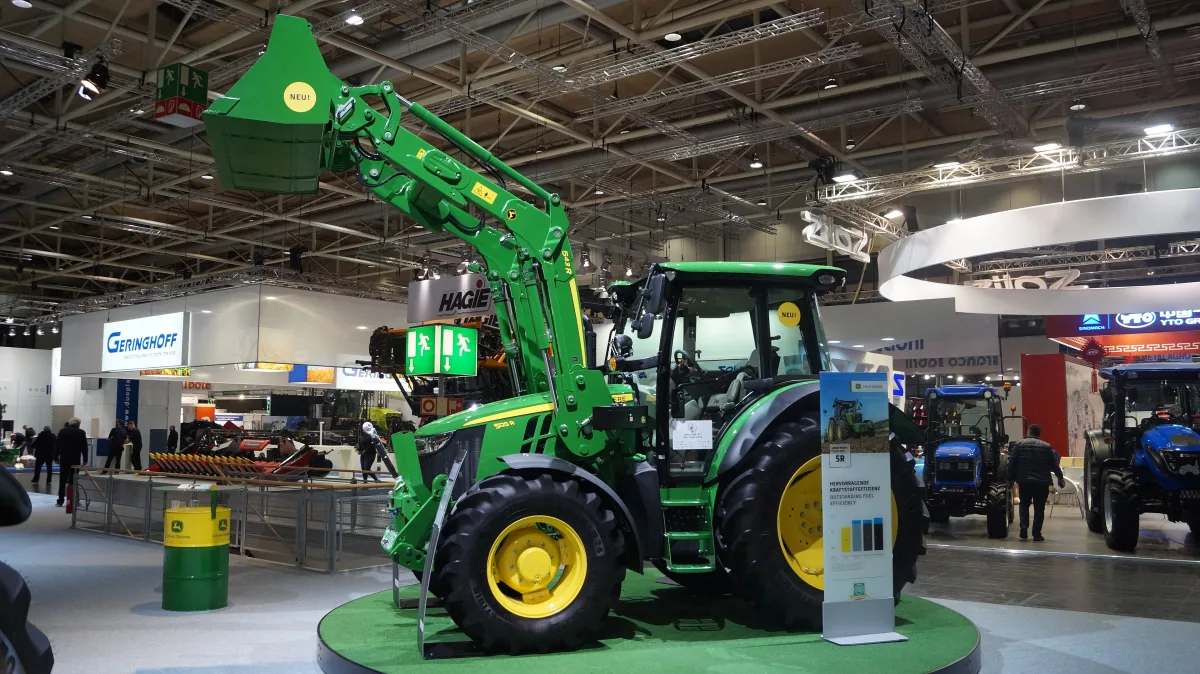
John Deere 5R: tractors, engines and what to check
John Deere 5R — mid-range utility tractors, produced (new generation — from 2020). We look at power classes, engines and what to check when buying a used 5R.






5R in brief
John Deere 5R — a series of mid-range utility tractors designed for farming, livestock and municipal work. Nominal power ranges roughly from 90 to 130 HP.
The series is praised for its comfortable cab, good visibility and reliable mechanics. There's a wide range of used 5R models available, as the series is widely used.
Generations and names
The series was updated: the first generation (e.g., 5090R, 5100R, 5125R) had a different design, while the new generation, introduced in 2020, features a refreshed cab and Stage V engines.
When buying a used tractor, it's important to know the year of manufacture and generation, as this affects the engine design and the presence of SCR systems.
Engines and transmissions
Engines — John Deere PowerTech, four-cylinder, around 4.5L displacement. Newer models use an SCR system with AdBlue.
Transmissions — stepped with reverse shuttle or semi-automatic. The choice depends on the trim and market.
What to check when buying a used 5R
Check the engine hours, oil and coolant leaks, turbocharger, SCR system and hydraulic operation. Ask for the service history.
Check the gearbox shifts, clutch, front and rear axle play, lifting mechanism, and cabin electronics. Inspect the wheels, load-securing points, and body.


Versions and trims
Names and equipment vary by market and year of production; we list the versions most commonly found in Europe.
5R su pakopine pavarų dėže
from 2020 and earlier generationsA more basic and affordable configuration.
- Often — a manual gearbox with reverse
- Often — a more basic cabin
- Lower price in the used market
5R su pusiau automatine dėže
later yearsA more user-friendly gearbox for daily driving.
- Semi-automatic gearbox
- Often — a more comfortable cabin
- Often — more hydraulic options
5R su krautuvu
depending on the trimOften used in livestock farming operations.
- Often — front loader
- Additional front axle suspension
- Check the loader hydraulics
5R su aukštesne įranga
depending on the trimWith additional comfort and tech features.
- Often — enhanced electronics
- Often — comfortable cabin
- Often — additional hydraulics
Comparison of 5R configurations
| Pakopinė dėžė | Pusiau automatinė | Su krautuvu | |
|---|---|---|---|
| Who it suits | For the budget-conscious | For everyday comfort | For livestock farming |
| Gearbox | Synchro-reverse gear | Pusiau automatinė | Depends on the trim level |
| Driving comfort | Basic | High | Medium to high |
| Price in the used market (relatively) | Budget-friendly | Mid-range | Mid-range |
Most farms will find the 5R with a manual or semi-automatic gearbox and a good service history suitable. For livestock farms, it's worth choosing the version with a tested loader.
Pros
- Comfortable cabin and good visibility
- Wide selection in the used market
- Extensive network of service centres and parts
- Holds its value well
Cons
- Less power for heavy tasks
- Newer models have more complex electronics
- Parts can be expensive
Frequently asked questions
How does the 5R differ from the 6R?
The 5R is lower-powered and more basic, while the 6R is a higher-class model with more power and greater comfort.
Is the 5R suitable for work with a trailer?
Yes, especially on livestock farms. It's important to check the front axle and trailer hitch points.
How do the old and new 5R generations differ?
The new generation (from 2020) features an updated cab and Stage V engines, while the previous one has a different design and older emissions standards.
Updated 2026-10-21 · Trim levels and equipment vary by market and model year — check the equipment of the specific car. · Translated automatically


