 English
 Lietuvių
 Latviešu
 Eesti
 Polski
 Русский
 Українська
 Deutsch
 Nederlands
 Čeština
 Slovenčina
 Svenska
 Norsk
 Dansk
 Suomi


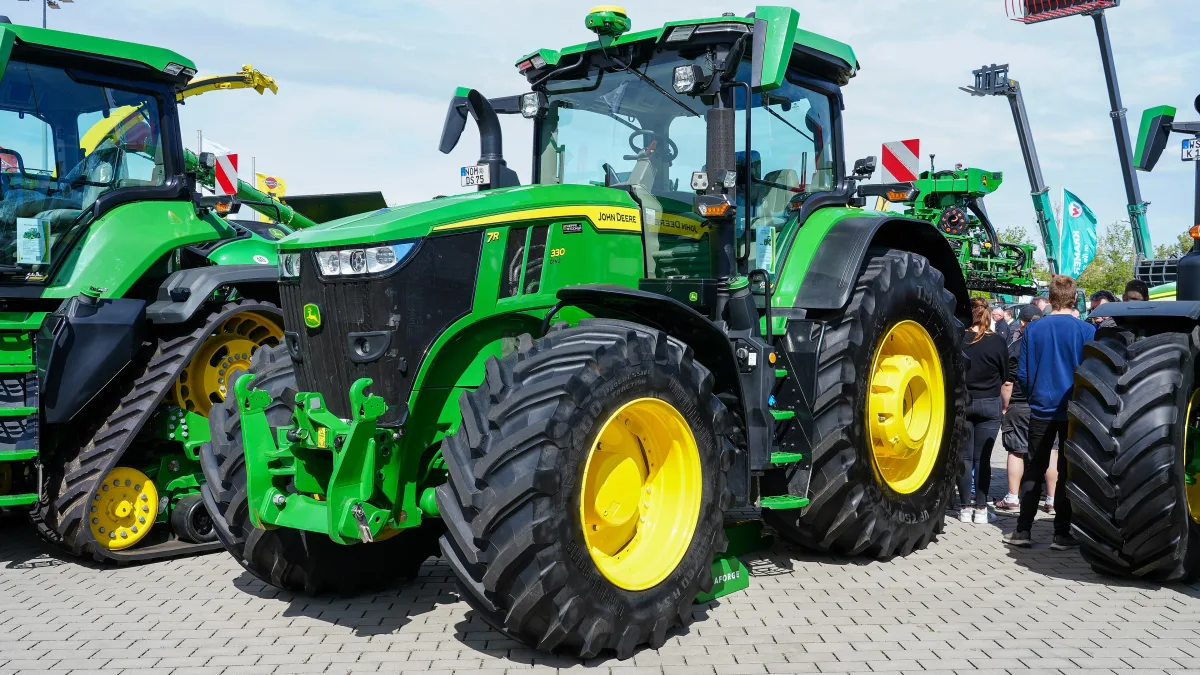
John Deere 7R: high-power tractors, engines and what to check
John Deere 7R — high-power versatile tractors, produced since 2011. We look at power classes, engines, transmissions and what to check when buying a used 7R.






7R in brief
John Deere 7R — a high-power versatile tractor designed for large farms, fieldwork, sowing and transport. Nominal power ranges from around 200 to over 350 HP.
The series is praised for its comfortable cab, reliable mechanics and high residual value. Used 7Rs are often pricey, but they hold their value well.
Generations and names
The series has been updated several times: engine emission standards (Stage IIIB, IV, V), transmissions and cab design have all changed. The numbering indicates approximate nominal power.
When buying a used tractor, it's crucial to know the year of manufacture and Stage standard, as this affects the engine design and the presence of SCR/AdBlue systems.
Engines and transmissions
Engines — John Deere PowerTech: six-cylinder 6.8L and 9.0L, with turbochargers and SCR system in newer models.
Transmissions — semi-automatic e23 PowerShift and stepless AutoPowr. Choice depends on the trim and year.
What to check when buying a used 7R
Check the engine hours, oil and coolant leaks, turbocharger, SCR/AdBlue system and hydraulic operation. Ask for a full service history.
Check the gearbox shifts, front and rear axle play, lifting mechanism, and cabin electronics. Inspect the wheels and body for signs of hard work.


Versions and trims
Names and equipment vary by market and production year; we list the versions most commonly found in Europe.
7R su e23 PowerShift
from 2011Semi-automatic gearbox, cheaper to maintain.
- e23 PowerShift box
- Often — a comfortable cabin
- Often — extended hydraulics
7R su AutoPowr
from 2011 and laterSmooth gear changes with a no-clutch gearbox.
- No-clutch gearbox
- Often — automatic driving mode
- More expensive to service
7R su aukštesne įranga
depending on the trimWith additional comfort and technology features.
- Often — GPS driving systems
- Often — enhanced electronics
- Often — air suspension in the cabin
7R su gumos juostomis
depending on the trimMay have tyre chains instead of wheels.
- Tyre chains
- Less soil compaction
- Check the wear on the chains
Comparison of 7R configurations
| e23 PowerShift | AutoPowr | Aukštesnės įrangos | |
|---|---|---|---|
| Who it's for | For large farms and budgets | For complex and long-term work | For tech-savvy farms |
| Transmission | Semi-automatic | Manual | Depends on the trim |
| Ease of driving | High | Top | Top |
| Price in the used market (relatively) | €€ | €€€ | €€€ |
The 7R with e23 or AutoPowr is a great fit for many large fleets, especially if it has a good service history. If tech is important, opt for the higher-spec version.
Pros
- Strong residual values
- Comfortable cabin
- Wide service and parts network
- Wide range of engine options
Cons
- Pricey in the used market
- Complex electronics
- Parts can be pricey
Frequently asked questions
How does the 7R differ from the 6R?
The 7R is a higher-horsepower, larger tractor designed for large farms. The 6R is more versatile and smaller.
Which transmission should you choose for the 7R?
The e23 PowerShift is reliable and easier to maintain, while the AutoPowr is smoother but more expensive. Your choice depends on the nature of your work.
Is the 7R suitable for a small farm?
Usually not: it's a high-horsepower tractor that's most useful on large plots.
Updated 2026-10-21 · Trim levels and equipment vary by market and model year — check the equipment of the specific car. · Translated automatically


