 English
 Lietuvių
 Latviešu
 Eesti
 Polski
 Русский
 Українська
 Deutsch
 Nederlands
 Čeština
 Slovenčina
 Svenska
 Norsk
 Dansk
 Suomi


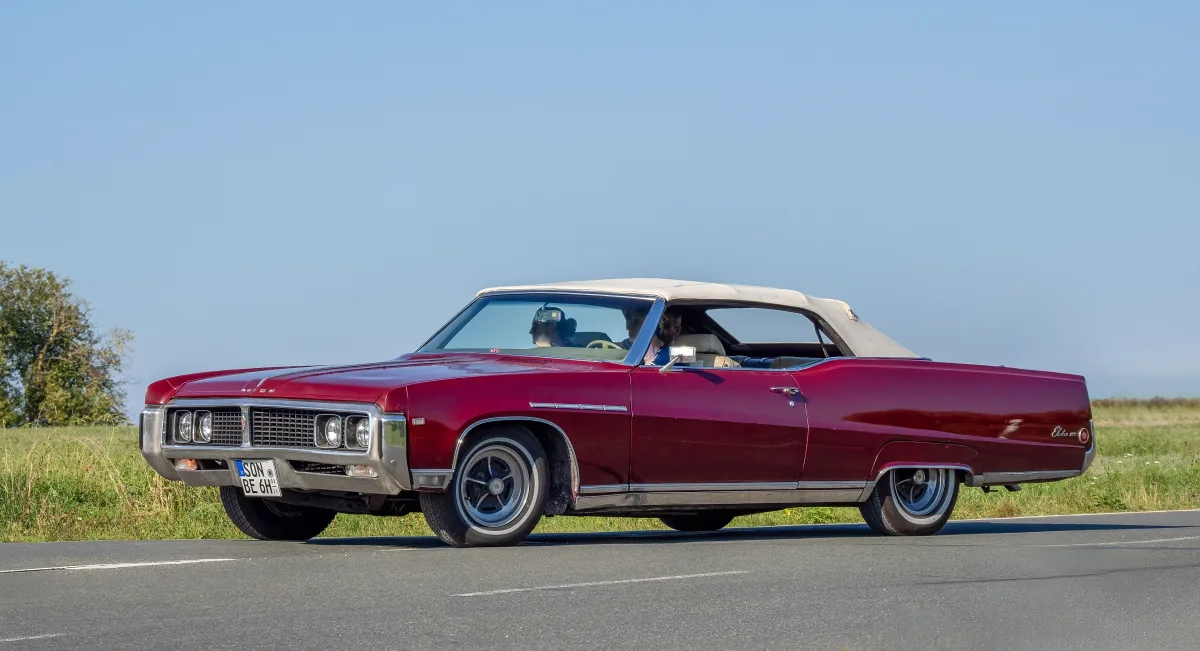
Buick Electra (1959–1990): a large American classic luxury car
Buick Electra — a large, luxurious American car produced from 1959 to 1990. Here, we look at the main generations, engines, and what you need to know if you're considering buying this classic car.






Electra in brief
The Electra was one of Buick's most luxurious models. It was produced as a large four-door sedan, coupe, or convertible, and for a long time stood out for its particularly large size and lavish trim.
In later decades, the Electra became smaller and more modern, with the top-of-the-range model for a long time being the Park Avenue. Therefore, cars from different years vary greatly in size and technology.
Generations — what's the difference
Early Electra (1959–1976) — giant cars with powerful V8 engines, rear-wheel drive, and plenty of chrome. Their name 'Electra 225' indicated roughly 225 inches in length.
In 1977, the Electra was downsized but remained a rear-wheel-drive car. From 1985, it became front-wheel drive and even more compact — with a V6 engine.
Engines and transmissions
Early Electra models had large-displacement V8 engines and automatic transmissions. Their torque was high, so the cars drove very smoothly but consumed a lot of fuel.
In later years, smaller V8 and V6 engines were introduced, and in the 1980s, front-wheel-drive construction with a V6. In all generations, the transmission was automatic.
What to check if you're thinking of buying one
First and foremost — the body and chassis. Rust is one of the biggest issues with classic American cars, especially in the wheel arches, floors, wings, and the lower part of the boot.
Check the condition of the engine and automatic transmission, brakes, power steering, and electrical system. Many early models have electric windows and seats, which can be expensive to repair.
It's crucial to ensure the original trim details are intact — chrome, interior upholstery, glass. Finding replacements can take time, and prices are high.


Trim levels
Names and equipment vary by market and year; we list the versions most commonly found in Europe.
Electra 225 ir Electra
1959–1976A large, rear-wheel-drive luxury class.
- Large V8 engine
- Automatic transmission
- Generous chrome trim
Electra (sumažinta)
1977–1984Smaller, but still rear-wheel-drive.
- V6 or V8 engine
- Automatic transmission
- Luxurious interior
Electra (priekinių ratų)
1985–1990A more compact, front-wheel-drive generation.
- V6 engine
- Front-wheel drive
- More modern interior
Generation comparison
| 1959–1976 | 1977–1984 | 1985–1990 | |
|---|---|---|---|
| Who it's for | For classic car enthusiasts | For the budget-conscious classic American car buyer | For the practical daily driver |
| Transmission | Rear-wheel drive | Rear-wheel drive | Front-wheel drive |
| Size | Very large | Large | Medium and large |
| Price in the used market (relatively) | €€€ | €€ | € |
Many buyers prefer later generations — they're simpler and more affordable. Early Electras are true classics, but require more money and maintenance.
Pros
- Spacious and very comfortable interior
- Powerful V8 engines in early generations
- Recognisable classic styling
- Simple mechanics
Cons
- High fuel consumption
- Rust and parts availability
- Size is impractical on city streets
Frequently asked questions
What does “Electra 225” mean?
The name indicated roughly 225 inches in length, as it was one of the largest American cars.
Is the Electra suitable for daily use?
Later generations may be more practical, but early Electras are classic cars, better suited to events and enjoyment.
Is it easy to find parts?
Some can be ordered from the US, but tracking down certain trim details might be tricky.
Updated 2026-10-19 · Trim levels and equipment vary by market and model year — check the equipment of the specific car. · Translated automatically


