 English
 Lietuvių
 Latviešu
 Eesti
 Polski
 Русский
 Українська
 Deutsch
 Nederlands
 Čeština
 Slovenčina
 Svenska
 Norsk
 Dansk
 Suomi


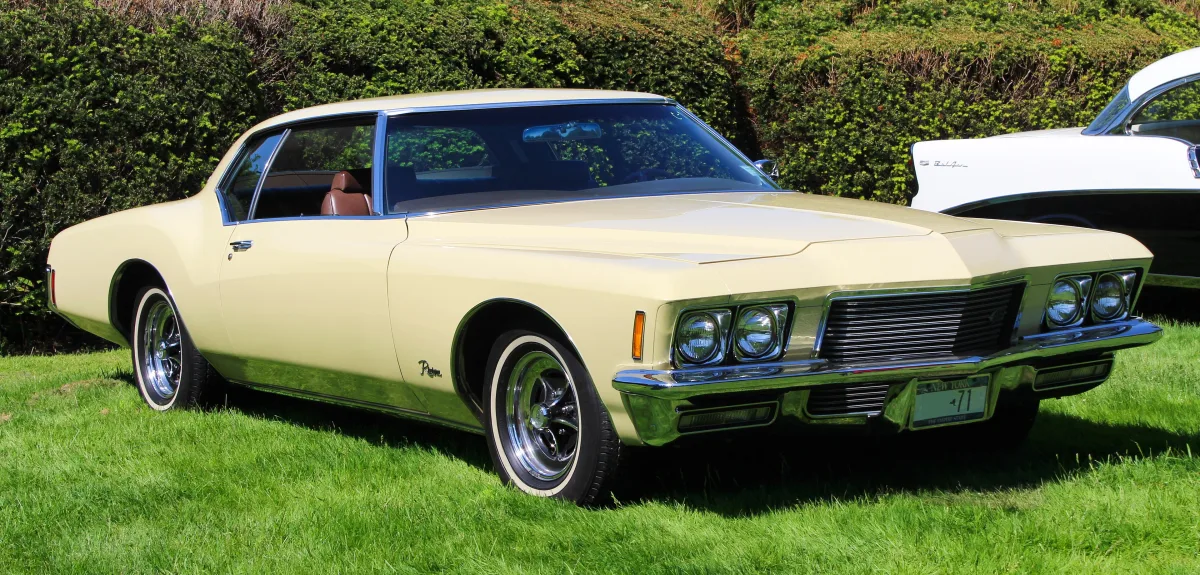
Buick Riviera: the legendary American coupé and a look through the generations
Buick Riviera — the large, luxurious American coupé produced from 1963 to 1999 with breaks and numerous generations. In this article, we look at the most famous generations, engines, and things to know for collectors or buyers.






Riviera in brief
The Riviera was created as a personal luxury coupé — large, comfortable, and with distinctive styling. Over nearly four decades, the model changed significantly, so cars from different years can vary greatly.
This is now mostly a collector's car, and its value depends on the generation, condition, and authenticity.
How the generations differ
First-generation (1963–1965) cars are prized for their elegant, understated design. The 1966–1970 generation stood out with a larger body and more powerful engines.
The third generation (1971–1973) is known for its distinctive 'boat-tail' rear, while the final generation (1995–1999) was more modern, with a V6 engine and a supercharger.
Engines
Early generations featured large V8 engines — from around 6.6 litres in the first generation to 7.5 litres in third-generation models. This reflects the American attitude towards power at the time.
The final-generation Riviera had a 3.8-litre V6 engine, offered with a supercharger, producing around 225–240 hp. All generations came with an automatic transmission.
What to check when buying a Riviera
As with any classic car, the body condition is key. Thoroughly inspect the floors, sills, wings, and rear end, especially on third-generation models.
Check that the engine and gearbox are original, that there are no oil leaks, and that the electrical systems work. Documentation is key for collectible cars.
Part availability depends on the generation — earlier generation parts are harder to find, while later generation parts are more commonly available.


Trim levels
Names and equipment vary by market and year; we list the versions most commonly found in Europe.
Riviera (I karta)
1963–1965The first generation, with an elegant design.
- Large V8 engines
- A refined, elegant design
- A rare collectible car
Riviera (II karta)
1966–1970A larger, more powerful generation.
- Powerful V8 engines
- A bigger body
- Luxurious interior trim
Riviera (III karta)
1971–1973Known for its 'boat-tail' rear.
- Around a 7.5-litre V8
- Distinctive rear end
- Very striking appearance
Riviera (paskutinė karta)
1995–1999The final, more modern generation.
- 3.8-litre V6, often with a supercharger
- Modern for its time
- More accessible than earlier generations
Generation comparison
| I karta | II karta | III karta | Paskutinė | |
|---|---|---|---|---|
| Engine | V8 | V8 | V8 | V6 |
| Who it's for | For classic car enthusiasts | For those seeking power | For lovers of distinctive design | For those looking for a more modern variant |
| Price in the used market (relatively) | €€€ | €€ | €€ | € |
If you're after a collector's car, it's worth looking at the earlier generations. The latest generation is more modern and easier to maintain.
Pros
- A luxurious and distinctive American coupé
- Plenty of different generations to choose from
- Powerful V8 engines
- Collector's potential
Cons
- High fuel consumption
- Risk of corrosion in classic generations
- Finding parts in Europe can take time
Frequently asked questions
How many generations did the Riviera have?
For nearly four decades, the Riviera underwent numerous changes, with the most famous being the 1963–1965, 1966–1970, 1971–1973, and 1995–1999 models.
What is the „boat-tail“ Riviera?
This nickname refers to the 1971–1973 generation, which features a distinctive, tapering rear end.
What engines did the Riviera have?
Early generations came with big V8s, while the last one featured a 3.8-litre V6, often with a supercharger.
Updated 2026-10-19 · Trim levels and equipment vary by market and model year — check the equipment of the specific car. · Translated automatically


