 English
 Lietuvių
 Latviešu
 Eesti
 Polski
 Русский
 Українська
 Deutsch
 Nederlands
 Čeština
 Slovenčina
 Svenska
 Norsk
 Dansk
 Suomi


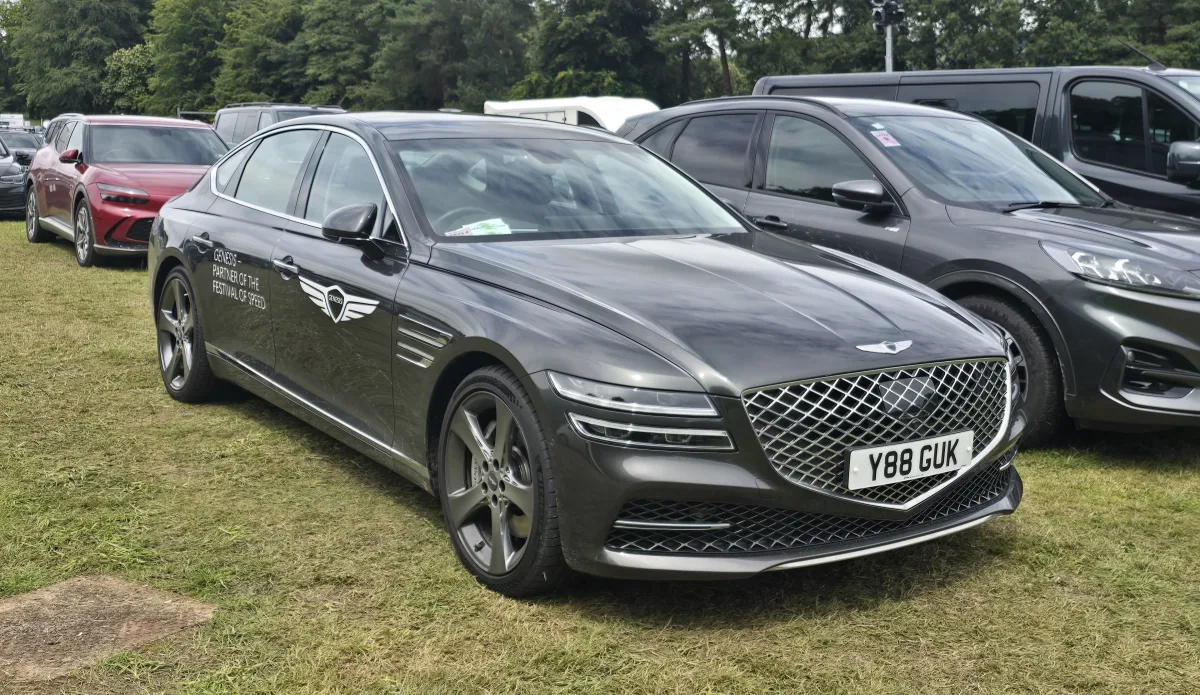
Genesis G80: first and second generations, engines and trims
Genesis G80 — the mid-size luxury sedan from the Korean luxury brand Genesis. We look at how the previous (2016–2020) and current generations differ, what engines they offer, including the electric G80, and what buyers need to know.






G80 in brief
The G80 is a luxury sedan designed to compete with the Mercedes-Benz E-Class, BMW 5 Series, and Audi A6. The first generation was a continuation of the earlier Hyundai Genesis (DH), while since 2020, the G80 has been an all-new car.
The current G80 stands out with its 'Two Lines' dual-line headlights, quiet cabin, and generous equipment. It's offered as a rear-wheel-drive or all-wheel-drive sedan, as well as an electric vehicle.
Generations — what's the difference
The first generation (DH, 2016–2020) — a traditional luxury sedan aimed at the US and Korean markets. It wasn't widely sold in Europe.
The second generation (RG3, from 2020) — a more modern platform, new design, and significantly more technology: a large screen, driver assistance systems, and a high level of interior refinement. It has also reached the European market.
Engines and transmissions
The second-generation G80 offers a 2.5-litre turbocharged petrol engine (around 300 hp), a more powerful 3.5-litre V6 with twin turbochargers (around 380 hp), and in some markets, a 2.2-litre diesel engine. The transmission is an 8-speed automatic.
Electrified G80 — the all-electric version with two motors and a large battery; the range, according to the manufacturer, spans several hundred kilometres. Initially, it came with a 3.3-litre turbo V6, 3.8-litre V6, and 5.0-litre V8 (depending on the market).
What to check when buying a used G80
Check the service history and ensure it matches the European market: cars imported from the US or Korea may have different equipment. Make sure all recalls and software updates have been carried out.
For the electric G80, request a battery condition report and check which charging cables are provided. Test all the driver assistance systems: cameras, adaptive cruise control, screens.
The used market selection is small, so don't rush and compare a few versions.


Versions
Names and equipment vary by market and year; we describe versions by engine.
G80 (DH)
2016–2020The first generation with V6 or V8 engines.
- Often — 3.8-litre V6
- Often — rear-wheel drive
- More features of the previous Hyundai Genesis
G80 2,5T
2020 –The main petrol version.
- Around 300 hp
- 8-speed automatic gearbox
- Rear- or all-wheel drive
G80 3,5T
2020 –More powerful V6 version.
- Around 380 hp
- Often — all-wheel drive
- Sportier version
Electrified G80
2021 –Purely electric version.
- Two electric motors
- Large battery
- All-wheel drive
Comparison of versions
| 2,5T | 3,5T | Electrified | |
|---|---|---|---|
| Who it's for | For daily use | For enthusiasts of dynamic driving | For those who charge at home |
| Power source | Petrol | Petrol | Electric |
| Transmission | Rear-wheel or all-wheel drive | Often — all-wheel drive | All-wheel drive |
| Price in the used market (relatively) | €€€ | €€€ | €€€ |
For most buyers, the simplest choice is the 2.5T version; the electric G80 is ideal if you have the means to charge at home.
Pros
- Luxurious, quiet and generously equipped interior
- Distinctive design
- Wide range of tech features
- A high-class alternative to German saloons
Cons
- Not many on the used market yet
- The brand is less known in Europe
- The service network isn't as extensive as competitors'
Frequently asked questions
Is the G80 the same as the Hyundai Genesis?
The first G80 generation (2016–2020) was a continuation of the previous Hyundai Genesis (DH). The second generation is an all-new model.
Is there an electric G80?
Yes, there's an Electrified G80 with two electric motors and a large battery.
What does the G80 compete with?
It goes up against the Mercedes-Benz E-Class, BMW 5 Series, Audi A6 and similar luxury saloons.
Updated 2026-10-21 · Trim levels and equipment vary by market and model year — check the equipment of the specific car. · Translated automatically


