 English
 Lietuvių
 Latviešu
 Eesti
 Polski
 Русский
 Українська
 Deutsch
 Nederlands
 Čeština
 Slovenčina
 Svenska
 Norsk
 Dansk
 Suomi


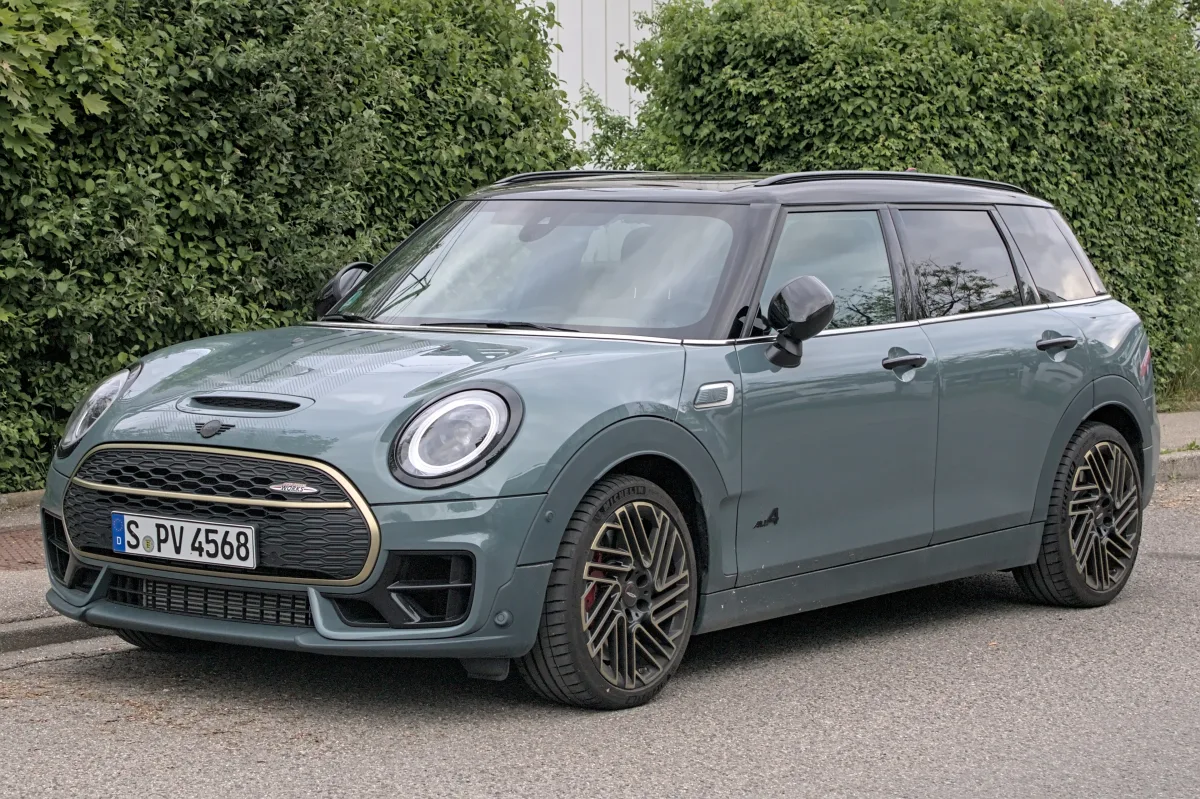
Mini Clubman: R55 and F54 generations, engines and trims
The Mini Clubman is a longer, estate-style Mini with distinctive rear-hinged doors. Two modern generations are commonly found in the used market: the R55 and F54. We look at how they differ, which engines are most popular, how the trims vary, and what to check before buying.






Clubman in brief
The Clubman name hails from the classic Mini era, and the modern BMW-built Clubman was introduced in 2007. Both generations feature rear-hinged doors that open like barn doors and a longer body than the standard Mini.
The Clubman is praised for its unique design, high-quality interior, and thrilling, go-kart-like handling. On the downside, the suspension is quite firm, and maintenance and spare parts are often pricier than those for standard compact cars.
R55 and F54 — how they differ
The R55 (2007–2014) is based on the three-door Mini and is nearly 4 metres long. Besides the two standard doors, it has a pair of small rear-hinged 'Clubdoor' doors on the right side — in left-hand drive countries, these open towards the road. The rear seat and boot are small, making it more of a stylish city car than a family estate.
F54 (2015–2024) is a completely new design: it has four conventional doors, is around 4.25 m long and in terms of size is comparable to compact class hatchbacks. The interior offers significantly more space, and in some versions, you can opt for ALL4 four-wheel drive. The 2019 facelift brought LED rear lights with a Union Jack motif and updated infotainment.
For most buyers, the F54 is the better choice — it's roomier, more modern and usually more reliable. The R55 is worth considering if price and distinctive styling are your top priorities.
Engines and transmissions
The R55 most commonly features petrol engines (mainly 1.6 l): One (around 95–98 hp), Cooper (around 120 hp), turbocharged Cooper S (around 175–184 hp) and John Cooper Works (around 211 hp). Diesels include the 1.6 l Cooper D (around 110 hp), and from 2011, the 2.0 l Cooper SD (around 143 hp). Transmissions are either a 6-speed manual or automatic.
The F54 typically comes with the One and Cooper featuring a 1.5 l three-cylinder engine (around 102 and 136 hp), Cooper S with a 2.0 l (around 178–192 hp), and John Cooper Works with a 2.0 l turbo (around 231 hp, from 2019 around 306 hp). Diesels include One D (1.5 l, around 116 hp), Cooper D (2.0 l, around 150 hp) and Cooper SD (2.0 l, around 190 hp).
The F54 is available with a manual or automatic transmission, and from 2018, petrol engines often come with a 7-speed dual-clutch Steptronic gearbox. ALL4 four-wheel drive is most commonly found with more powerful engines and always in the John Cooper Works version.
What to check when buying a used Clubman
R55 1.6 l petrol engines were notorious for timing chain tensioner issues, increased oil consumption and cooling system leaks. A cold engine shouldn't rattle after starting, and for turbocharged Cooper S models, check the oil change frequency and the condition of the turbocharger.
F54 generation engines are usually more reliable, but for diesel cars that have done a lot of city driving, check the diesel particulate filter (DPF) and EGR valve. With a dual-mass flywheel, test slow driving and pulling away from a standstill — juddering is a sign that a repair might be needed.
Many Clubman models come with reinforced tyres, which can run flat (known as run-flat), so check the condition of the tyres and suspension noise. Ensure the rear doors open smoothly and that all electronics work, and compare the mileage with service records.


Versions
Mini versions primarily differ by engine, with equipment often supplemented by packages (e.g., Pepper, Chili, Salt). Equipment varies by market and year; we list the versions most commonly found in Europe.
One
R55, F54The base and most affordable version for relaxed driving.
- The least powerful petrol engine
- Simpler equipment and smaller alloy wheels
- Often — supplemented with the Pepper package
Cooper
R55, F54The most popular version — a good balance of dynamics and economy.
- More powerful petrol engine
- Often — light-alloy wheels and automatic climate control
- Often — Pepper or Chili package
Cooper D
R55, F54Diesel version for high-mileage drivers.
- Low fuel consumption in the city
- Equipment similar to the Cooper version
- Often — automatic transmission
Cooper S
R55, F54Sporty turbocharged version for driving pleasure
- Air intake vent on the engine cover and sportier bumpers
- Often — sport seats and larger alloy wheels
- Often — LED or xenon headlights
John Cooper Works
R55, F54The most powerful and sporty Clubman version
- Most powerful turbocharged engine and sport suspension
- Upgraded brakes and JCW interior trim
- The F54 offers all-wheel drive ALL4
Comparison of F54 generation versions
| One | Cooper | Cooper S | John Cooper Works | |
|---|---|---|---|---|
| Who it suits | For relaxed city driving | For everyday driving | For dynamic handling | For sports car enthusiasts |
| Wheels (most often) | 16 inch | 16–17 inch | 17–18 inch | 18–19 inch |
| Engine | 1.5 l, 3 cyl., around 102 hp | 1.5 l, 3 cyl., around 136 hp | 2.0 l, around 178–192 hp | 2.0 l, around 231–306 hp |
| Interior | Standard | Often with Pepper or Chili pack | Often sport seats | Sport seats, JCW trim |
| Price in the used market (relatively) | Budget-friendly | Mid-range | Mid-range | Premium |
For most buyers, the F54 Cooper is the best bet – its engine is adequate for daily driving, and maintenance is the least expensive. The Cooper S is worth considering for its dynamics, while the John Cooper Works is only for those truly seeking a sporty car.
Pros
- Distinctive design and rear-hinged doors
- High-quality interior and plenty of customisation options
- Thrilling, precise handling
- The F54 offers significantly more space and the option of all-wheel drive
Cons
- Firm suspension, especially with larger wheels and reinforced tyres
- More expensive servicing and replacement parts
- R55 generation issues with fuel and oil consumption
Frequently asked questions
Which Clubman generation is best to buy used?
For many buyers, the best choice is the F54, especially after the 2019 refresh: it's roomier, more modern, and usually more reliable. The R55 is cheaper, but older, and its petrol engines need more attention.
Is the Mini Clubman suitable for a family?
The F54 Clubman is great for a small family — two adults can fit in the back, and the boot is similar to that of a compact-class hatchback. The R55 is too cramped and is better suited for one or two people.
Which Clubman engine is the most reliable?
The 1.5-litre petrol (Cooper) and 2.0-litre diesel engines of the F54 Clubman are considered more reliable than the 1.6-litre petrol engines of the R55. However, the most important thing is a history of regular servicing and timely oil changes.
Updated 2026-10-09 · Trim levels and equipment vary by market and model year — check the equipment of the specific car. · Translated automatically


