 English
 Lietuvių
 Latviešu
 Eesti
 Polski
 Русский
 Українська
 Deutsch
 Nederlands
 Čeština
 Slovenčina
 Svenska
 Norsk
 Dansk
 Suomi


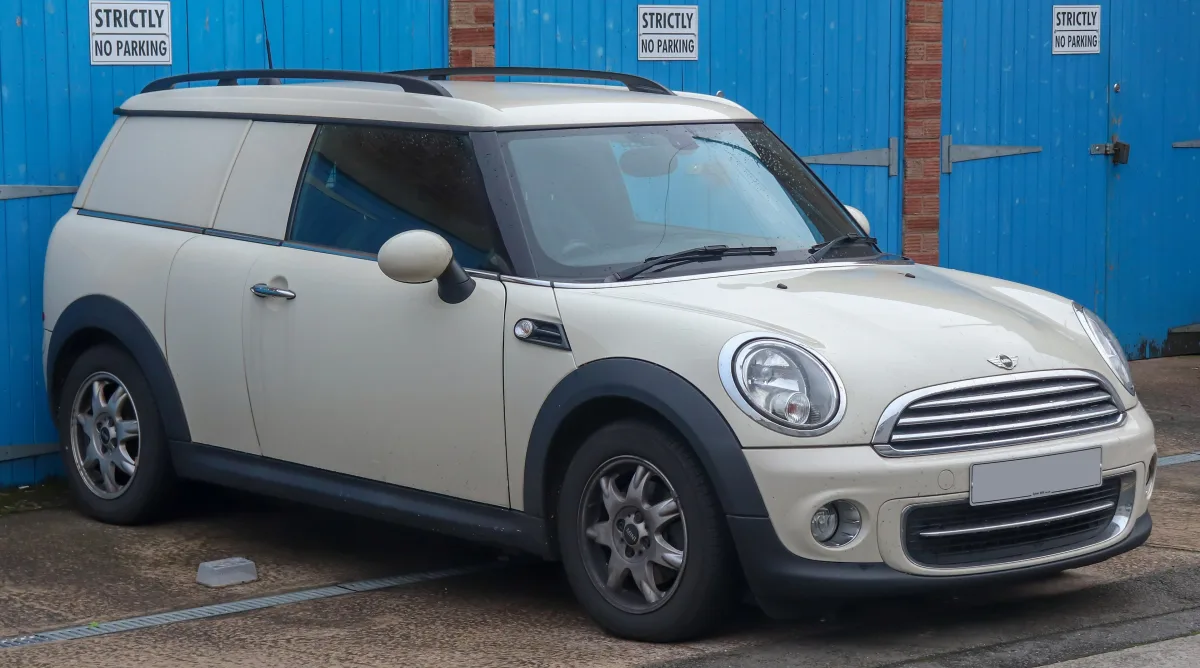
Mini Clubvan: commercial Clubman, engines and what to check when buying
The Mini Clubvan is a two-seater commercial version of the Mini Clubman, sold between 2012 and 2014. Instead of rear seats, it has a cargo area. We look at the engines, trims, and what you need to know when buying such a car.






Clubvan in brief
The Clubvan was designed as a city-friendly light commercial vehicle that retains the Mini character. Instead of rear seats, there's a cargo space, and the rear side windows are replaced with solid panels.
The car features a two-seater cabin and a separate cargo area. It was sold for a short period (2012–2014), making it a rarity in Lithuania.
Which trim to choose
The choice is mainly between a petrol and a diesel engine. Diesel is more economical for daily and long-distance driving, while petrol is simpler if you mostly drive in the city.
Since this is a commercial vehicle, it's crucial to check how it was used: in fleet use, it might have been driven extensively.
Engines and transmissions
The Clubvan was offered with a 1.6-litre petrol (around 120 hp) and a 1.6-litre diesel (around 90–110 hp) engine. Most commonly fitted is a 6-speed manual gearbox.
Mini engines are generally dynamic and economical, but some Mini 1.6-litre petrol engines are often associated with timing chain and oil leak issues — check the service history.
What to check when buying a used Clubvan
Check the cargo area for wear and tear, scratches, and corrosion, as commercial vehicles are used intensively. Inspect the rear doors and their locks.
In the engine, pay attention to oil leaks, distribution chain noises, and cold starting. In a diesel vehicle, check the particulate filter.
Verify that the vehicle is legally registered as a commercial one and review its service history.


Trim levels
The Clubvan didn’t have classic trim levels — you choose just the engine and additional equipment.
Cooper
2012–2014The petrol version for city driving.
- 1.6-litre petrol engine
- Two-seater cabin
- Cargo area with a flat floor
Cooper D
2012–2014The diesel version for more economical journeys.
- 1.6-litre diesel engine
- Two-seater cabin
- Often comes with a manual gearbox
Comparison of Clubvan versions
| Cooper | Cooper D | |
|---|---|---|
| Who it’s suitable for | City driving | For more frequent and longer journeys |
| Used car listings (most often) | 15–16 column inches | 15–16 column inches |
| Engine | 1.6 petrol | 1.6 diesel |
| Price in the used market (relatively) | Mid-range | Mid-range |
If you do a lot of out-of-town driving, opt for a diesel. For city use and occasional trips, a petrol engine will do.
Pros
- Mini car feel with commercial practicality
- Compact city size
- Economical engines
- A rare, standout vehicle
Cons
- Two seats only
- Some engines have well-known issues
- Rare in Lithuania, so supply is limited
Frequently asked questions
How does the Clubvan differ from the Clubman?
The Clubvan lacks rear seats and side windows, and has a large cargo area. The Clubman is a passenger estate with rear seating.
Is the Clubvan registered as a commercial vehicle?
Yes, it's usually a light commercial vehicle, but always check the specific requirements with the Registry.
Is the Clubvan reliable?
Mini reliability depends on the engine and maintenance. The key factors are service history and the condition of the distribution mechanism.
Updated 2026-10-14 · Trim levels and equipment vary by market and model year — check the equipment of the specific car. · Translated automatically


