 English
 Lietuvių
 Latviešu
 Eesti
 Polski
 Русский
 Українська
 Deutsch
 Nederlands
 Čeština
 Slovenčina
 Svenska
 Norsk
 Dansk
 Suomi


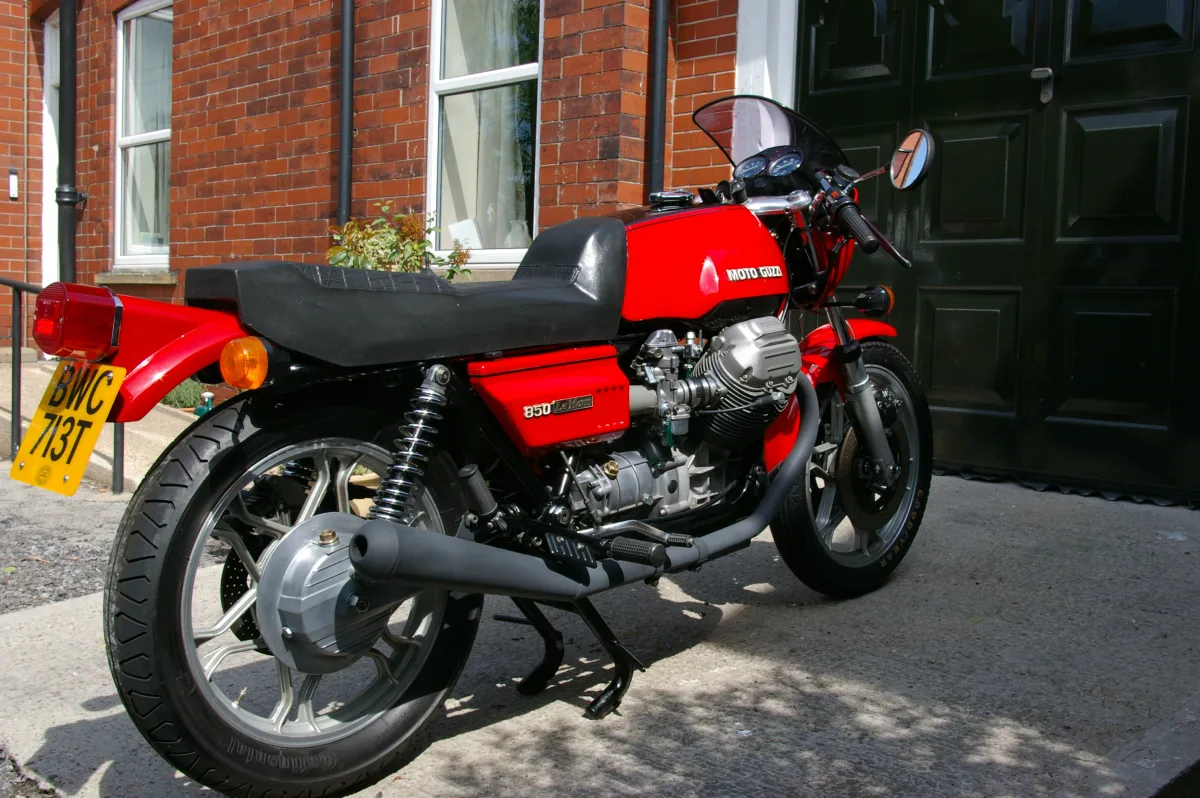
Moto Guzzi Le Mans: a classic sporty V2 motorcycle and what to check
Moto Guzzi Le Mans (1976–1993) — a legendary Italian sport bike with a longitudinally mounted V-twin engine and shaft drive. We look at the main Le Mans generations, how they differ, and what to check when buying this classic motorcycle.






Le Mans in brief
Le Mans is one of the most famous Moto Guzzi sport bikes. It combined a sporty stance, low handlebars, and the signature V-twin engine with shaft drive, setting it apart from the contemporary Japanese four-cylinder bikes.
Thanks to its looks and character, the Le Mans is now a highly sought-after classic. Many examples have been restored or modified, so originality and documentation are particularly important.
Generations — how they differ
The first generations (Le Mans I, II, and III, from 1976) had around 850 cm³ engines, while the later ones (from the mid-1980s) were around the 1000 cm³ class. They featured a more aggressive stance, redesigned frame elements, and different bodywork.
The earliest versions are considered to have a purer look, while the later ones are more modern and comfortable. When buying, it's crucial to know exactly which generation is on offer, as parts and price vary significantly.
Engine and running gear
The engine is a 90° V-twin, air-cooled, with carburetors. It delivers a strong, characteristic pull at low revs, but as revs increase, the bike leans slightly to one side due to the longitudinal crankshaft.
Gearbox — five-speed, rear wheel driven by a driveshaft. The motorcycle is quite long, stable at high speeds, but heavier than modern sport bikes. The brakes are older, so you need to ride them cautiously.
What to check when buying a Le Mans
First off — originality and paperwork: check the frame and engine numbers to ensure they match the documents. Ask for information about any restoration work, what's been changed, and which parts are original.
Listen to the engine when it's cold and warm, check the oil leakage, carburetor operation, chain, and gearbox. Inspect the frame, exhaust, driveshaft supports, brakes, and electrical system. Older motorcycles can have many modifications, so choose examples with a clear history.


Trims and versions
The Le Mans was produced in several generations; we list the main ones.
Le Mans I–III
1976–1980First-generation motorcycles around 850 cm³.
- Around 850 cm³ V2 engine
- Shaft drive
- Classic sport exhaust
Le Mans 1000 ir vėlesni
Mid-1980s–1993Later generations with around 1000 cm³ motorcycles.
- Around 1000 cm³ class engine
- Shaft drive
- More modern appearance
Comparing Le Mans generations
| Le Mans I–III | Vėlesni Le Mans | |
|---|---|---|
| Who it's for | For classic car collectors | For collectors and classic car enthusiasts |
| Engine | Around 850 cm³ | Around 1000 cm³ class |
| What to check first | Originality, engine | Engine, frame |
| Price in the used market (relatively) | €€€ | €€ |
The Le Mans is perfect for those seeking classic cars with character. Opt for examples with a clear history and original parts.
Pros
- Legendary Moto Guzzi design
- The character of the V2 engine
- Shaft drive — less maintenance
- Collector's value
Cons
- Heavy and old
- Fewer parts and services available
- Many restored examples
Frequently asked questions
Is the Le Mans a collector's motorcycle?
Yes, especially earlier models in original condition. Value depends on originality and history.
Is the Le Mans suitable for daily use?
It might be, if the motorcycle is well-maintained, but it's old, heavy, and has an older braking system, so modern motorcycles are more suited to daily use.
How does the Le Mans differ from other Moto Guzzis?
The Le Mans has a sporty tank and low handlebars, while other models (e.g., California) are more oriented towards touring or cruising. The engine and shaft drive are shared.
Updated 2026-10-21 · Trim levels and equipment vary by market and model year — check the equipment of the specific car. · Translated automatically


