 English
 Lietuvių
 Latviešu
 Eesti
 Polski
 Русский
 Українська
 Deutsch
 Nederlands
 Čeština
 Slovenčina
 Svenska
 Norsk
 Dansk
 Suomi


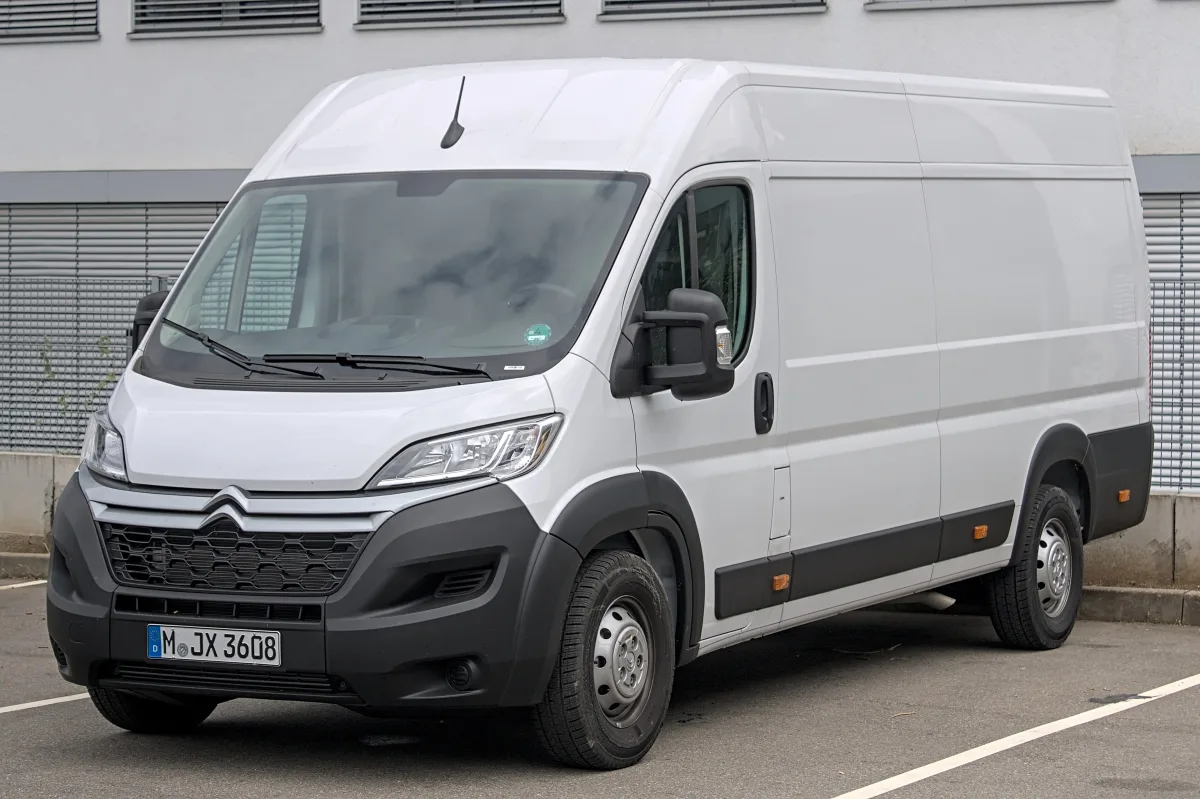
Citroën Jumper: II generation and its updates, engines, body styles
Citroën Jumper — a large van that in Lithuania is encountered as a cargo vehicle, minibus, flatbed truck, or the basis for a camper. We look at the differences between generations and updates, the most common engines, body styles, and what to check before buying a used Jumper.






Jumper in brief
The Jumper has been in production since 1994 and is built alongside the Fiat and Peugeot — its twins are the Fiat Ducato and Peugeot Boxer, and since 2021, the Opel Movano is also built on the same platform. In the UK, the Jumper is sold under the Citroën Relay name. Shared technology means a wide range of parts and mechanics who are familiar with these vans.
The Jumper is front-wheel drive, with a low loading floor. It comes as a van, passenger Combi, minibus, cab truck, double cab, and platform for campers. The van is offered in several lengths (L1–L4) and roof heights (H1–H3), with the gross weight usually around 3.5 tonnes.
I and II generation — what's the difference
The I generation (1994–2006) is now rare and usually very high-mileage. It's worth considering only as a cheap workhorse, carefully assessing body corrosion.
The II generation (from 2006) is roomier, more comfortable, and safer. During the 2014 update, the front, headlights, interior, and engines were changed, so in the used market, updated models are often preferred.
In recent years, newer engines, more driver-assistance systems, and the electric ë-Jumper have emerged. The 2024 Jumper received a new front end with a new Citroën badge and a refreshed interior.
Engines and transmissions
Up until 2014, the 2.2 HDi (around 100–130 hp) and 3.0 HDi (around 160–180 hp) diesels were most commonly encountered. After the update, the 2.2 HDi was offered for a while, then replaced by the 2.0 BlueHDi (around 110–160 hp), and later by the 2.2 BlueHDi (around 120–165 hp).
For a long time, the Jumper, like the Boxer, had PSA group diesel engines, and it only shared the 3.0-litre engine with the Fiat Ducato. Most vehicles have a manual transmission; the latest models can also be found with an automatic.
For microbuses, the longest bodies, and frequent heavy loads, more powerful engine versions are better suited, while for light urban deliveries, less powerful ones usually suffice.
What to check when buying a used Jumper
Check the mileage against service records and MOT history, as working Jumper vans often have very high mileage. Test the clutch and two-mass flywheel — vibration under load, hard-to-engage gears, or juddering in neutral often indicate an expensive repair.
Check diesel engines for the turbocharger, injectors, EGR valve, and particulate filter. In Euro 6 BlueHDi engines, pay attention to the AdBlue system — its failures are quite common.
Check the underside of the body, sills, door bottoms and wheel arches for rust. Inspect the front suspension, brakes and tyres, as these vans often drive overloaded. In a microbus, check the seat mounts and the operation of the rear heater and air conditioning.


Body versions
Trim names vary greatly by market and year, so we list the most commonly encountered body versions.
Furgonas
First and Second GenerationsThe most common cargo version with a variety of length and height combinations.
- Mostly L1–L4 length and H1–H3 height
- Often — one or two sliding side doors
- Wide-opening rear doors
Combi
Second GenerationPassenger version with windows and seats at the rear.
- Mostly up to 9 seats
- Simple, easy-to-clean interior
- Often — removable rear seats
Mikroautobusas
Second GenerationLarger passenger version for schools, drivers and groups.
- More than 9 seats
- Often — a high roof and long body
- Often — an additional heater and rear air conditioning
Važiuoklė su kabina
First and Second GenerationsBase for flatbeds, enclosed, drop-side, or special bodies
- Often — a flatbed or enclosed body
- Often — a tilting cargo bed
- Body size depends on the chassis
Dviguba kabina
Second GenerationA cab with a second row of seats — for work with a crew
- Up to 6–7 seats
- Often — a flatbed body
- A shorter cargo platform
Comparison of second-generation versions
| Furgonas | Combi | Mikroautobusas | Važiuoklė su kabina | |
|---|---|---|---|---|
| Who it's for | For cargo and deliveries | For passengers and family | For group and student transport | Body types and special bodies |
| Wheels (usually) | Steel | Steel | Steel | Steel |
| Cargo area / cabin | From mid-size to very large load space | Up to 9 seats | More than 9 seats | Depends on the chassis |
| Price in the used market (relatively) | Budget | Mid-range | Premium | Mid-range |
For cargo, the most sensible options are usually the L2H2 or L3H2 van. For passengers, the Combi is sufficient, while a minibus is only worth considering if you need more than 9 seats.
Pros
- Plenty of spare parts (same tech as Peugeot Boxer, Fiat Ducato, and Opel Movano C)
- A wide range of body styles — from van to minibus
- Low cargo floor and large load space
- Many experts who are well-acquainted with this technology
Cons
- Corrosion is common in older vehicles
- Expensive repairs for the gearbox and dual-mass flywheel
- Many highly depreciated commercial vehicles
Frequently asked questions
Do Citroën Jumper parts fit the Peugeot Boxer?
In many cases, yes: Jumper and Boxer of the same generation share the same body, chassis, and engines. They mainly differ in front-end details and badges, so parts should still be checked against the vehicle identification number.
What does Jumper L2H2 or L3H3 mean?
L denotes body length, H — roof height: the larger the number, the longer or taller the cargo area. L2H2 is sufficient for most jobs, while larger bodies are suitable for big but light loads.
Is it worth buying a microbus Jumper?
A microbus is suitable if you regularly transport more than 9 people. When buying, it's important to check not only the engine and gearbox but also the seat mounts, safety belts, and the operation of the rear heating and ventilation systems.
Updated 2026-10-10 · Trim levels and equipment vary by market and model year — check the equipment of the specific car. · Translated automatically


