 English
 Lietuvių
 Latviešu
 Eesti
 Polski
 Русский
 Українська
 Deutsch
 Nederlands
 Čeština
 Slovenčina
 Svenska
 Norsk
 Dansk
 Suomi


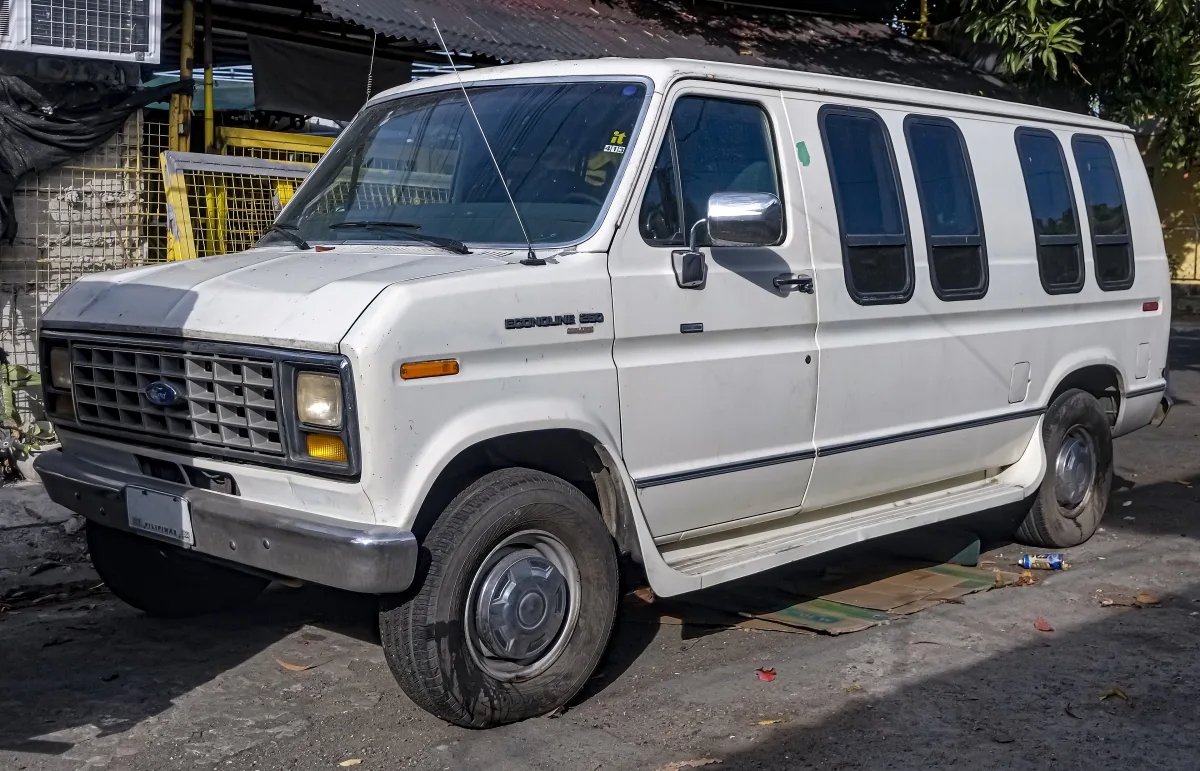
Ford E-Series: vans and minibuses, engines and what to know when buying
Ford E-Series (Econoline) — the American full-size van, produced since 1961. Here we look at the main variants (E-150, E-250, E-350), engines and what to consider when buying used.






E-Series in brief
E-Series (known as Econoline until 1992) — a full-size van with a separate chassis, V8 or V10 engine and rear-wheel drive. It's often used as a cargo van, minibus, ambulance or camper.
In Lithuania, you'll find imported vehicles, often converted into campers or adapted for other purposes. Van production ended in 2014, but cutaway chassis versions were produced for longer.
Versions — what's the difference
The different E-150, E-250 and E-350 designations indicate the permitted payload and chassis strength: the E-150 is the lightest, while the E-350 is for heavier work. There are also passenger variants, known as Wagon / Club Wagon.
It's important to check the maximum permitted weight in the registration documents. Heavier versions in Lithuania may require a higher category licence.
Engines and transmissions
Used models come with 4.6 and 5.4-litre V8 petrol engines and a 6.8-litre V10. For some years, a 6.0-litre 'Power Stroke' diesel engine was also offered.
The transmission is a four-speed automatic. The engines are simple and robust, but they're thirsty, so LPG conversions are common.
What to check when buying
Check for rust on the frame and body, suspension, steering mechanism, and brakes. If the van has been converted, ensure the conversion is registered and has the proper documentation.
In the case of the diesel 'Power Stroke', thoroughly inspect the cooling system, oil cooler, and EGR cooler, as these systems are known to be problematic for this engine. For gas setups, check the installation documents.


Trim levels
E-Series trim names depend on the version and year; we list the main variants.
E-150
1992–2014The most basic version.
- Often — 4.6 or 5.4 V8
- Suitable for camping or light loads
- Simpler suspension
E-250
1992–2014Mid-range version.
- Sturdier suspension than the E-150
- Often — 5.4 V8
- Suitable for cargo vans
E-350 Super Duty
1992–2014Heavy-duty version.
- Often — 5.4 V8 or 6.8 V10
- A sturdier vehicle
- Often — dual rear wheels (dually)
Wagon / Club Wagon
1992–2014Passenger minibus version.
- Often — up to 12–15 seats
- More seats than a van
- Ideal for groups and hauling
Version comparison
| E-150 | E-250 | E-350 | Wagon | |
|---|---|---|---|---|
| Who it's for | Light cargo or camper base | For medium loads | For heavy-duty work | For passenger transport |
| Engine | V8 | V8 | V8 or V10 | V8 or V10 |
| Trim | Base | Mid-range | High-spec | High-spec |
| Cab | Van | Van | Van | Passenger |
| Price in the used market (relatively) | € | € | €€ | €€ |
The E-150 or E-250 is often sufficient for a basic cargo van or light-duty workhorse; opt for the E-350 for heavier tasks.
Pros
- Spacious cargo area
- Robust build
- Reliable and hardworking engines
- Parts are widely available in the US
Cons
- High fuel consumption
- A large and heavy vehicle
- Older cars are prone to corrosion and wear
Frequently asked questions
Is the E-Series suitable for camping?
Yes, it's popular among campers for its spacious interior, but it's crucial to check the towing capacity and paperwork.
How does the E-150 differ from the E-350?
The E-350 has a sturdier suspension and higher payload capacity, while the E-150 is lighter and suited to lighter duties.
Can you drive it with a B category license?
That depends on the gross vehicle weight rating. If it exceeds 3.5 tonnes, a B category license won't suffice.
Updated 2026-10-14 · Trim levels and equipment vary by market and model year — check the equipment of the specific car. · Translated automatically


