 English
 Lietuvių
 Latviešu
 Eesti
 Polski
 Русский
 Українська
 Deutsch
 Nederlands
 Čeština
 Slovenčina
 Svenska
 Norsk
 Dansk
 Suomi


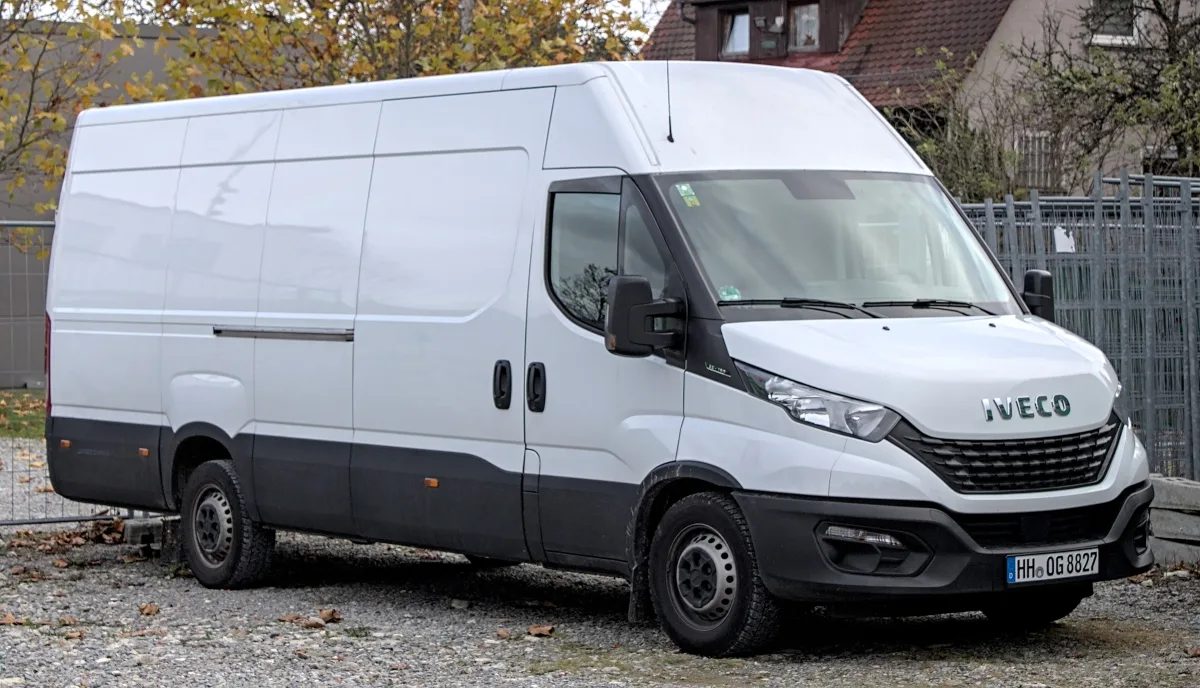
Iveco Daily: 5th and 6th generations, engines and body styles
Iveco Daily — the big van with a ladder-frame chassis, akin to light trucks and often chosen for heavy-duty work. We look at what sets the 5th and 6th generations apart, which engines and body styles are most common, and what to check when buying a used Daily.






Daily in brief
The Daily has been in production since 1978. In the used market, you'll mostly find 5th (2011–2014) and 6th (from 2014) generation models. Unlike most rivals, the Daily has a chassis and rear-wheel drive, making it well-suited to heavy loads and trailers; there's also a 4x4 all-wheel-drive version.
Main body styles include the van, passenger minibus, and cab chassis (flatbeds, tipper trucks, refrigerated units). Vans come in various lengths and heights, with the largest cargo areas around 20 m³.
The name indicates the version: the first digits are the gross vehicle weight (e.g., 35 — 3.5 t, 50 — 5 t, 70 — 7 t), the letter S is for single rear axles, C for twin rear axles, and the last digits are the approximate power (e.g., 35S16 — around 160 hp).
Which generation to choose
The 5th generation (2011–2014) is the more accessible option, technically close to the previous generation but with an updated cab and styling.
The 6th generation (from 2014) features an improved chassis, more body options, up to 7.2 t gross vehicle weight, and an 8-speed Hi-Matic automatic gearbox. Models refreshed in 2019 got a new front end, often with LED headlights and more driver-assistance systems.
For many buyers, the best choice is the sixth generation, especially after the 2019 refresh.
Engines and transmissions
Daily uses 2.3 l and 3.0 l diesels. The 2.3 l engine typically has around 115–160 hp, while the 3.0 l offers around 150–210 hp. Euro 6 versions come with AdBlue system. There's also the compressed natural gas-powered Natural Power and electric eDaily version.
Transmissions include a 6-speed manual, a robotised unit in older versions, and an 8-speed automatic Hi-Matic in the sixth generation.
The 2.3 l engine is sufficient for lighter tasks, while the 3.0 l is worth choosing for heavier versions, frequent towing, or when loaded.
What to check when buying a used Daily
Check the service and MOT history. With a manual transmission, inspect the clutch and dual-mass flywheel; with an automatic, ensure gears shift smoothly.
Inspect the frame, underbody, cabin underside, and wheel arches for rust, especially in older models and those that have carried building materials. For diesels, check the DPF, EGR, and AdBlue systems.
Most Daily models exceed 3.5 t, so ensure you have the correct driver's license category. When towing loads heavier than 3.5 t, a tachograph is required — check it works and has a valid certificate.


Cab styles
Cab styles, lengths, heights, and equipment vary by market and year; we list the most common versions found in Europe.
Furgonas 35S
Fifth and sixth generationMostly the 3.5 t version with single rear wheels.
- Driven with a B category license
- Various lengths and roof heights
- Often — 2.3 l engine
Furgonas 35C–70C
Fifth and sixth generationHeavier versions with dual rear wheels.
- Greater payload capacity
- Often — the largest cargo area
- Often — 3.0 l engine
Važiuoklė su kabina
Fifth and sixth generationBase model for flatbeds, tipper trucks, and other body types.
- Single or double cab versions
- Ladder frame construction
- Often — up to 7 t gross vehicle weight
Keleivinis
Fifth and sixth generationMinibus for passenger transport.
- Often — more than 9 seats
- Windows and heating throughout the cabin
- May require a D1 or D category licence to drive
4x4
Fifth and sixth generationFour-wheel drive version for tough road conditions.
- Four-wheel drive
- High ground clearance
- Rare and more expensive
Comparison of VI generation versions
| 35S furgonas | 35C–50C furgonas | Važiuoklė su kabina | Keleivinis | |
|---|---|---|---|---|
| Who it suits | Most loads | Heavy loads | Towing and construction | Passenger vehicle |
| Rear-wheel drive | Single cab | Double cab | Often double cab | Often double cab |
| Driver's license category (most often) | B | Either B or C1, depending on the weight | Either C1 or C | Either D1 or D |
| Engine | Often a 2.3-litre | 2.3-litre or 3.0-litre | Often a 3.0-litre | 2.3-litre or 3.0-litre |
| Price in the used market (relatively) | Budget | Mid-range | Mid-range | Premium |
For most buyers, the best choice is the sixth-generation 35S van, which can be driven with a B licence. Heavier versions are worth considering when a large payload is needed.
Pros
- Robust construction and large payload capacity
- Choose up to 7 tonnes gross vehicle weight
- Reliable engines
- The rear-wheel drive is suitable for heavy loads and trailers
Cons
- Firmer ride than competitors, especially when empty
- Higher load compartment floor
- Heavier versions require a C category license and a tachograph
Frequently asked questions
What do the numbers and letters in the Daily name mean?
For example, 35S16: 35 — total weight 3.5 t, S — single rear wheels, 16 — around 160 HP. The letter C indicates dual rear wheels and usually a heavier version.
Can the Daily be driven with a B category license?
Yes, if the total weight does not exceed 3.5 t — these are usually 35S versions. Heavier versions require a C1 or C category license, and when carrying loads — a tachograph as well.
How does the Daily differ from other large vans?
The Daily has a chassis similar to a truck's and rear-wheel drive, making it sturdier for heavy loads and towing. On the other hand, it rides more roughly when empty, and the load compartment floor is higher.
Is it worth choosing the Hi-Matic automatic transmission?
Yes, if you drive a lot in the city or multiple drivers use the vehicle — the automatic transmission reduces clutch wear. Before buying, ensure it shifts smoothly and has a service history.
Updated 2026-10-09 · Trim levels and equipment vary by market and model year — check the equipment of the specific car. · Translated automatically


