 English
 Lietuvių
 Latviešu
 Eesti
 Polski
 Русский
 Українська
 Deutsch
 Nederlands
 Čeština
 Slovenčina
 Svenska
 Norsk
 Dansk
 Suomi


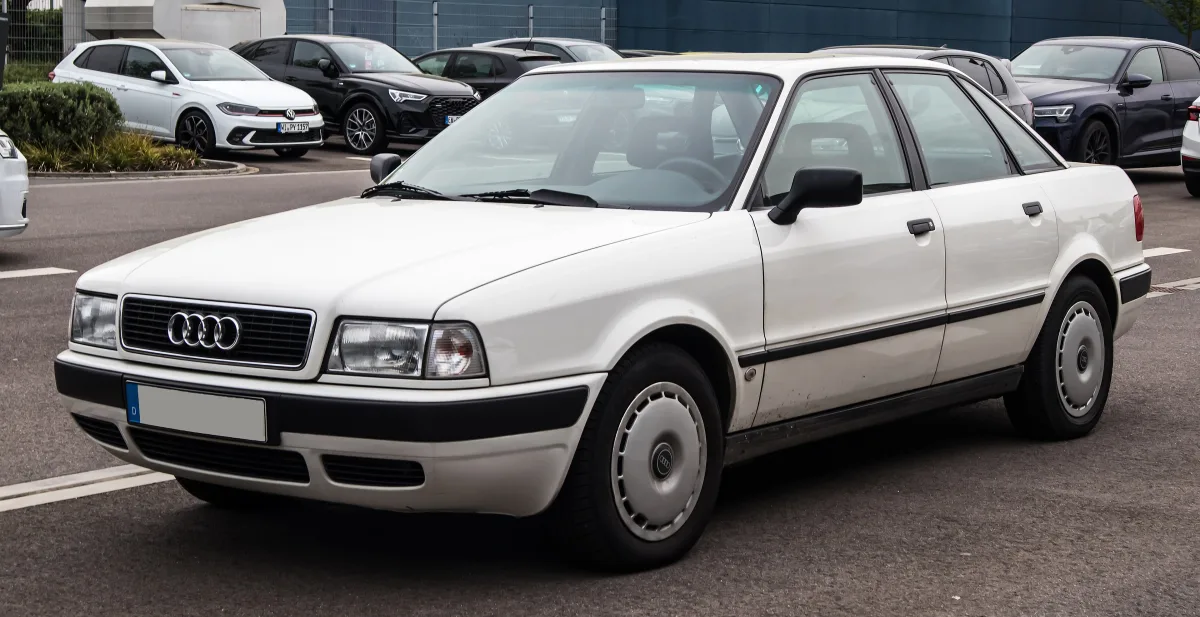
Audi 80: B3 and B4 generations, engines and trims
Audi 80 — a mid-size car produced from 1972 to 1996 and the forerunner of the Audi A4. In Lithuania, you'll most often encounter B3 and B4 generations, which are valued for their robustness and galvanised bodies. We'll look at what sets them apart, which engines are most common, and what to check when buying a car of this vintage.






Audi 80 in brief
The Audi 80 was produced in four generations: B1 (1972–1978), B2 (1978–1986), B3 (1986–1991) and B4 (1991–1995, Avant until 1996). Today, the used market is almost exclusively B3 and B4 models, with earlier generations typically snapped up by collectors.
B3 and B4 generation cars feature galvanised bodies, so if well-maintained, they've held up better than most contemporaries. They're simple, robust and easy-to-service cars, but their age is over 30 years, so the condition of each example varies greatly.
B3 and B4 — what's the difference
The B3 (1986–1991) stood out with its boxy, modern-for-the-time body. It was only available as a saloon, with the more upmarket version dubbed the Audi 90. This generation also spawned the Audi Coupé and Audi Cabriolet.
The B4 (1991–1995) was a significant update over the B3: a different front end with wider grilles, larger bumpers, a longer wheelbase and more spacious rear. From 1992, an Avant estate was offered, and the engine range was expanded to include V6 and 1.9 TDI options.
The B4 generation is more practical for daily driving — it's newer, roomier, and often in better condition. The B3 appeals to those who prefer the design of the earlier generation or are looking for a more affordable car.
Engines and gearboxes
The B3 generation most commonly features 1.6–2.0-litre petrol engines and a 1.6-litre turbodiesel, while the Audi 90 and some later Audi 80 versions came with a five-cylinder 2.3-litre engine.
The B4 generation most commonly features 1.6 and 2.0-litre petrol engines (around 70–115 hp), a five-cylinder 2.3 E (around 133 hp), 2.6 and 2.8-litre V6 (around 150 and 174 hp) engines, and 1.9 TD and 1.9 TDI (around 90 hp) diesels. The most powerful are the S2 and RS2 with five-cylinder turbocharged engines.
The most common gearbox is a five-speed manual, with automatics being less frequent. Both generations were also offered with the quattro permanent four-wheel-drive system.
What to check when buying a used Audi 80
Although the body is galvanised, rust can occur where the car has been repaired after accidents, as well as on sills, wheel arches, and under door hinges. Inspect the underbody and ask if the body has ever been welded.
In a car of this age, you'll often need to replace rubber parts, hoses, and suspension components. Check if the engine is leaking oil, runs smoothly when cold, and in the case of the 1.9 TDI, starts easily and doesn't smoke. The central locking is pneumatically operated, so issues with the pump are not uncommon.
Request registration and technical inspection documents, and compare VIN numbers. Some body and interior details can be hard to find, so it's worth choosing a car that's as complete and original as possible. Vehicles older than 30 years that meet the criteria can be registered as historic vehicles.


Versions
Audi 80 trim levels varied by market and year, so we list the most commonly encountered body and drivetrain versions.
Audi 80 sedanas
B3 and B4The most common version is the straightforward and sturdy four-door saloon.
- Mostly 1.6–2.0 petrol engines or 1.9 TD/TDI diesels
- Simple, easy-to-maintain technology
- Adequately spacious boot
Audi 80 Avant
B4The estate with a larger boot is the most practical version.
- A larger and taller boot
- Practical tailgate
- Many of the same engines as the saloon
quattro
B3 and B4Permanent four-wheel drive is great for winter grip.
- Four-wheel drive
- Often — with more powerful engines
- Higher fuel consumption
Audi Coupé
1988–1996Based on the B3 and B4, this is a two-door coupé.
- Lower, sportier body
- Often — a five-cylinder engine
- Less common, more prized among enthusiasts
Audi Cabriolet
1991–2000Convertible with a soft top, produced longer than the Audi 80 itself.
- Soft top, often electrically operated
- Mostly 2.0, 2.3 or 2.6–2.8 V6 engines
- Often prized among enthusiasts
S2 ir RS2
1990–1995Sporty versions with turbocharged five-cylinder engines and quattro transmission.
- Very rare, prized by collectors
- Four-wheel drive quattro
- RS2 only available as an Avant
Comparison of most common versions
| Sedanas | Avant | quattro | Cabriolet | |
|---|---|---|---|---|
| Who it's for | Ideal for daily driving | For families and cargo | Perfect for winter and rough roads | Great for leisure and summer |
| Body style | Sedanas | Estate | Sedan or Avant | Convertible |
| Transmission | Front-wheel drive | Front-wheel drive | All-wheel drive | Front-wheel drive |
| Engine (most common) | 1.6–2.0, 1.9 TD/TDI | 2.0, 1.9 TDI | 2.0–2.8 | 2.0–2.8 |
| Price in the used market (relatively) | € | €€ | €€ | €€€ |
For daily use, the B4 sedan or Avant with a 2.0 petrol or 1.9 TDI engine is best. Cabriolet and quattro versions are worth choosing for comfort, but they are often more expensive and their condition needs to be checked more thoroughly.
Pros
- Galvanised, well-corrosion-resistant body
- Simple and robust technology
- Moderate repair costs and plenty of mechanics familiar with the model
- Some versions become sought-after classic cars
Cons
- High mileage — many worn-out parts
- Interior and body parts are increasingly hard to find
- The safety of older designs and fewer modern features
Frequently asked questions
Which Audi 80 generation is better — B3 or B4?
For daily use, the B4 is usually the better choice: it's newer, more spacious at the rear, offers more engine options, including the 1.9 TDI, and comes as an Avant estate. The B3 appeals to those who like its design or are looking for a more affordable car.
Does the Audi 80 really rust?
The B3 and B4 bodies are galvanised, so they rust much less than most cars of that era. However, rust can still appear after poor repairs or accidents, so it's essential to check the sills, wheel arches, and underbody before buying.
Which Audi 80 engine is the most reliable?
The reliable options include the simple 2.0 petrol, the five-cylinder 2.3, and the 1.9 TDI. V6 versions are smoother and more powerful, but their maintenance and repair costs are typically higher.
Is the Audi 80 suitable for daily driving today?
A well-maintained Audi 80 can be a reliable daily driver, but it lacks modern safety systems, and some parts can be harder to find. For many buyers, it's more of a second car or an enthusiast's choice.
Updated 2026-10-09 · Trim levels and equipment vary by market and model year — check the equipment of the specific car. · Translated automatically


