 English
 Lietuvių
 Latviešu
 Eesti
 Polski
 Русский
 Українська
 Deutsch
 Nederlands
 Čeština
 Slovenčina
 Svenska
 Norsk
 Dansk
 Suomi


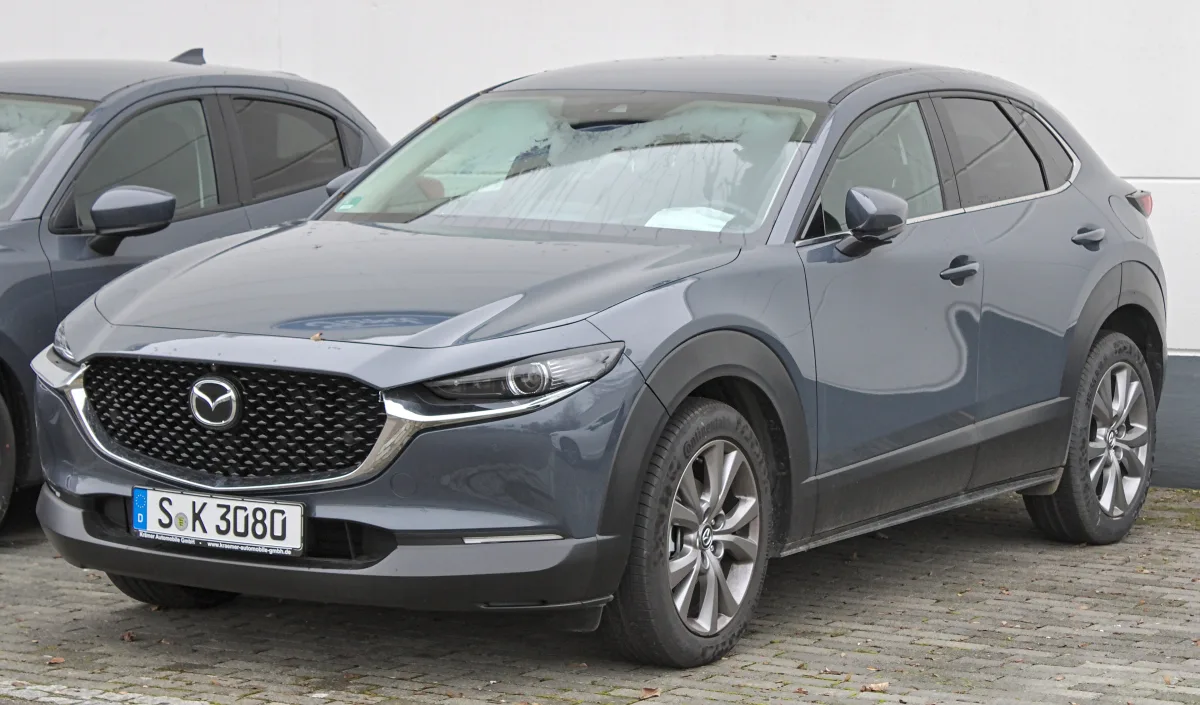
Mazda CX-30: engines, trims, and what to check when buying
The Mazda CX-30 is a compact crossover that debuted in 2019 and slots between the CX-3 and CX-5. We'll look at the engines, trims, updates, and key points to check before buying a used CX-30.






The CX-30 in brief
The CX-30 is based on the Mazda3 platform, so it drives similarly—precise steering, a stable ride, and a high-quality interior. Compared to the Mazda3 hatchback, it's taller, has more ground clearance, and a more practical boot.
Mazda has long relied on naturally aspirated Skyactiv engines with small to mid-sized displacements, rather than tiny turbocharged units. This is appreciated for reliability, though power and torque are less than some rivals.
Which version to choose
The first-generation CX-30s (2019–2022) are quite popular on the used market: there's a large supply, and prices are attractive. They offered the 2.0 Skyactiv-G, more powerful Skyactiv-X, and the diesel 1.8 Skyactiv-D engines.
The refreshed CX-30 (from 2023) gets a new front bumper, revised trims, improved equipment, and some technical tweaks. If your budget allows, these versions are worth considering.
Engines and transmissions
The most common petrol engine is the 2.0 Skyactiv-G with the light hybrid M Hybrid system, offering around 122–150 hp (depending on the version). More complex and powerful is the 2.0 Skyactiv-X (around 180–186 hp), which uses spark-controlled compression ignition.
You might find the 1.8 Skyactiv-D diesel engine (around 116 hp). Six-speed manual or six-speed automatic transmissions are offered, with some versions featuring all-wheel drive (AWD).
What to check when buying a used CX-30
Request the service history and ensure the car was serviced at a Mazda dealership or according to the manufacturer's guidelines. For the Skyactiv-X engine, ask if all manufacturer software updates have been performed.
Check a diesel car, mostly driven in the city, for issues with the diesel particulate filter (DPF). Inspect the bodywork: repainted parts and uneven gaps can indicate previous accidents.
Test the multimedia system and its controls (rotary dial), as well as the safety systems — adaptive cruise control, lane-keeping assist, and blind-spot monitoring.


Trim levels
Names and equipment vary by market and year; we list the most common trims found in Europe.
Prime-Line
post-2023Base trim after the refresh.
- Often 16-inch wheels
- Key driver-assistance features
- Standard multimedia system
Centre-Line
post-2023Mid-range trim with more comfort.
- Often — automatic climate control
- Often — cameras and parking sensors
- Often — additional comfort features
Exclusive-Line
post-2023A higher-spec version with better equipment.
- Often — LED headlights
- Often — heated seats
- Often — additional driver-assistance systems
Homura
post-2023A sportier-looking version.
- Often — darker alloy wheels
- Often — red or contrasting interior details
- Often — more kit than the Exclusive-Line
Takumi
post-2023Top-spec trim with plusher trim.
- Often — leather or higher-grade interior trim
- Often — larger alloy wheels
- Often — a full suite of driver-assistance systems
Trim comparison
| Prime-Line | Exclusive-Line | Homura | Takumi | |
|---|---|---|---|---|
| Who it's for | Budget pick | Balanced comfort | Sporty styling | Maximum comfort |
| Wheels (most common) | 16 inch | 18 inch | 18 inch | 18 inch |
| Interior | Basic | More comfortable | Sportier | Luxurious trim |
| Price in the used market (relatively) | € | €€ | €€ | €€€ |
A great choice for many buyers is the Exclusive-Line with the 2.0 Skyactiv-G engine. Takumi is worth considering if maximum comfort is key, while Homura is all about the looks.
Pros
- A quality interior and a precisely controlled steering wheel
- Naturally aspirated engines without turbochargers
- Stylish looks and a sturdy chassis
- An attractive price-to-specification ratio
Cons
- The boot isn't the largest in its class
- Naturally aspirated engines aren't the most dynamic
- The rear seat is a bit cramped for taller passengers in earlier versions
Frequently asked questions
How does the CX-30 differ from the CX-5?
The CX-30 is smaller, based on the Mazda3 platform, and is more suited to the city and couples or small families. The CX-5 is larger, more spacious, and better for families with children.
Is it worth choosing the Skyactiv-X?
It offers more power and torque but is more complex and expensive. If you're not after dynamism, the 2.0 Skyactiv-G is often the more practical choice.
Can the CX-30 have all-wheel drive?
Yes, AWD is offered in some versions, but you'll need to check the specific equipment of the car in question.
Updated 2026-10-17 · Trim levels and equipment vary by market and model year — check the equipment of the specific car. · Translated automatically


