 English
 Lietuvių
 Latviešu
 Eesti
 Polski
 Русский
 Українська
 Deutsch
 Nederlands
 Čeština
 Slovenčina
 Svenska
 Norsk
 Dansk
 Suomi


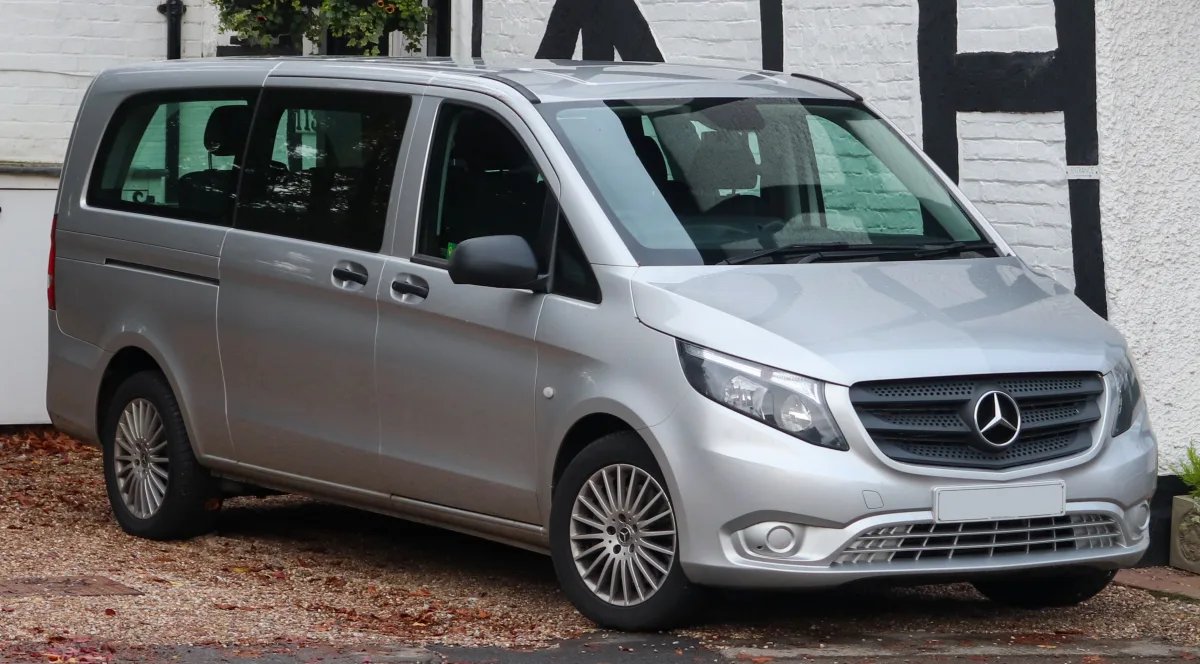
Mercedes-Benz Vito: W639 and W447 generations, engines and body styles
The Mercedes-Benz Vito is a mid-sized commercial minibus, popular in Lithuania both as a work van and as a passenger vehicle. We look at how the W639 and W447 generations differ, which engines are most commonly found, what body styles are available, and what to check before buying a used Vito.






Vito in brief
The Vito has been in production since 1996 and is smaller than the Sprinter, making it more city-friendly: it fits into most driveways and parking spaces, and drives like a large estate car. Its more luxurious passenger cousin is called the Viano (in the W639 generation) and the V-Class (in the W447 generation).
The Vito comes as a cargo van, Mixto (van with a second row of seats), and passenger version — in the W639 generation it's called the Vito Kombi, in the W447 generation — the Vito Tourer. Several lengths are usually available; payload capacity depends on the version and typically reaches around one tonne.
W639 vs W447 — what's the difference
The W639 generation (2003–2014, facelifted in 2010) is a rear-wheel-drive vehicle and currently the cheapest way to get a Vito. Most have covered a lot of miles, so the focus should be on the technical condition and body corrosion rather than the spec.
The W447 generation (from 2014) is more modern, quieter, and more economical. It stands out by offering front-wheel drive, rear-wheel drive, and all-wheel drive (4MATIC). Three lengths are most commonly found — roughly from 4.9 to 5.4 m.
In 2019, the W447 received a newer 2.0-litre diesel engine, a 9-speed automatic gearbox, and more driver assistance systems, with an electric eVito following later. In the used market, these are the priciest but least worn Vito models.
Engines and gearboxes
The W639 is most commonly found with 2.2 CDI diesel engines (109, 111, 115 CDI), post-facelift with 2.1 CDI (110, 113, 116 CDI), and the most powerful were the 3.0 V6 CDI. Gearboxes are either manual or 5-speed automatics.
The W447 front-wheel-drive versions typically had a 1.6-litre diesel engine, rear-wheel-drive versions a 2.1 CDI (most often 114, 116, and 119 CDI), and post-2019 facelift a 2.0-litre diesel engine (e.g. 116, 119, and 124 CDI). The automatic gearbox was 7G-TRONIC pre-facelift, 9G-TRONIC post-facelift.
The number in the name (e.g. 116 CDI) indicates power output, not engine capacity, so check the exact engine power in the documents before buying.
What to check when buying a used Vito
Commercial Vito vans often have high mileages, so check the service history rather than just the odometer. In a manual gearbox, check the clutch and dual-mass flywheel – vibration when moving off or grinding in neutral often indicates an expensive repair.
Inspect W639 models carefully for corrosion: it often appears on the bottom of doors, on the rear doors, in the wheel arches, and in the sills. Also, check the suspension, as heavy loads can quickly wear out the suspension and brakes.
Check the particulate filter and AdBlue system on newer Euro 6 diesel engines — there shouldn't be any faults on the instrument panel. Ask about the vehicle's usage: courier, construction, or passenger transport work all lead to different wear and tear.


Body styles and trim levels
Equipment varies greatly depending on the market, year, and order; we list the versions most commonly found in Europe.
Vito furgonas
W639 and W447 generationsCrew cab version with two or three seats in the cabin.
- Separate cargo area
- Often — one or two sliding side doors
- Available in several lengths
Vito Mixto
W447 generationVan with a second row of seats — perfect for teamwork.
- Second row of seats behind the cabin
- Cargo area behind the seats
- Often — side windows next to the second row
Vito Kombi
W639 generationBasic passenger version of the W639 generation.
- Mostly 8–9 seats
- Basic, utilitarian interior trim
- Often — sliding doors on both sides
Tourer Base
W447 generationBase W447 passenger version, designed for transporting passengers.
- Up to 9 seats
- Basic, easy-to-clean interior
- Mostly steel wheels
Tourer Pro
W447 generationThe most popular passenger version — more comfortable and better equipped.
- Better interior trim
- Often — climate control and rear air conditioning
- Often — lightweight alloy wheels
Tourer Select
W447 generationThe best-equipped Vito Tourer version, close to the V-Class.
- The most luxurious interior trim
- Often — LED headlights and a larger multimedia screen
- Often — automatic transmission
Comparing W447 generations
| Furgonas | Mixto | Tourer Pro | Tourer Select | |
|---|---|---|---|---|
| Who it's for | For cargo and services | Crew with tools | Passenger transport | For comfort and business trips |
| Most common wheels | Steel | Steel | Often light alloy | Light alloy |
| Saloon | Cab only | Cab and second row | Up to 9 seats, better trim | Most luxurious trim |
| Price in the used market (relatively) | € | € | €€ | €€€ |
For work, a rear-wheel-drive van or Mixto with a 2.1 or 2.0 diesel usually does the trick. For ferrying passengers, the Tourer Pro is the most sensible choice, while the Select is only worth considering if comfort is key.
Pros
- A handy size — it fits where a Sprinter won’t
- A wide range of body styles and drivetrains (front-wheel, rear-wheel, all-wheel)
- Robust rear-wheel-drive diesels and a decent automatic gearbox
- A large selection in the used market
Cons
- Body corrosion on the W639 generation
- Higher running costs than some rivals
- Commercial vehicles often have high mileage
Frequently asked questions
Which Vito generation should you choose?
If the budget allows — go for the W447 generation, ideally post-2019 facelift: it’s more modern, more economical and usually less worn out. The W639 Vito is cheaper, but you almost always need to factor in body and chassis repair costs.
How do front-wheel and rear-wheel-drive W447 Vitos differ?
Front-wheel-drive versions are lighter and cheaper, but they have less powerful 1.6 diesels. Rear-wheel-drive Vitos are more powerful, tow better, and more often come with an automatic gearbox.
How does the Vito Tourer differ from the V-Class?
Both are built on the same platform, but the V-Class is a luxurious people carrier with a cabin on par with a regular car. The Vito Tourer is simpler, more practical, and usually cheaper in the used market.
When is a Vito's mileage too high?
The mileage alone doesn't tell you much — what matters is how the car has been maintained. Opt for a Vito with a verifiable service history and be sure to check the sump, timing belt, turbo, and body corrosion.
Updated 2026-10-09 · Trim levels and equipment vary by market and model year — check the equipment of the specific car. · Translated automatically


