 English
 Lietuvių
 Latviešu
 Eesti
 Polski
 Русский
 Українська
 Deutsch
 Nederlands
 Čeština
 Slovenčina
 Svenska
 Norsk
 Dansk
 Suomi


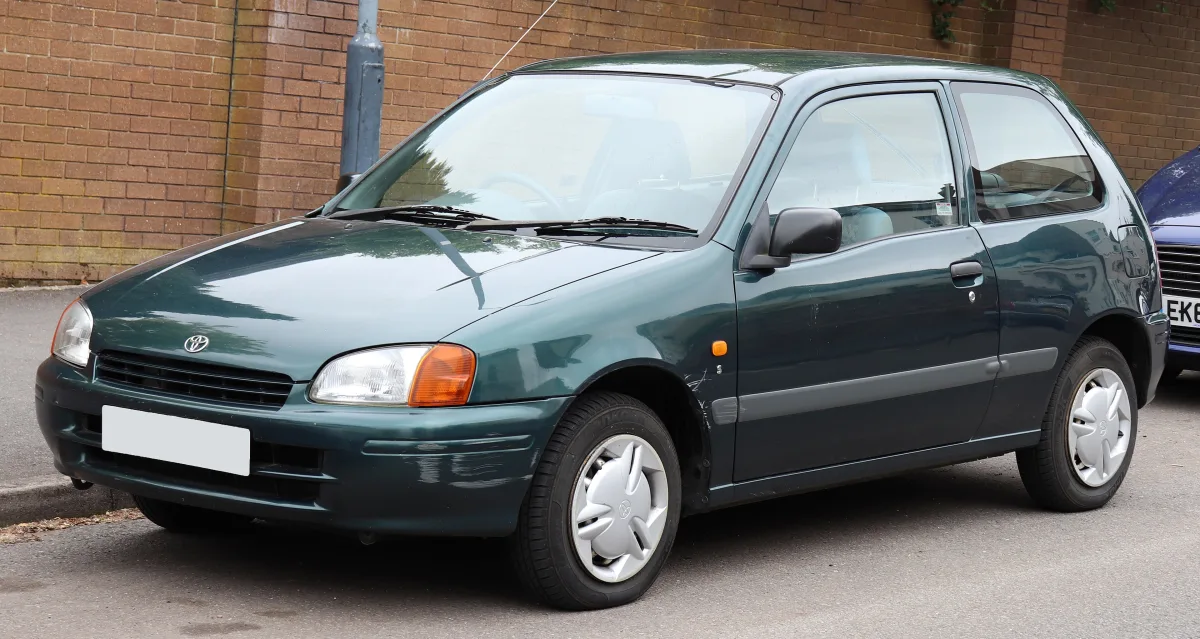
Toyota Starlet: P60, P70, P80 and P90 generations, engines and trims
Toyota Starlet — a small Toyota hatchback produced from 1973 to 1999 and popular in the 1980s and 1990s as an affordable, simple city car. We'll look at the generations, engines, known trims, and what to check when buying a used Starlet.






Starlet in brief
The Starlet is one of Toyota's smallest hatchbacks, known for its simple construction and typical Japanese reliability. Body styles varied by generation: usually 3- and 5-door hatchbacks.
Later generations are the most popular in the used market — EP81 and EP91. They are fairly simple, affordable, and economical, making them ideal as a first or second city car.
Which generation to choose
Earlier generations (up to the mid-1980s) were rear-wheel drive, while from 1984 the Starlet became a front-wheel drive car. The most modern and practical are the EP81 (1989–1995) and EP91 (1996–1999).
If you're after a simple daily driver, go for an EP81 or EP91 in good body condition. Enthusiasts should check out the turbo versions, which offer significantly more power but are harder to find.
Engines and transmissions
The most common engine is the 1.3-litre petrol unit, which delivers around 75hp and is economical. Smaller engines were available earlier, and sporty turbo versions had a 1.3-litre turbo engine and around 135hp.
Transmissions are either a 5-speed manual or a 3- or 4-speed automatic. The manual is simple and robust, while the automatic needs its fluid changed regularly.
What to check when buying a used Starlet
First, inspect the body for rust: check the sills, wheel arches, rear end, and floor. This is a common issue with Japanese cars of this era.
Check the timing belt change history, engine condition, and cooling system. For turbo versions, it's especially important to determine if the engine wasn't over-revved too much — check oil consumption and turbocharger condition.
Many Starlets were imported from Japan, so it's worth checking the documents, mileage, and whether the car was in an accident.


Trim levels
Names and equipment vary by market and year; we list the most commonly found trim levels in Europe.
XL
All generationsThe base, no-frills trim level.
- Often — steel wheels
- Basic interior trim
- Mostly a 1.3-litre engine
GL
All generationsA popular trim level with more comfort features.
- Often — better interior trim
- Often — electric windows
- Often — more interior equipment
GLi
Later generationsA higher-spec version with a petrol engine.
- Often — a petrol engine
- Often — alloy wheels
- Often — more comprehensive comfort features
GT Turbo
Sport versionSport version with turbo engine.
- 1.3-litre turbo engine
- Sport suspension
- Often — sport seats
Trim comparison
| XL | GL | GLi | GT Turbo | |
|---|---|---|---|---|
| Who it's for | For everyday use | For daily comfort | More comfort | For sporty driving |
| Wheels (most often) | Steel | Steel or light alloy | Light alloy | Light alloy |
| Engine | 1.3-litre | 1.3-litre | 1.3-litre, naturally aspirated | 1.3-litre turbo |
| Price in the used market (relatively) | Budget-friendly | Budget-friendly | Budget-friendly | Mid-range |
Most buyers will opt for the GL or GLi with a well-maintained body. The GT Turbo is for enthusiasts ready to commit to a bigger budget and more intensive maintenance.
Pros
- Simple, reliable construction
- Low fuel consumption
- Low maintenance
- Compact and city-friendly
Cons
- Old cars — rust is a common issue
- Basic safety levels by today's standards
- Turbo versions are rare and pricey
Frequently asked questions
Is the Starlet economical?
Yes, with the 1.3-litre engine, fuel consumption is low, and maintenance is straightforward and affordable.
Is the Starlet suitable for a beginner driver?
Yes. It's small, easy to handle, and affordable to run, although the safety levels are more basic than those of newer cars.
Which Starlet generation is the best?
Later generations — EP81 and EP91 — are most often recommended as they are more modern and practical.
Updated 2026-10-19 · Trim levels and equipment vary by market and model year — check the equipment of the specific car. · Translated automatically


