 English
 Lietuvių
 Latviešu
 Eesti
 Polski
 Русский
 Українська
 Deutsch
 Nederlands
 Čeština
 Slovenčina
 Svenska
 Norsk
 Dansk
 Suomi


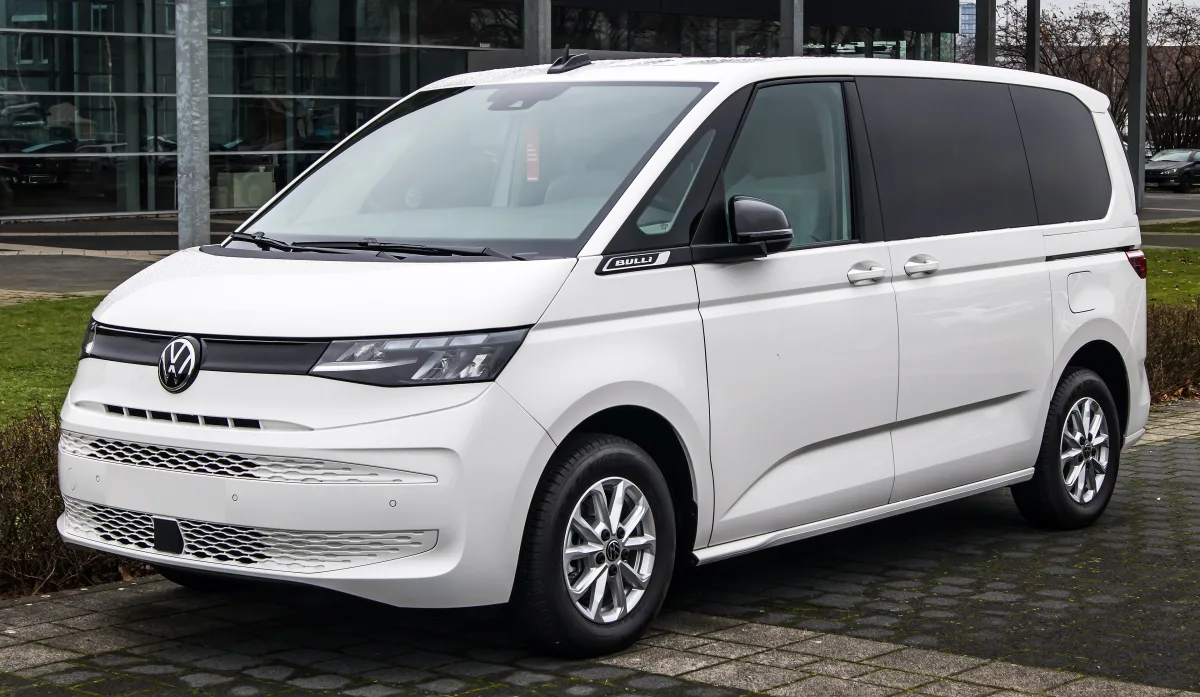
Volkswagen Multivan: T6, T6.1 and T7 generations, engines and trims
The Volkswagen Multivan is the people carrier of the Transporter family, favoured by large families and travellers. We look at how the T6, T6.1 and new T7 differ, which engines are most common, how the trims vary and what to check when buying a used Multivan.






Multivan in brief
The Multivan name has been used for several decades, and in the used market you'll most often encounter the T5 (2003–2015), T6 (2015–2019) and refreshed T6.1 (from 2019). The all-new T7 Multivan was introduced in 2021, built on a light commercial vehicle platform.
The Multivan differs from the standard Transporter or Caravelle in terms of comfort: the interior usually has 7 seats, the second-row seats can swivel, and there's often a table between them. The seats are mounted on rails, so the interior can be adapted for both passengers and large loads.
T6, T6.1 and T7 — what's the difference
The T6 (2015–2019) was a significant update over the T5: it featured a new front end, more modern diesel engines and additional equipment. The T6.1 (late 2019) received a new dashboard, digital instruments, a more modern infotainment system and electric power steering, which allowed for more advanced driver assistance systems. These models are the most popular in the used market.
T7 Multivan (from 2021) — a completely different beast: it's lower, more reminiscent of a large MPV, comes in shorter and longer versions, and features sliding doors on both sides. The seats are lighter and easier to remove, and for the first time, it offers a plug-in hybrid, the eHybrid.
When choosing between them, it's worth noting that the T6 and T6.1 are traditional, robust people carriers with more headroom and often feature 4Motion four-wheel drive, while the T7 is more comfortable and modern, though it's more family-oriented than workhorse.
Engines and gearboxes
The T6 and T6.1 are most commonly found with a 2.0 TDI diesel engine, with power ranging from around 100 to 200 hp; the most popular versions have about 150 hp. Petrol 2.0 TSI engines are rare in Lithuania.
The T7 Multivan is offered with 1.5 and 2.0 TSI petrol, 2.0 TDI diesel (around 150 hp) engines, and the eHybrid plug-in hybrid (around 218 hp). All T7 versions come with an automatic DSG gearbox.
T6 and T6.1 models can have a manual or 7-speed DSG gearbox, with 4Motion four-wheel drive offered with more powerful diesel engines.
What to check when buying a used Multivan
The Multivan is often used for long journeys and work, so the mileage can be high. Check it against service records and, in manual cars, the clutch and dual-mass flywheel: vibration or judder when moving off can indicate expensive repairs may be needed.
The DSG gearbox should shift smoothly, without any jerking; ask if the oil was regularly changed. For diesel cars, check the particulate filter (DPF), EGR valve, and AdBlue system.
Test the sliding doors (especially electric ones), seat belts, and rotating seats. Inspect the body for rust on the door sills, wheel arches, and lower edges — this is a particularly common issue with older T5 models.


Trim levels
Names and equipment vary by market and year; we list the most commonly found Multivan trims in Europe.
Trendline
T6, T6.1The base trim with standard Multivan equipment.
- Often — second-row swivel seats
- Usually — steel wheels
- Often — a more basic infotainment system
Comfortline
T6, T6.1The most popular choice — more comfort for a sensible price.
- Light-alloy wheels
- Often — automatic climate control and parking sensors
- Often — electric sliding doors
Highline
T6, T6.1The best-equipped standard T6 and T6.1 trim.
- More luxurious interior trim
- Often — LED headlights and leather seats
- Often — electric tailgate and boot cover
Life
T7The base T7 trim with modern equipment.
- LED headlights and digital dials
- Lightweight, sliding seats on runners
- Often — adaptive cruise control
Style
T7The more luxurious T7 for comfort lovers.
- Higher-class interior trim
- Often — matrix LED headlights
- Often — electric sliding doors
Trim comparison
| Comfortline (T6.1) | Highline (T6.1) | Life (T7) | Style (T7) | |
|---|---|---|---|---|
| Who it's for | For families and road trips | More comfort | For the modern family car | Comfort and styling |
| Wheels (most often) | 16–17 inch | 17–18 inch | 16–17 inch | 17–18 inch |
| Front headlights | Halogen, sometimes LED | Often LED | LED | LED, often matrix |
| Engine | 2.0 TDI | 2.0 TDI | TSI, TDI, eHybrid | TSI, TDI, eHybrid |
| Price in the used market (relatively) | € | €€ | €€ | €€€ |
For many buyers, the best choice is the T6.1 Comfortline or Highline with the 2.0 TDI engine. The T7 is worth considering if comfort and modern features close to those of a regular car are important to you.
Pros
- The interior is highly versatile and easily configurable
- Holds its value well
- A wide range of spare parts available
- Suitable for both families and long journeys
Cons
- Often more expensive than competitors in the used market
- Repairs to the gearbox, DSG, and diesel systems can be costly
- Older models are prone to rust
Frequently asked questions
What sets the Multivan apart from the Caravelle and Transporter?
The Transporter is a commercial vehicle, the Caravelle is a passenger minibus with more seating, and the Multivan is the most comfortable version for families and trips, featuring swivel seats, a table, and better trim.
Which Multivan to choose — T6.1 or T7?
The T6.1 is more robust, simpler, and often comes with four-wheel drive, making it suitable for both work and travel. The T7 is more modern, quieter, and more comfortable for daily use, but it is usually more expensive in the used market.
Is it worth buying a Multivan with high mileage?
A well-maintained Multivan can cover many miles, but with high mileage, you often need to replace the gearbox, dual-mass flywheel, suspension parts, or diesel system components. Choose a vehicle with a verified service history and have it checked by a service before purchasing.
Updated 2026-10-09 · Trim levels and equipment vary by market and model year — check the equipment of the specific car. · Translated automatically


