 English
 Lietuvių
 Latviešu
 Eesti
 Polski
 Русский
 Українська
 Deutsch
 Nederlands
 Čeština
 Slovenčina
 Svenska
 Norsk
 Dansk
 Suomi


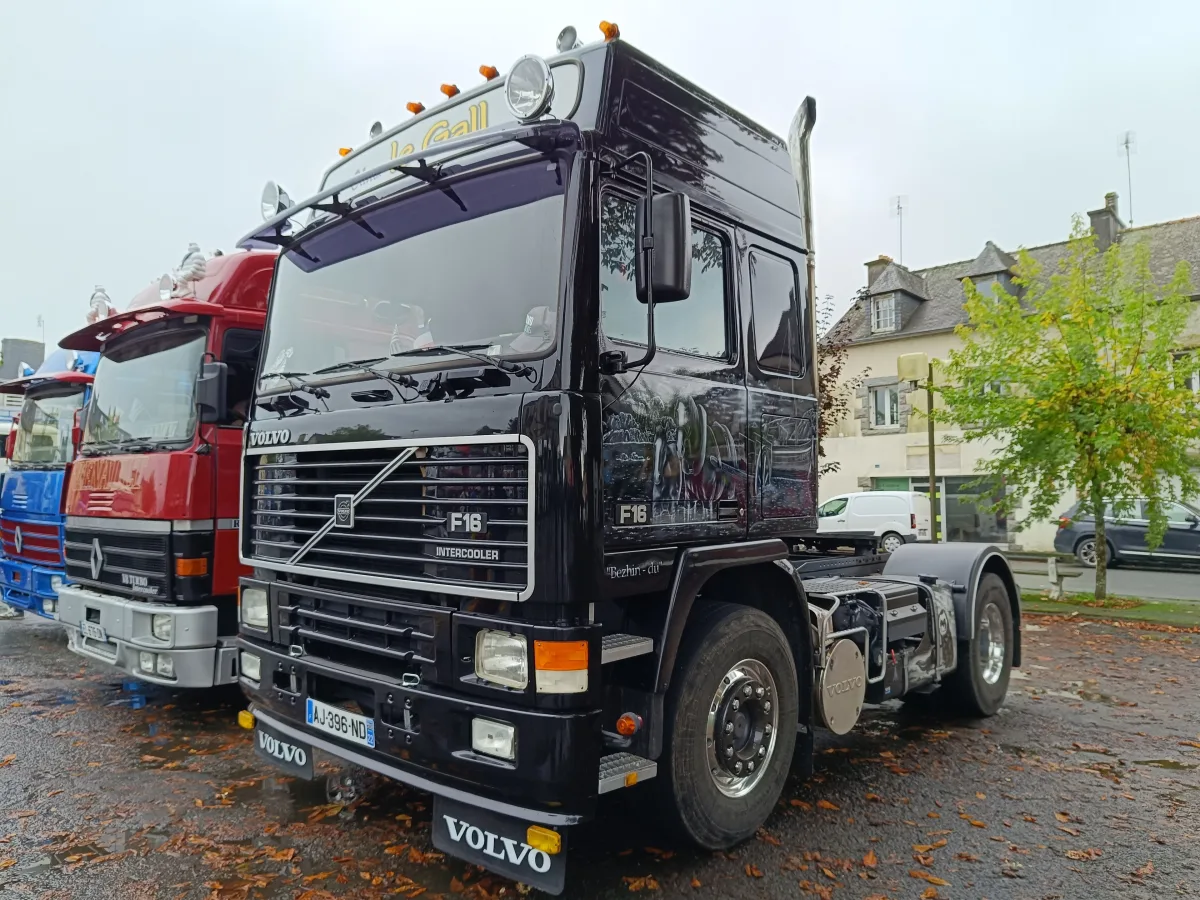
Volvo F16: series, engine and what to check when buying
The Volvo F16 is the most powerful version of the Volvo F series produced between 1987 and 1993, designed for heavy long-distance hauls and large loads. We look at what sets it apart, what engine it has, and what to check if you're after this classic truck.






The F16 in brief
The F16 was the top-tier Volvo heavy truck: along with the F10 and F12, it made up the F family, but it had the largest engine and the most power. It was usually a 4x2 or 6x2 truck with a spacious 'Globetrotter' type sleeper cab.
Today, the F16 is a rare and sought-after classic truck. It's favoured by collectors, heavy-haul operators, and those who appreciate powerful yet straightforward mechanics.
The series — what makes it special
The F16 was introduced in 1987 as the most powerful version of the F series, and by 1993, it was replaced by the FH16. Therefore, production was short-lived, and many examples are genuine rarities.
Compared to the F10 and F12, the F16 has a larger engine and a reinforced chassis designed for heavier loads. Externally, it resembles the F12, so identification requires checking the cab badge and engine specs.
Since the vehicle is old, its Euro emissions standard often doesn't comply with modern pollution zones, so when buying, check where it's allowed to operate.
The engine and gearbox
The F16 has a roughly 16-litre six-cylinder turbodiesel with an intercooler. Power exceeds 450 hp, and torque is one of the highest of its time.
Gearboxes are usually manual, often with an overdrive. It's worth test-driving them: the condition of the synchromesh and synchronizers is particularly important, as they endure heavy loads.
The engine is straightforward in terms of maintenance, but repairs can be expensive due to the large parts and limited supply. Before buying, it's worth considering if you have a mechanic who specializes in older Volvo engines.
What to check when buying an F16
First and foremost, check the frame and cab. Corrosion at the cab corners, seams, and crossmembers is common, and the cab lift system should operate smoothly.
Start the engine cold and assess the exhaust, oil pressure, cooling system, and turbocharger noise. Check the air system, brakes, and engine brake.
Verify in the documents if the vehicle is genuinely an F16 or a converted F12, and check the mileage against the records. For a rare vehicle, maintaining originality is crucial.


Versions
The F16 was produced in several versions; we list the most commonly encountered.
F16 vilkikas 4x2
Full production runA classic long-haul truck.
- The "Globetrotter" style sleeper cab
- High power output
- Simpler interior trim
F16 vilkikas 6x2
A common heavy-duty cargo versionAdditional axle for heavier loads.
- Higher payload
- Often — with a lift axle
- More expensive maintenance
F16 su krovinine važiuokle
Rarer variantWith a cab or special chassis.
- Often — a flatbed cab
- Reinforced chassis
- The condition of the cab determines the value
F16 sunkiems kroviniams
Special editionReinforced version, especially for heavy-duty trucks.
- Reinforced suspension
- Often — 6x4
- Rare and sought-after
Originali klasikinė būklė
Any variantCars that have retained their factory appearance.
- Original parts
- Often — collector's value
- Pricier than practical
F16 version comparison
| 4x2 vilkikas | 6x2 vilkikas | Su važiuokle | Originalus klasikinis | |
|---|---|---|---|---|
| Who it suits | For long-distance trips | For heavier loads | For specialist work | For collectors |
| Cab | Sleeping area | Sleeping area | Mostly sleeping area | Original |
| Engine | Around 16 litres | Around 16 litres | Around 16 litres | Around 16 litres |
| Price in the used market (relatively) | Mid-range | Mid-range | Mid-range | High-end |
If you're after a reliable workhorse, opt for the F16 with its sturdy frame and proven engine; if you're a collector, hunt for an original-condition example. Due to its rarity and age, the price greatly depends on the specific vehicle.
Pros
- Large engine and powerful towing capacity
- Spacious, comfortable sleeper cab
- Rare and sought-after classic workhorse
- Fairly simple, well-maintained mechanics
Cons
- Old vehicle — rust and wear and tear are common
- High fuel consumption
- Limited parts availability, repairs can be expensive
Frequently asked questions
How does the F16 differ from the F12?
The F16 features a larger, approximately 16-litre engine and a more robust chassis designed for heavier loads. Externally, they look similar, so identifying the F16 requires checking the cab badge and engine specs.
Can the F16 be used today?
Yes, but due to its age, it doesn't meet modern emissions zone requirements. Check where it can be operated and if it meets the technical inspection standards.
Is the F16 considered a classic?
Due to its short production run and powerful engine, the F16 is quite rare and sought-after, making it highly valued as a classic. Its value is determined by its condition and originality.
Updated 2026-10-21 · Trim levels and equipment vary by market and model year — check the equipment of the specific car. · Translated automatically


