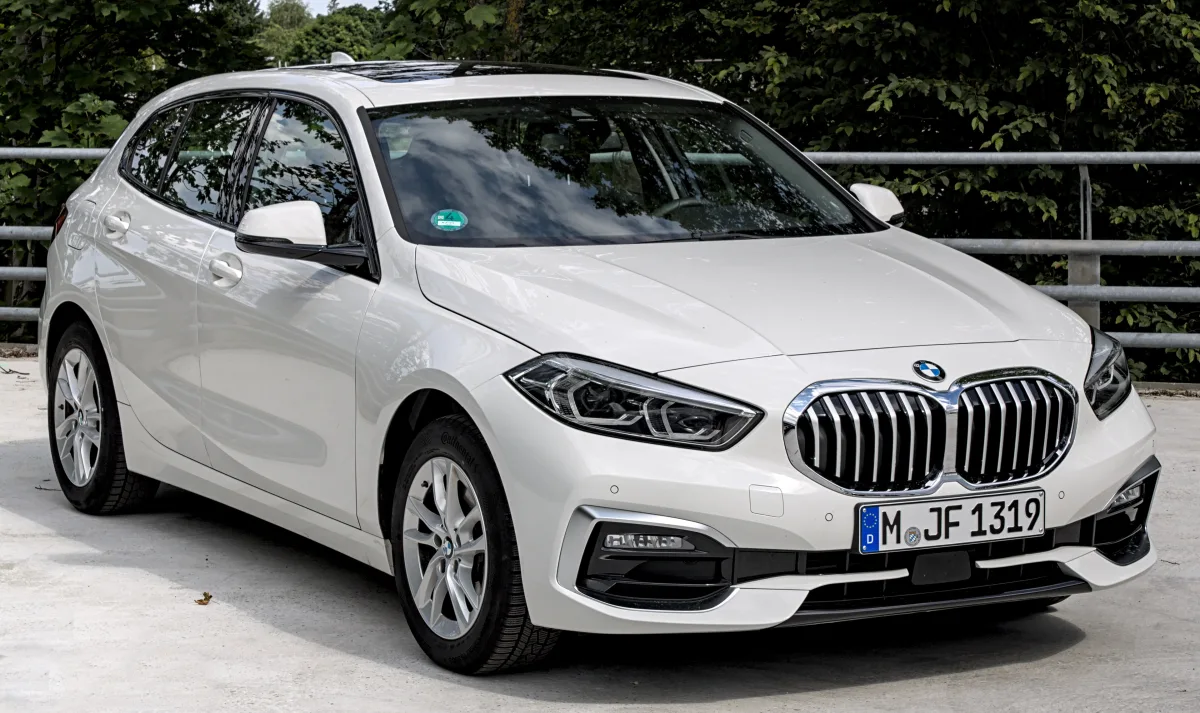
BMW 1 Series: F20 and F40 generations, engines and trims
The BMW 1 Series is the entry-level BMW hatchback, competing with the Audi A3 and Mercedes-Benz A-Class since 2004. We review the two most popular generations on the used market — the rear-wheel-drive F20 (2011–2019) and the front-wheel-drive F40 (2019–2024): engines, trim lines and what to check before buying.
ADVERTISEMENT
The 1 Series in brief
Generations are designated by codes: E87 (along with its coupe and convertible derivatives), F20/F21 (5-door and 3-door), F40, and the F70 produced from 2024. The first two generations stood out because, unlike most cars in this class, they featured rear-wheel drive.
The 1 Series is praised for its high-quality interior, precise steering and efficient engines. It's a great way to get into a BMW on a budget, though you have to factor in that the rear seat and boot — especially in the F20 generation — are smaller than those of many rivals.
F20 vs F40 — what's the difference
The F20 (2011–2019) is the most popular generation on the Lithuanian used market. Rear-wheel drive and a longitudinally mounted engine give it a driving feel that's rare in this class, while the six-cylinder M135i and M140i rank among the fastest hatchbacks in their segment. The 2015 facelift updated the headlights and introduced a new generation of engines.
The F40 (2019–2024) switched to front-wheel drive (with top versions featuring xDrive all-wheel drive). As a result, there is more cabin and rear-seat space, the boot is larger, and the interior is more modern, featuring a digital instrument cluster and larger displays. Its driving dynamics have become more comparable to other cars in its class.
When choosing between them, it's worth deciding what matters more: the F20 for driving pleasure and affordability, or the F40 for space, modern tech and newer model years.
Engines and gearboxes
The F20 generation is most commonly found with the 116d, 118d and 120d diesels, and the 116i, 118i and 120i petrols. Following the 2015 facelift, the 116i and 118i received 1.5-litre three-cylinder engines. The sportiest models are the M135i (around 320 hp) and M140i (around 340 hp) with a 3.0-litre six-cylinder engine.
The F40 lineup is anchored by the 118i (1.5-litre, three-cylinder), the 116d, 118d and 120d diesels, the sporty 128ti (front-wheel drive) and the M135i xDrive with a 2.0-litre four-cylinder engine (around 300 hp).
F20 models typically feature either a ZF 8-speed automatic or a 6-speed manual gearbox. The F40 generation uses a 7-speed dual-clutch or an 8-speed automatic transmission, depending on the engine.
What to check when buying a used 1 Series
On early F20 diesels (N47, up to around 2015), the timing chain is located at the back of the engine and can stretch — upon cold startup, there should be no rattling or whining noises. Ask whether the chain has already been replaced and if factory recall campaigns have been carried out.
BMW models are prone to oil leaks from the valve cover and oil filter housing gaskets. On diesels that have seen heavy urban use, check the particulate filter (DPF) and the EGR system.
Many 1 Series cars run on run-flat tyres — check their condition as well as the suspension. M135i and M140i models are frequently modified or driven hard, making service history and a thorough mechanical inspection especially crucial.
ADVERTISEMENT
Trim levels (equipment lines)
BMW trim levels are known as lines; their names and equipment packages vary depending on the market and model year.
Urban Line
F20
A lighter, modern-design F20 line.
White or light exterior accent details
Special alloy wheels
Lighter interior trim
Sport Line
F20, F40
A sportier look and seats without the M Sport package.
Sports seats
Gloss black exterior trim
Larger alloy wheels
Advantage
F40
Base line with a higher level of standard equipment.
Automatic climate control
Parking sensors
Frequently includes LED headlights
Luxury Line
F40
An elegant line focused on comfort.
Chromed exterior details
More luxurious interior trim
Frequently includes leather seats
M Sport
F20, F40
The most popular line on the used market — featuring a sporty look and suspension setup.
M Aerodynamics package
Sports suspension and M steering wheel
Larger alloy wheels
M135i / M140i
F20, F40
The sportiest versions of the 1 Series.
F20 — 3.0-litre six-cylinder, F40 — 2.0-litre with xDrive
M Sport brakes and suspension
Sports seats
Comparison of F40 lines
Advantage
Sport Line
M Sport
M135i xDrive
Who it's for
For the rational buyer
For a sporty look
For sporty driving
For driving pleasure
Wheels (mostly)
16–17 in.
17 in.
17–18 in.
18–19 in.
Styling
Standard
Black trim
M Aerodynamics package
M Performance parts
Interior
Standard
Sports seats
Sports seats, M steering wheel
Sports seats, M trim
Used market price (relative)
€
€€
€€
€€€
For most buyers, the sweet spot is the 118i or 118d with the Sport Line or M Sport package. If driving dynamics are your top priority, it's worth seeking out a rear-wheel-drive F20 generation.
Pros
Upscale cabin and precise steering
Economical petrol and diesel engines
The F20 offers rare rear-wheel drive in this class
Splendid ZF 8-speed automatic gearbox in the F20
Cons
Tight rear legroom, especially in the F20
Timing chain issues on early F20 diesels
Higher maintenance costs than most rivals
Frequently asked questions
Which 1 Series generation is best on the used market?
If space and modern tech matter most, go for the F40. If you want rear-wheel-drive thrills and a lower price tag, look for a 2015–2019 facelifted F20 featuring the newer-generation engines.
Is the 1 Series suitable for a family?
It can suffice for a small family with one child, but rear seat and boot space are tight. If you need more room, it's worth stepping up to the 3 Series or Touring estate.
What is the difference between the rear-wheel-drive and front-wheel-drive 1 Series?
The rear-wheel-drive F20 offers a more playful drive and better weight distribution, though rear passenger and boot space suffer. The front-wheel-drive F40 is more spacious and practical, and generally easier for inexperienced drivers to manage in winter.
Updated 2026-10-09 · Trim levels and equipment vary by market and model year — check the equipment of the specific car. · Translated automatically
Comments
No comments about the BMW 1 Series yet. Share your experience.
We use necessary cookies to run the website. With your consent, we will also use analytics and advertising measurement cookies — to understand how the website is used and to measure our advertising results. Learn more
 English
 Lietuvių
 Latviešu
 Eesti
 Polski
 Русский
 Українська
 Deutsch
 Nederlands
 Čeština
 Slovenčina
 Svenska
 Norsk
 Dansk
 Suomi


 4