 English
 Lietuvių
 Latviešu
 Eesti
 Polski
 Русский
 Українська
 Deutsch
 Nederlands
 Čeština
 Slovenčina
 Svenska
 Norsk
 Dansk
 Suomi


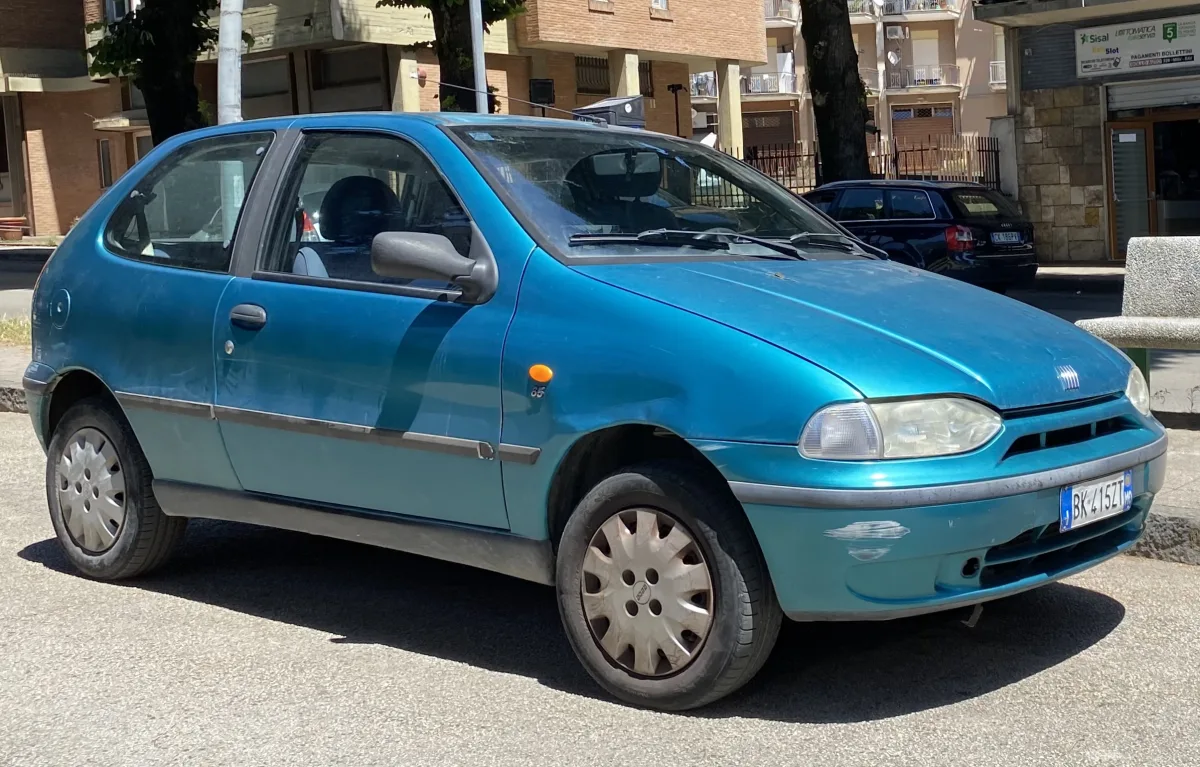
Fiat Palio: a global compact, generations and what to check
The Fiat Palio is a small hatchback and estate car designed primarily for developing markets since 1996. In Brazil, it became one of the most popular models, while in Europe, the first-generation Palio and Weekend estate were sold. We briefly look at the essentials, engines, and what to check.






The Palio in brief
The Palio is Fiat's 'global car', designed to be cheap to produce and easy to maintain. The main variant is a small hatchback, from which the Weekend estate, Siena sedan, and Strada pickup are derived.
Several generations of the Palio are sold in different markets. In Lithuania, you'll mostly find first-generation cars, which are now quite dated.
Which version to choose
The most common model in the European market is the Weekend estate: it's practical and suits a family well. If you only need a city car, the hatchback will do.
The key is not the trim level but the technical condition. Choose the best-maintained car with a clear service history.
Engines and gearboxes
Palio engines are simple petrol units ranging from 1.0 to 1.6 litres, with diesel options available in some markets. The gearbox is usually a 5-speed manual.
The construction is simple, so most issues can be fixed cheaply, although parts might take time to arrive.
What to check when buying a used Palio
Pay attention to rust in the sills, wheel arches, and front end. Check the suspension, brakes, and steering — these cars are often driven hard.
Check for a cold engine: uneven running or smoke indicates problems. Check the electrical equipment and ensure all windows, heating, and lights are working.


Trims
Trim names vary by market and year; in Europe, you'll find S, EL, ELX, and HLX.
S
First generationBase trim.
- Basic interior
- Minimal equipment
- The most affordable option
EL
First generationAdditional comfort features.
- Often — electric windows
- Often — central locking
- Often — sound system
ELX
First generationMid-range trim with more equipment.
- Often — air conditioning
- Often — driver's airbag
- Often — upgraded interior
HLX
First generationTop-of-the-range trim
- Often — full electric equipment
- Often — lightweight alloy wheels
- Often — additional safety systems
Trim comparison
| S | EL | ELX | HLX | |
|---|---|---|---|---|
| Who it's for | For everyday use | A touch more comfort | Most buyers | Maxed-out spec |
| Wheels (most often) | 13–14 inch | 13–14 inch | 14 inch | 14–15 inch |
| Interior | Base | Base | Mid-range | High-spec |
| Engine | 1.0–1.2 | 1.2–1.4 | 1.2–1.6 | 1.4–1.6 |
| Price in the used market (relatively) | € | € | € | € |
In this case, the trim level is less important than the condition. Opt for a well-maintained car with a clear history.
Pros
- Simple and cost-effective design
- Low running costs
- The practicality of a versatile weekend car
- Highly popular in Brazil, so a wide range of parts available
Cons
- Low passive safety rating
- Rust and wear
- Rare in Lithuania, parts might take time to arrive
Frequently asked questions
How does the Palio differ from the Siena and Strada?
These are cars built on the same platform: Palio is a hatchback and estate, Siena is a sedan, Strada is a pickup.
Does the Palio have a diesel engine?
Diesel variants are offered in some markets, but in Lithuania, petrol versions are most commonly found.
Is the Palio Weekend practical?
Yes, the estate offers more cargo space than the hatchback, but the car is quite old, so the key factor is its mechanical condition.
Updated 2026-10-14 · Trim levels and equipment vary by market and model year — check the equipment of the specific car. · Translated automatically


