 English
 Lietuvių
 Latviešu
 Eesti
 Polski
 Русский
 Українська
 Deutsch
 Nederlands
 Čeština
 Slovenčina
 Svenska
 Norsk
 Dansk
 Suomi


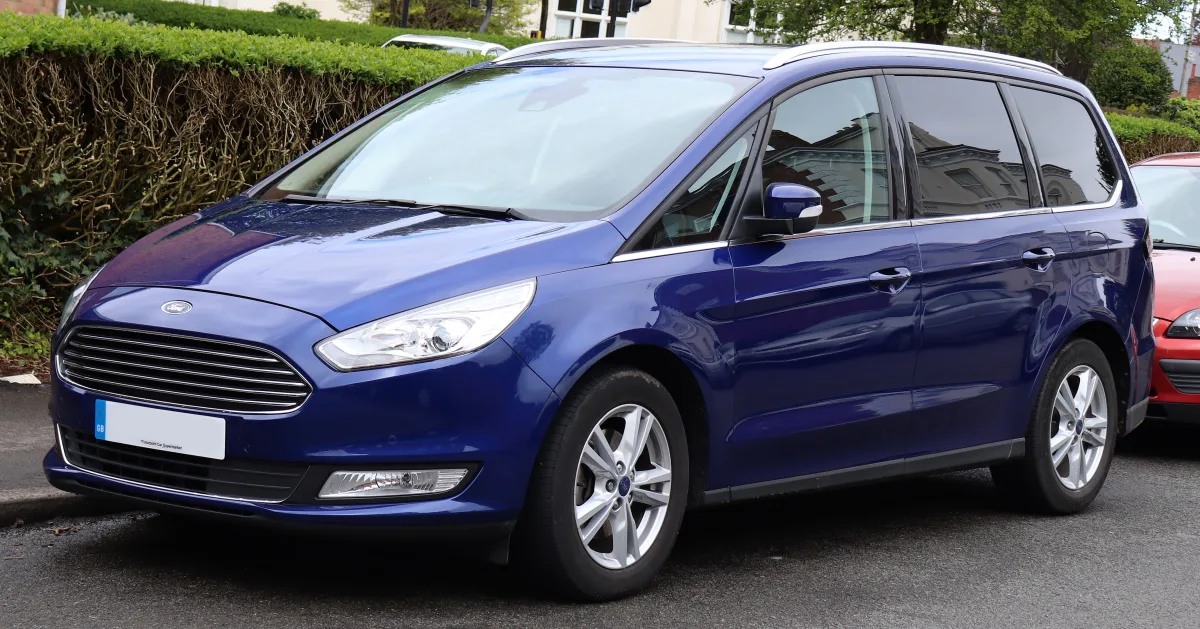
Ford Galaxy: II and III generations, engines and trims
The Ford Galaxy is a large seven-seater MPV that's popular in Lithuania among big families and those who need plenty of space for passengers and luggage. We're looking at the II (2006–2015) and III (2015–2023) generations: how they differ, which engines are most popular, how the trims compare, and what to check when buying used.






Galaxy in brief
The first-generation Galaxy (1995–2006) was developed jointly with Volkswagen and had siblings — the VW Sharan and SEAT Alhambra. From the second generation onwards, the Galaxy is purely a Ford: it's built on the same platform as the Mondeo and S-Max, so it drives like a large hatchback rather than a minibus.
The Galaxy's biggest selling point is its space. In the second and third rows, the seats are separate, and in the third row, adults can sit for shorter journeys, while the folded seats leave a vast, flat boot. Its sportier, lower sibling is the Ford S-Max.
Galaxy production in Europe ended in 2023, so today it's a used-car market choice only. Most of the cars sold in Lithuania are diesels and imported from Western Europe.
II and III generation — how they differ
The second generation (2006–2015) is significantly larger and more modern than its predecessor, with all five rear seats folding flat into the floor. A 2010 facelift refreshed the exterior and interior, introduced EcoBoost petrol engines, and brought the PowerShift automatic gearbox. Today, it's the cheapest way to get a large seven-seater, but most cars have already clocked up plenty of miles.
The third generation (2015–2023) is built on a new platform shared with the Mondeo Mk5 and S-Max II. The interior is quieter and better insulated, featuring the SYNC infotainment system, more driver-assistance features, and all-wheel drive (AWD) for some diesel engines. In some models, the third row of seats folds electrically.
From 2018–2019, the older 2.0 TDCi diesels were replaced with 2.0 EcoBlue units and an eight-speed automatic gearbox, and from 2021, a hybrid version became available. If your budget allows, these newer models are the best choice.
Engines and gearboxes
In the second generation, you'll most commonly find 1.8 TDCi (around 125 hp) and 2.0 TDCi (around 115–163 hp) diesels, with the more powerful 2.2 TDCi being rarer. Petrol options include 2.0 and 2.3-litre naturally aspirated engines, and after 2010, the 1.6 and 2.0 EcoBoost.
The third generation is dominated by 2.0 TDCi (around 120–210 hp) and, from 2018, 2.0 EcoBlue (around 150–240 hp) diesels; the most powerful versions have twin turbos. Petrol engines, the 1.5 and 2.0 EcoBoost, are rare in Lithuania. The hybrid, the 2.5 FHEV (around 190 hp), works with an eight-speed automatic gearbox and can't be charged from an external power source.
Transmissions — 6-speed manual or automatic. Up to 2010, some engines were paired with a conventional automatic, later mostly a 6-speed dual-clutch PowerShift, and with EcoBlue diesels — an 8-speed conventional automatic.
What to check when buying a used Galaxy
Most used Galaxies are diesel and high-mileage, so check the service history for regular maintenance. Listen for a two-mass flywheel (vibration or judder when starting and stopping the engine), check the diesel particulate filter (DPF) and EGR valve, and in EcoBlue diesels, ensure there are no AdBlue system errors in the instrument cluster.
The PowerShift box should shift smoothly, without hesitation or judder; ask if its fluid has been changed. In an all-wheel-drive car, listen for any binding when driving and cornering.
The Galaxy was often a family car, so test all seat adjustment mechanisms, the operation of the third row (especially electric folding), and door and tailgate locks. Evaluate the rear suspension and brakes considering that the car is often heavily loaded.


Trim levels
Names and equipment vary by market and year; we list the most common trims found in Europe.
Ambiente
Second generationThe base second-gen trim is basic and rarely seen in Lithuania.
- Often — steel wheels
- Often — manual air conditioning
- Basic sound system
Trend
Second and third generationPopular mid-range trim with all the essential equipment.
- Often — light-alloy wheels
- Often — automatic climate control
- Third time around — SYNC multimedia system
Ghia
Second generationComfort trim with plusher interior trim
- Plusher interior trim, often — wood inlays
- Often — partial or full leather upholstery
- More comfort equipment
Titanium
Second and third generationBest-equipped standard trim and the most common choice in the used market
- Larger light-alloy wheels
- Often — dual-zone climate control and parking sensors
- Often — keyless entry and more driver assistance systems
Comparison of most common trims
| Trend | Ghia | Titanium | |
|---|---|---|---|
| Generation | Second and third | Second | Second and third |
| Who's it for | For the sensible family buyer | Best for comfort on a budget | For those wanting the most kit |
| Common wheel sizes | 16 inch | 16–17 inch | 17–18 inch |
| Interior | Cloth upholstery | More luxurious trim, often leather | More features, often partial leather |
| Price in the used market (relatively) | €–€€ | € | €€–€€€ |
For many families, the best choice is the third-generation Titanium with the 2.0 TDCi or 2.0 EcoBlue diesel engine. If your budget is tight, the second-generation Ghia or Titanium offers plenty of comfort for less, but then the key factor is the vehicle's condition.
Pros
- The cabin is incredibly spacious with a third row of seats suitable for adults
- The large boot with flat floors when the seats are folded down
- Stable and comfortable on the road, drives like a hatchback
- Economical diesel engines and a wide range of options
Cons
- Large — not easy to park in the city
- Most used cars have high mileage
- Repairs to diesel engines' DPF, EGR, and twin-turbo systems can be expensive
Frequently asked questions
What's the difference between the Ford Galaxy and S-Max?
The technology and engines are essentially the same, but the Galaxy is taller, with a more spacious third row of seats and a larger boot. The S-Max is lower and sportier, and its third row is better suited to children. If you need seven seats all the time, go for the Galaxy.
Which generation of Galaxy is best to buy used?
For many buyers, the best is the third generation, especially the 2018–2023 models with the 2.0 EcoBlue engine — they're quieter, safer, and newer. The second generation is much cheaper, but you should choose it based on its condition and service history, not the spec.
Does the Galaxy have four-wheel drive?
The second-generation Galaxy is front-wheel drive only. In the third generation, some diesel engines were offered with four-wheel drive (AWD), but most used cars in the market are front-wheel drive.
Is it worth buying a Galaxy with the PowerShift gearbox?
Yes, if the gearbox works smoothly and there's a service history. Before buying, test the car for local movement and slow driving — judders or knocks when shifting indicate that repairs might be needed.
Updated 2026-10-09 · Trim levels and equipment vary by market and model year — check the equipment of the specific car. · Translated automatically


