 English
 Lietuvių
 Latviešu
 Eesti
 Polski
 Русский
 Українська
 Deutsch
 Nederlands
 Čeština
 Slovenčina
 Svenska
 Norsk
 Dansk
 Suomi


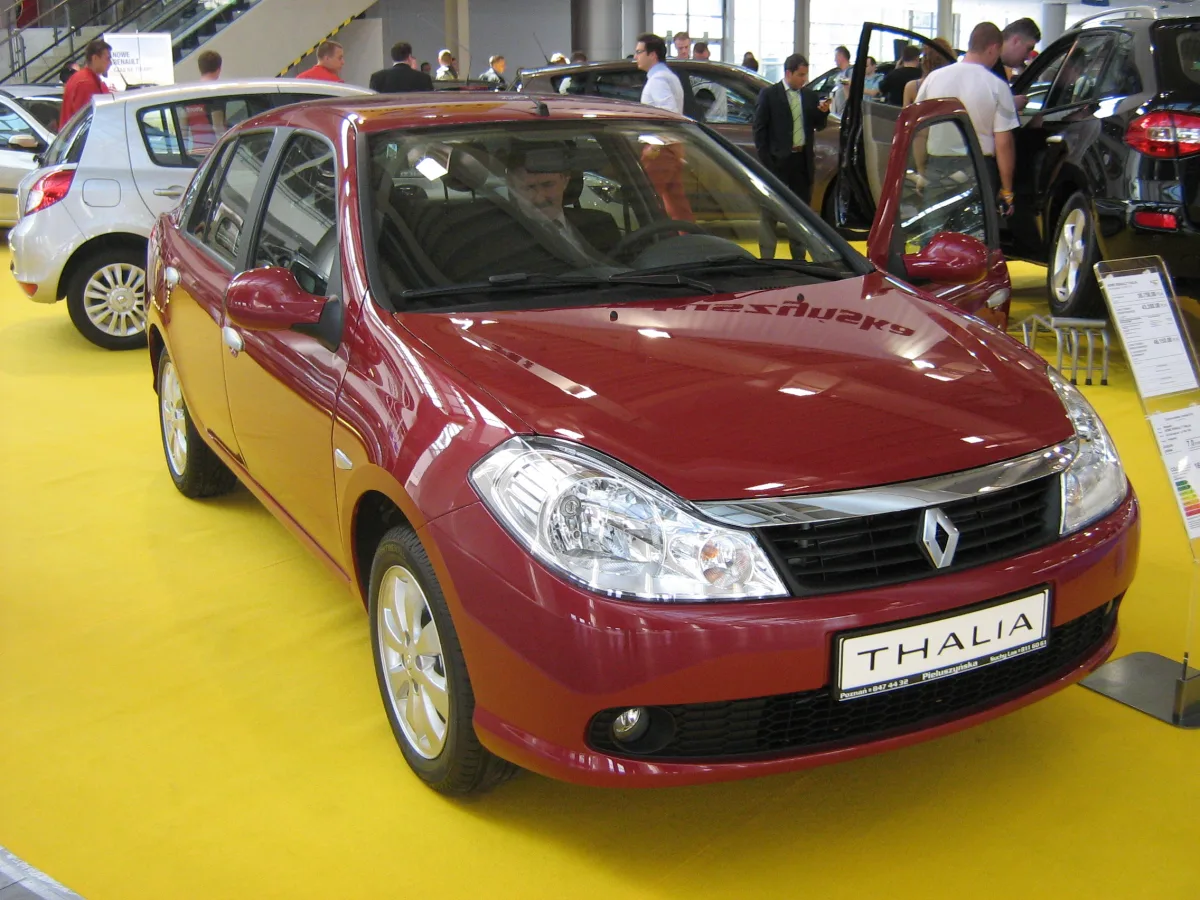
Renault Thalia: generations, engines and trims
The Renault Thalia is a compact sedan built on the Clio platform and primarily sold in Eastern Europe and other markets. We'll look at two generations, the most common engines, trims, and what to check before buying a used Thalia.






Thalia at a glance
The Thalia is an affordable, practical sedan built on the Clio platform. In some markets, it's sold as the Symbol, while in Eastern Europe, it goes by Thalia.
It's a simple, no-frills car that doesn't come with complex systems. Its advantage is the availability of spare parts, as many are shared with the Clio, but its downside is a more basic level of comfort and safety.
Generations — what's the difference
The first generation (1999–2008) was based on the Clio II. It's basic, with straightforward engines, but it's now quite old, so the key factors are its technical condition and body corrosion.
The second generation (2008–2013) was based on the Clio III and features a more modern design, better interior, and more safety equipment. In the used market, it's generally a better choice than the first generation.
Engines and gearboxes
The most common petrol engines are the 1.2 (in various power outputs), 1.4, and 1.6, plus there's a 1.5 dCi diesel engine, which is great for high-mileage drivers.
The gearbox is almost always manual, with automatics being rare. The exact engine lineup depends on the year and market.
What to check when buying a used Thalia
Inspect the body for corrosion, especially on the sills, wheel arches, and boot floor. Check for any amateur repairs after impacts.
Replace the engine timing belt according to the manufacturer's schedule; ask when this was last done. Check the diesel engine for turbocharger and injector issues.
Test drive the vehicle and brakes, as cars are often used intensively. Check the electrical equipment and air conditioning.


Trim levels
Names and equipment vary by market and year; we list the most common trims found in Europe.
Authentique
All generationsBase trim.
- Often comes with steel wheels
- Often — no air conditioning
- Standard safety equipment
Expression
All generationsMid-range trim with more comfort features.
- Often — air conditioning
- Electric windows
- Sound system with USB or CD
Dynamique
All generationsBetter-equipped version.
- Often — lightweight alloy wheels
- Often — dim headlights
- More spacious interior
Privilège
All generationsTop-of-the-range trim
- Often — leather steering wheel or upholstery
- Often — automatic air conditioning
- More safety and comfort features
Trim comparison
| Authentique | Expression | Dynamique | |
|---|---|---|---|
| Who it's for | Ideal for daily use | For everyday driving | For those seeking a better-equipped car |
| Alloy wheels (most often) | Steel | Steel | Light alloy |
| Air conditioning | Often isn't | Often is | There is |
| Price in the used market (relatively) | € | € | €€ |
Best bet is the better-equipped Expression or Dynamique with air conditioning. The base Authentique is only for those prioritising cost.
Pros
- A modest and practical sedan
- Simple technology, readily available parts
- Spacious boot for the class
- Low running costs
Cons
- More refined comfort and safety levels
- Some cars are very dated
- The sedan body is less versatile than a hatchback
Frequently asked questions
Is the Thalia the same as the Clio?
Built on the Clio platform and sharing many parts, the Thalia is nonetheless a distinct sedan model.
Which generation of Thalia is best?
Most often, the second generation (from 2008): it's more modern and better equipped. However, the first generation is cheaper, so when buying, consider the condition of the specific car.
Is the Thalia economical?
Most versions have small engines and consume little fuel, with the 1.5 dCi diesel being particularly economical.
Updated 2026-10-14 · Trim levels and equipment vary by market and model year — check the equipment of the specific car. · Translated automatically


