 English
 Lietuvių
 Latviešu
 Eesti
 Polski
 Русский
 Українська
 Deutsch
 Nederlands
 Čeština
 Slovenčina
 Svenska
 Norsk
 Dansk
 Suomi


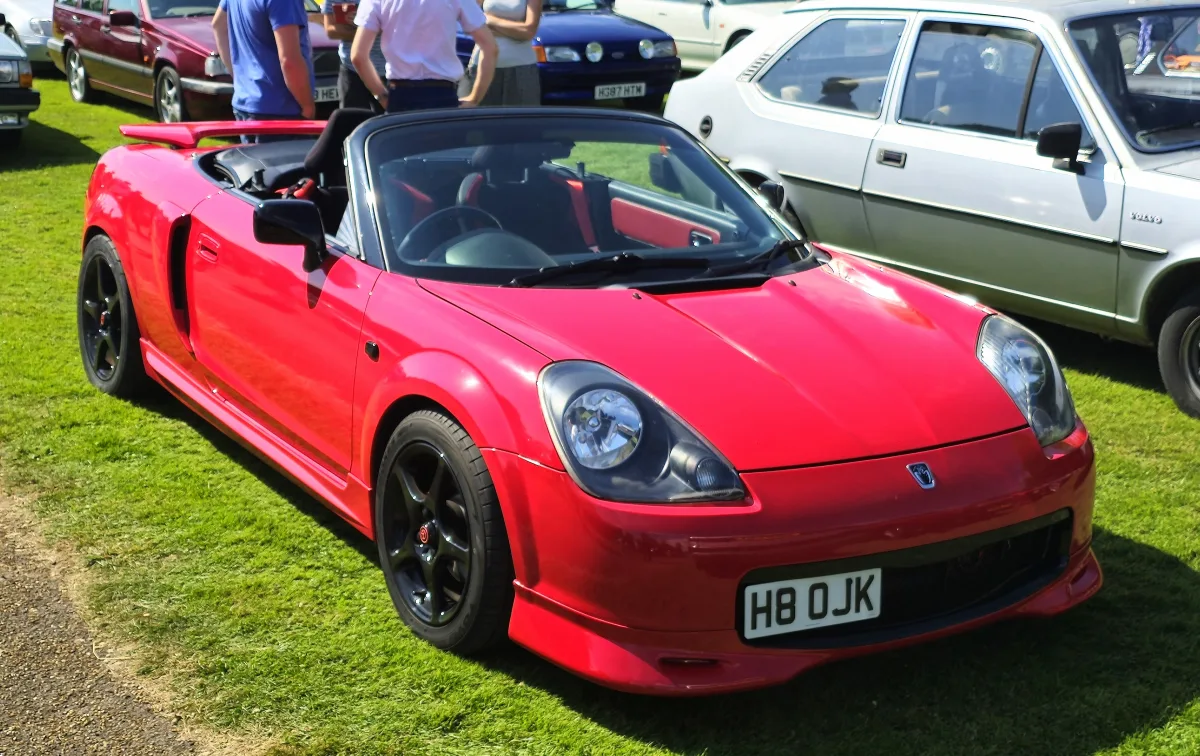
Toyota MR2: three generations, engines, and buying advice
The Toyota MR2 (1984–2007) — a two-seater sports car with a mid-engine layout. Produced in three generations: W10, W20, and W30. We'll look at their differences, engines, and what to check before buying.






MR2 in brief
The MR2 — a compact sports car with a rear-mounted engine, ensuring great balance and precise handling. All generations are two-seaters, with the latest (W30) being a roadster.
The model is praised for its driving pleasure and light weight, but it's not a practical car with minimal boot space.
Which one to choose
The W10 (1984–1989) — a lightweight, simple coupe with a 1.6-litre engine, now a collectible car. The W20 (1989–1999) — larger and more powerful, with 2.0-litre engines, including a turbo version.
The W30 (1999–2007) — a smaller, lighter roadster with a 1.8-litre VVT-i engine. It's more modern and easier to maintain, but less powerful than the W20 turbo.
Engines and transmissions
The W10 most commonly had a 1.6-litre petrol engine, the W20 a 2.0-litre petrol (naturally aspirated or turbo), and the W30 a 1.8-litre VVT-i.
Transmissions are manual, with the W30 also offering a semi-automatic (SMT) option.
What to check when buying a used MR2
Inspect the body thoroughly for signs of accidents, corrosion, and rust (especially on the roadster's roof). Many MR2s were tuned or driven aggressively.
Check the engine condition, transmission, clutch, and brakes. In the W20 version, pay attention to the rear suspension, while in the W30, check the oil level and engine operation.


Trims
Names and equipment vary by market and year; we list the trims most commonly found in Europe.
W10 1.6
W10The first generation is a lightweight coupe with a 1.6-litre engine.
- 1.6-litre petrol engine
- Simple, lightweight construction
- Often comes with a removable roof
W20 2.0
W20The more powerful second generation with a 2.0-litre engine.
- 2.0-litre petrol engine
- Often features a sporty style
- Often comes with a removable roof panel
W20 Turbo
W20Turbo version with increased power.
- 2.0-litre turbo engine
- Often — sporty interior
- Often — larger wheels
W30 1.8
W30Roadster with 1.8 l VVT-i engine.
- 1.8 l VVT-i engine
- Convertible roadster roof
- Often — SMT gearbox
Version comparison
| W10 1.6 | W20 2.0 | W30 1.8 | |
|---|---|---|---|
| Who it's for | For classic car enthusiasts | For sporty driving | For open-top driving |
| Engine | 1.6 l | 2.0 l | 1.8 l VVT-i |
| Body | Coupe | Coupe | Roadster |
| Price in the used market (relatively) | €€ | €€ | €€ |
W30 — modern and easier to maintain, W20 — more powerful, W10 — classic. The choice depends on the purpose, but the most important thing is a well-maintained example.
Pros
- Excellent balance and precise handling
- Lightweight and lively dynamics
- Toyota's reputation for reliability
- Unconventional mid-engine layout
Cons
- Impractical — small boot and only two seats
- Many examples have been tuned or driven aggressively
- The price of well-preserved examples can be high due to collectability
Frequently asked questions
Which MR2 generation is the best?
W30 — easiest to maintain and more modern, W20 — more powerful, and W10 — classic. It all depends on your needs.
Is the MR2 suitable for daily driving?
Often just as a second car — it has only two seats and a small boot.
Is the MR2 reliable?
Toyota's engineering is considered robust, but it largely depends on the previous owner and service history.
Updated 2026-10-09 · Trim levels and equipment vary by market and model year — check the equipment of the specific car. · Translated automatically


