 English
 Lietuvių
 Latviešu
 Eesti
 Polski
 Русский
 Українська
 Deutsch
 Nederlands
 Čeština
 Slovenčina
 Svenska
 Norsk
 Dansk
 Suomi


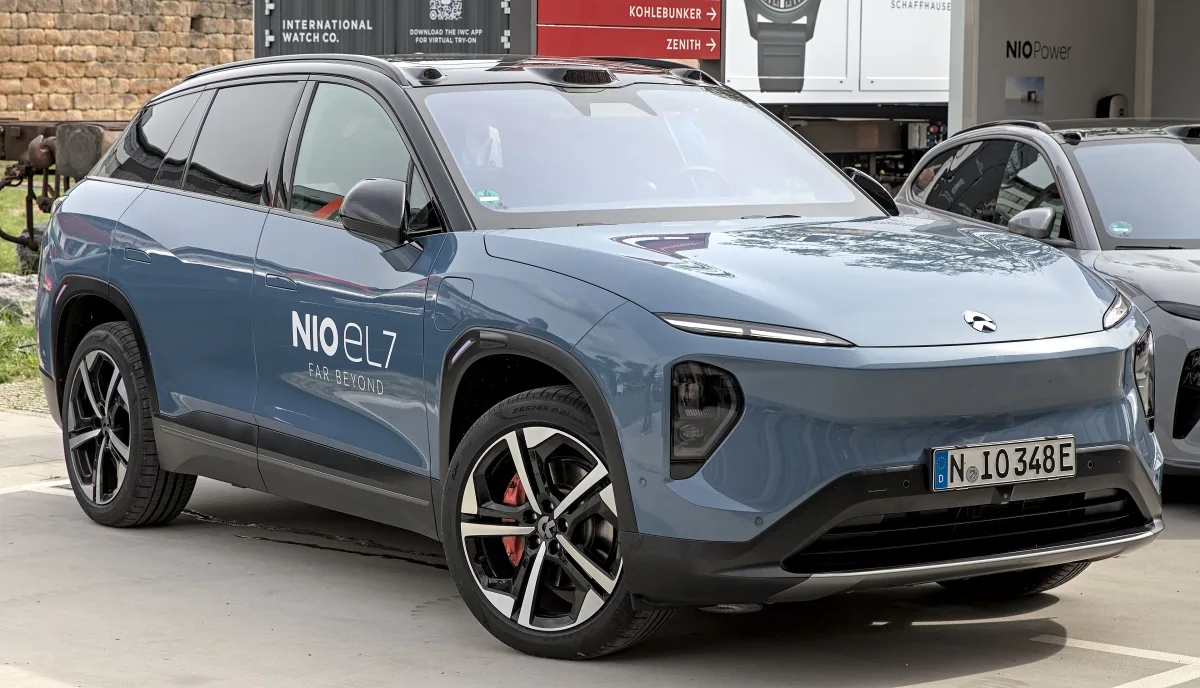
NIO ES7 (EL7): batteries, engines, and what to know when buying
The NIO ES7 is a mid-sized electric SUV launched in 2022, sold in Europe as the EL7. We look at the differences between battery versions, how the swappable battery works, and what to check before buying such a car in Lithuania.






ES7 in brief
The NIO ES7 is a five-door electric crossover from Chinese manufacturer NIO, launched in 2022 as the first model on the NT 2.0 platform. The car is roughly 4.9 m long, with a wheelbase of about 2.97 m, making it comparable in size to mid-sized luxury SUVs. The body and chassis are largely made of aluminium.
In Europe, the model is sold as the NIO EL7. Standardly, it comes with a dual-motor all-wheel drive and pneumatic suspension. A unique NIO feature is the swappable battery: at compatible stations, it can be swapped for a fully charged one instead of a lengthy recharge.
Versions — what's the difference
The ES7 is produced in one generation, so the main difference between cars is battery capacity. In China, 75, 100, and 150 kWh batteries were offered, but the choice is narrower in Europe. The largest capacity battery is rarer and more expensive.
NIO regularly updates the software of its cars over the air, so the feature set of cars from different years can vary more than usual. Before buying, check what software is installed and if it still receives updates.
Engines, battery, and charging
The ES7 has two electric motors: a front one (around 180 kW) and a rear one (around 300 kW). Combined power is about 480 kW (roughly 650 hp), and the manufacturer quotes a 0-100 km/h time of around 3.9 seconds. There's no traditional gearbox — a single-speed transmission is used.
The driving range depends on the battery. Manufacturer figures are often given according to China's CLTC cycle, which is more optimistic than the WLTP used in Europe, so take the real-world range with a pinch of salt. The network of battery swap stations in Europe is much smaller than in China, so check the nearest station in advance.
What to check when buying a used ES7
First, find out if the battery is owned by the car's owner or leased under a separate contract. NIO offers both options, and a leased battery and its allocation might be tied to the first owner — discuss transfer conditions in writing.
Request a battery condition report and charging and battery swap history. Check the air suspension (whether the car doesn't sag when parked), charging port, body panels for signs of accidents, and the operation of all electronic systems. There might not be official service in Lithuania, so before buying, find out who will service the car and where parts will come from.


Versions by battery
Names and possible versions vary by market and year; the ES7 isn't as clearly segmented by trim levels in Europe as conventional cars, so we list versions by battery.
75 kWh
from 2022The smallest capacity battery — the cheapest and lightest option.
- Dual-motor all-wheel drive
- Air suspension
- Often — a shorter range than with a 100 kWh battery
100 kWh
from 2022The go-to choice for longer journeys.
- Dual-motor all-wheel drive
- Replaceable battery
- Often — a longer range
150 kWh
Chinese marketThe largest battery, rarely seen in Europe.
- Significantly longer range according to the manufacturer's specs
- Dual-motor all-wheel drive
- Often — a heavier and pricier hit
EL7
European marketThe ES7 version tailored for European markets.
- Adapted to European market requirements
- Dual-motor all-wheel drive
- Often — the standard CCS2 charging connector in Europe
Battery version comparison
| 75 kWh | 100 kWh | 150 kWh | |
|---|---|---|---|
| Who it's for | City driving and short trips | Versatile use | Long distances |
| Battery | 75 kWh | 100 kWh | 150 kWh |
| Engines | Two engines, all-wheel drive | Two engines, all-wheel drive | Two engines, all-wheel drive |
| Used market availability | Limited | Limited | Very limited |
| Price in the used market (relatively) | €€ | €€€ | €€€ |
For most buyers, the mid-range battery is the sweet spot: it offers a decent range without breaking the bank. The key is not the version, but clear documentation for the battery and servicing.
Pros
- Spacious, luxuriously appointed interior
- Powerful all-wheel electric drive
- Pneumatic suspension as standard
- Option to swap battery instead of charging
Cons
- Limited service and battery replacement network in Europe
- Unclear resale value
- Issues with battery leasing and subscription tie-ins
Frequently asked questions
Is the ES7 and EL7 the same car?
Essentially, yes. The EL7 is the name for the European market, while ES7 is the name used in China. Specific specifications may vary slightly by market.
Can the ES7 be charged at regular charging stations?
Yes, the car can be charged at traditional charging stations. Battery swap stations are an additional option but are not mandatory.
What should you be most wary of when buying a used ES7?
Unclear battery ownership and hard-to-reach servicing. Before purchasing, clarify the battery agreement and where the car will be serviced.
Updated 2026-10-21 · Trim levels and equipment vary by market and model year — check the equipment of the specific car. · Translated automatically


