 English
 Lietuvių
 Latviešu
 Eesti
 Polski
 Русский
 Українська
 Deutsch
 Nederlands
 Čeština
 Slovenčina
 Svenska
 Norsk
 Dansk
 Suomi


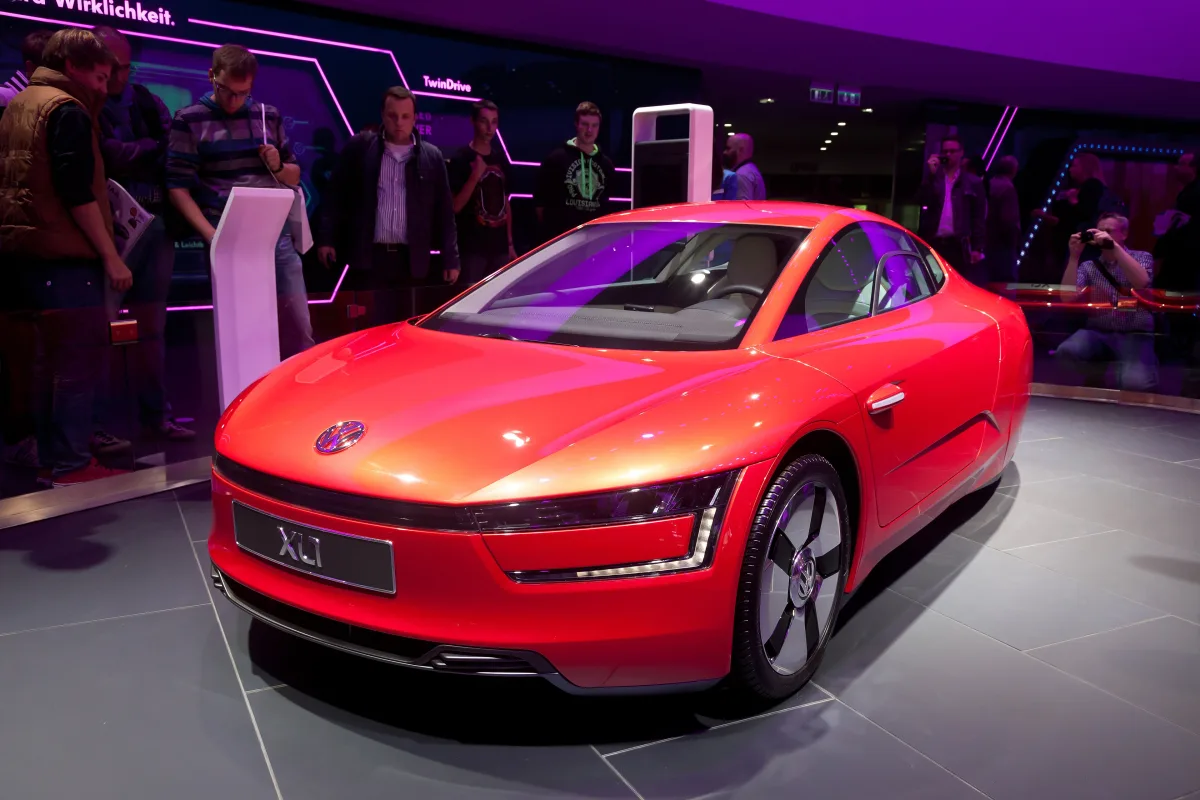
Volkswagen XL1: an incredibly economical plug-in hybrid worth knowing about
Volkswagen XL1 — a two-seater plug-in hybrid produced in very limited numbers (around 250 units) between 2013 and 2016. Thanks to its aerodynamic shape and lightweight carbon fibre construction, it consumes around 1 litre of diesel per 100 km. It's a collector's item, not your typical used car.






XL1 in brief
The XL1 was created to showcase just how economical a car Volkswagen could build. It's a two-seater, with passengers sitting side by side (the seats are slightly offset), a carbon fibre body, and doors that open upwards like wings.
The drag coefficient is incredibly low (around 0.19), and the car weighs approximately 795 kg. Instead of conventional exterior mirrors, cameras are used, and the tyres are very narrow to reduce drag.
Engines and transmission
The engine is a 0.8-litre twin-cylinder turbodiesel (around 48 hp), paired with an electric motor (around 27 hp). Combined power is approximately 69 hp. The transmission is a 7-speed DSG, with power sent to the rear wheels.
A lithium-ion battery of around 5.5 kWh allows for approximately 50 km of electric-only range. Top speed is around 160 km/h. Official fuel consumption is around 0.9–1.0 litres per 100 km.
The XL1 in daily use
The XL1 is more suited to demonstrations and collecting than daily use: the boot is small, the ride height is low, and the seats are close together. However, it is legally roadworthy and comes with all the necessary safety features.
Due to limited production runs and a unique design, repairs and parts are only available through the official Volkswagen network or specialist collector services.
What to check when buying an XL1
The most important thing is the car's provenance and documentation. Since only around 250 units were made, each one's history must be verified: VIN, ownership, service history, and whether the original documents are present.
Before buying, consult with a specialist who knows the XL1 construction: battery condition, hybrid system operation, carbon fibre body damage, and camera mirror functionality are key inspection points.
The car is very rare, so it's unlikely to find it listed at a typical price — valuation depends on the collector market.


Trim levels
The XL1 was produced in just one technical specification, so there was practically no choice of trim levels.
XL1
2013–2016The sole production version: plug-in hybrid with a carbon fibre body.
- 0.8-litre two-cylinder turbodiesel + electric motor
- 7-speed DSG, rear-wheel drive
- Scissor doors (open upwards), cameras instead of mirrors
XL1 comparison with conventional cars
| XL1 | Kompaktinis dyzelis | Miesto elektromobilis | |
|---|---|---|---|
| Who it's for | Collectors and enthusiasts | Everyday use | Short city distances |
| Number of seats | 2 | 5 | 4–5 |
| Gearbox | Plug-in hybrid (0.8 l TDI + electric motor) | Diesel engine | Electric only |
| Price in the used market (relatively) | €€€ | € | €€ |
The XL1 is a collector's item, not a practical daily driver. It's worth buying only if you know its value and have the means to maintain it at a specialist service.
Pros
- It boasts incredibly low fuel consumption — around 1 l/100 km
- Unique carbon-fibre construction and aerodynamics
- Extremely limited production run — a collector's item
- Can travel up to 50 km on electric power alone
Cons
- Just two seats and limited boot space
- Spare parts and repairs can be hard to come by
- Very few examples available on the market
Frequently asked questions
How many XL1s were produced?
Around 250 units were made in total, with some being bought back by the manufacturer. This makes it one of the rarest Volkswagen models.
What are the XL1's fuel consumption figures?
Officially, it's around 0.9–1.0 l/100 km in mixed driving. Real-world consumption depends on battery charge and driving style.
Is the XL1 suitable for daily use?
Theoretically, yes, as it has all the necessary certifications for the road. However, the two-seater cabin, limited boot space, and high maintenance costs make it less practical than a conventional car.
Updated 2026-10-14 · Trim levels and equipment vary by market and model year — check the equipment of the specific car. · Translated automatically


