 English
 Lietuvių
 Latviešu
 Eesti
 Polski
 Русский
 Українська
 Deutsch
 Nederlands
 Čeština
 Slovenčina
 Svenska
 Norsk
 Dansk
 Suomi


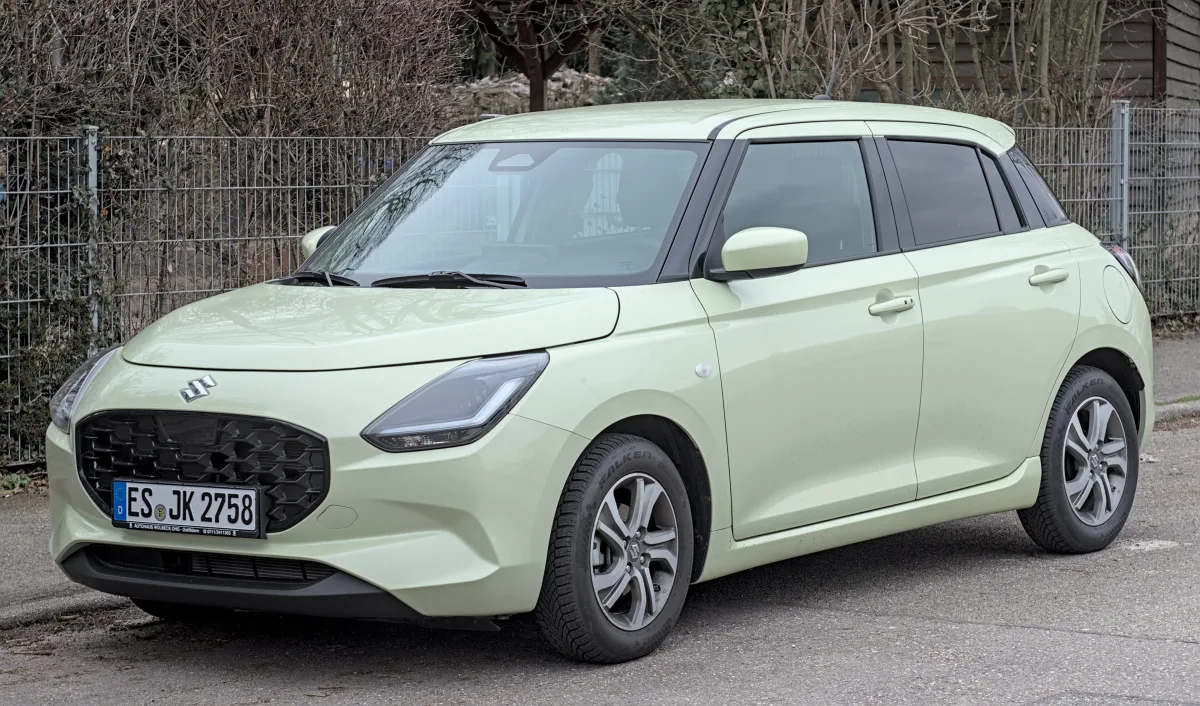
Suzuki Swift: generations, engines, and trims comparison
The Suzuki Swift is a compact, lightweight, and frugal city hatchback, appreciated in Lithuania for its mechanical simplicity and low running costs. We review how the newer Swift generations differ, which engines are the most popular, how trim levels vary, and what to check when buying a used one.






Swift at a glance
The current Swift has been produced as a global model since 2004, and sold in Europe since 2005. Four generations have been released so far: 2005–2010, 2010–2017, 2017–2024, and the latest from 2024 onwards. Most European cars are 5-door hatchbacks, though the two older generations were also offered as 3-doors.
The Swift is prized for its low weight, frugal petrol engines, and straightforward, reliable mechanics. A rarer feature in its class is the all-wheel-drive system available on certain versions (known as ALLGRIP in newer generations), making the Swift popular among those who frequently drive on gravel roads or snow. Alongside the regular versions, there has always been a sporty Swift Sport.
Which generation to choose
The 2010–2017 generation retained its predecessor's styling, but became more spacious and better equipped. It remains a common budget choice: most of these cars feature the 1.2-litre petrol engine, which is regarded as reliable and inexpensive to maintain.
The 2017–2024 generation is built on a new, lighter platform—the car weighs under a tonne, meaning even low-output engines feel adequate. Mild-hybrid (SHVS) versions appeared in this generation, along with driver assistance systems in higher trim levels. This is the most popular generation on the used market.
The latest generation (from 2024) is technically close to the previous one, but features a new three-cylinder engine with a mild-hybrid system and a more modern interior. Such cars are still rare on the used market, which keeps their prices higher.
Engines and transmissions
The 2010–2017 Swift typically features a 1.2-litre petrol engine (approx. 94 hp) and, more rarely, a 1.3 DDiS diesel. The Swift Sport from that generation used a 1.6-litre naturally aspirated engine (approx. 136 hp).
In the 2017–2024 generation, the main engines are the 1.2 Dualjet (approx. 90 hp) and the turbocharged 1.0 Boosterjet (approx. 111 hp), frequently paired with the SHVS mild-hybrid system. Following the 2020 facelift, the European lineup was mostly streamlined to the 1.2 Dualjet Hybrid (approx. 83 hp). The Swift Sport packs a 1.4 Boosterjet engine (approx. 140 hp, and from 2020 with a 48V mild hybrid, approx. 129 hp). The latest generation features a 1.2-litre three-cylinder mild hybrid (approx. 82 hp).
Most Swifts come with a manual gearbox. Automatics are usually traditional torque-converters in older generations, CVT units in newer ones, while some 2017–2024 versions were fitted with the AGS automated manual gearbox.
What to check when buying a used Swift
On older cars, inspect the bodywork first: sills, wheel arches, and the underbody—older Swifts can rust in the Lithuanian climate. During the test drive, make sure the clutch does not slip and that gears engage smoothly and without crunching.
On 1.3 DDiS diesel cars driven heavily in urban environments, check the particulate filter (DPF) and the dual-mass flywheel. The AGS automated manual shifts slower with a brief pause—that is just how it operates, but hesitation or jerky pull-aways could signal expensive repairs.
On mild-hybrid (SHVS) cars, check if the automatic start-stop system works—if it doesn't, failing batteries are often to blame. Verify the mileage using MOT and service records, and check the body for painted panels and uneven panel gaps.


Trim levels
Trim names vary by country: in Germany and many European countries, they are Club, Comfort, and Comfort+, while in the UK they are SZ3, SZ-T, and SZ5. Below are the most common trims for the 2017–2024 generation and the Swift Sport.
Club
2017–2024 generationEntry-level trim — basic, but comes with essential conveniences.
- Usually steel wheels
- Air conditioning and basic audio system
- Electric front windows
Comfort
2017–2024 generationThe most popular choice — more equipment for a sensible price.
- Alloy wheels
- Often includes a touchscreen infotainment system and reversing camera
- Often features automatic climate control
Comfort+
2017–2024 generationThe top regular trim packed with the most equipment.
- Often features LED headlights
- Often includes navigation and keyless entry
- Often equipped with adaptive cruise control and autonomous emergency braking systems
Swift Sport
2010–2017 and 2017–2024 generationsSporty version with a punchier engine and stiffer suspension.
- 2010–2017 model used a 1.6-litre naturally aspirated engine, later replaced by the 1.4 Boosterjet
- 17-inch alloy wheels and sports seats
- Often features LED headlights and exclusive styling accents
2017–2024 generation trim comparison
| Club | Comfort | Comfort+ | Sport | |
|---|---|---|---|---|
| Who it is best for | Budget daily driving | Most buyers | Tech and features enthusiasts | Driving enjoyment |
| Wheels (typically) | 15 in. | 16 in. | 16 in. | 17 in. |
| Headlights | Halogen | Mostly halogen | Often LED | LED |
| Engine | 1.2 Dualjet | 1.2 Dualjet, 1.0 Boosterjet | 1.2 Dualjet, 1.0 Boosterjet | 1.4 Boosterjet |
| Used market price (relative) | € | €€ | €€ | €€€ |
For most buyers, the Comfort trim with the 1.2 Dualjet or 1.0 Boosterjet engine is the sweet spot. Comfort+ is worth going for if you want LED headlights and driver assists, while the Swift Sport is the pick if you're after a lightweight, fun-to-drive hatch.
Pros
- Low fuel consumption and running costs
- Lightweight, agile and city-friendly
- Simple, dependable mechanics
- All-wheel drive available on certain versions
Cons
- Small boot
- Lots of hard plastic in the cabin, gets noisy at motorway speeds
- Older examples can be prone to rust
Frequently asked questions
Which Swift generation is the best buy used?
For most buyers, the 2017–2024 generation is the top pick: it's light, frugal and much more modern inside. If you're on a tight budget, look for a 2010–2017 Swift with the 1.2 petrol engine and a solid service history.
What is the Swift SHVS?
SHVS is a mild-hybrid system featuring a compact integrated starter-generator and a secondary battery. It assists the engine under acceleration and slightly cuts fuel use, though it can't drive on pure electric power and doesn't need to be plugged in.
Is the Swift good for long road trips?
It's up for it, but remember it's a compact city car: motorway noise is more noticeable, and the boot is small. Four adults will manage fine for shorter journeys, but for long trips with luggage, you'll be happier in something larger.
Is the Swift Sport worth buying?
Definitely, if you're after a lightweight hot hatch that's a blast to drive. The Swift Sport is quicker and stiffer than standard models, so its ride can feel firm on rough daily commutes.
Updated 2026-10-09 · Trim levels and equipment vary by market and model year — check the equipment of the specific car. · Translated automatically


