 English
 Lietuvių
 Latviešu
 Eesti
 Polski
 Русский
 Українська
 Deutsch
 Nederlands
 Čeština
 Slovenčina
 Svenska
 Norsk
 Dansk
 Suomi


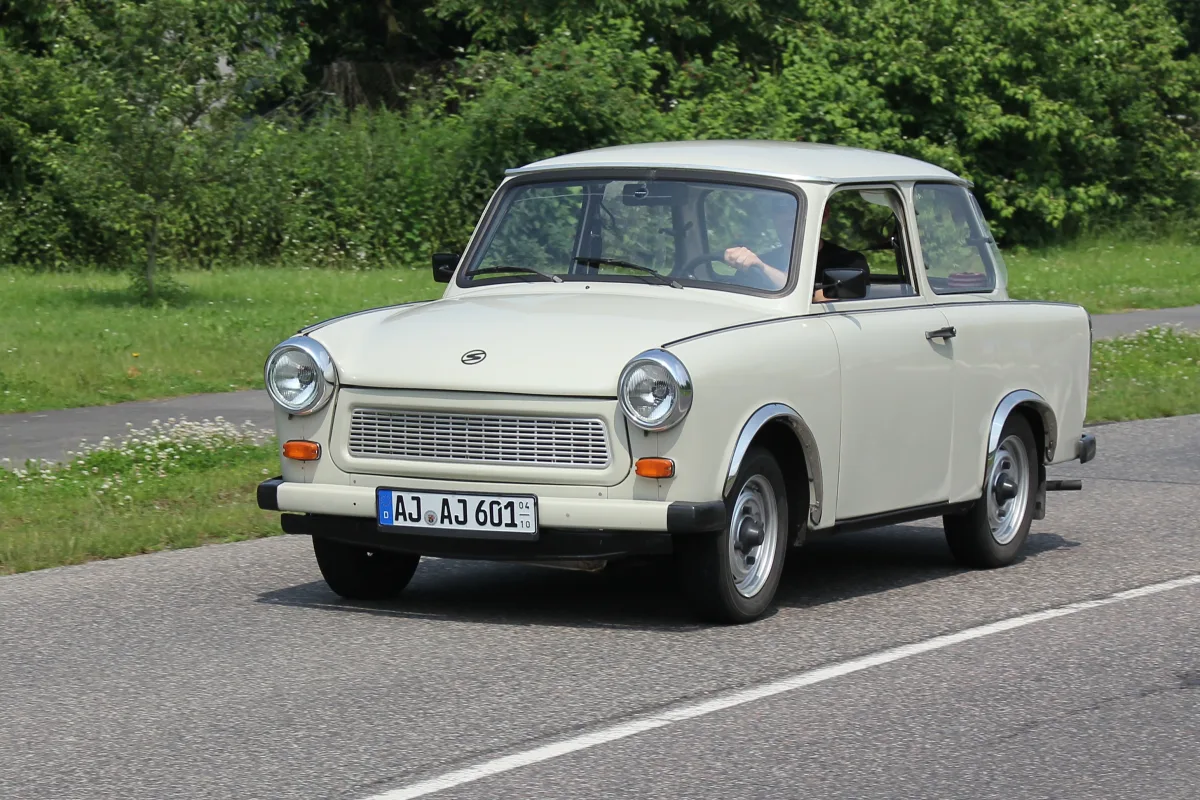
Trabant 601: East German legend, variants and what to know when buying
The Trabant 601 — a car produced by the East German factory Sachsenring Zwickau (1964–1990), becoming one of the most recognisable symbols of the socialist bloc. In this article, we look at its versions, engine, and what you need to know when buying this classic car.






The Trabant 601 in brief
The Trabant 601 — a small two-door car with front-wheel drive and a two-stroke engine. The body is made from 'Duroplast' — a composite of resin and cotton fibre, so it doesn't rust like steel.
The car was produced with barely any changes for nearly 25 years. Today, it's valued for its historical significance, simplicity, and for providing insight into the automotive industry behind the Iron Curtain.
Body variants
The most common variant is the two-door saloon (Limousine). There was also an estate (Kombi, Universal), a convertible Tramp, and a military version, the Kübel.
Cars from different years differ in minor details — interior, some mechanical parts, so it's worth identifying the exact version by production year and documents.
Engine and gearbox
The Trabant 601 has a two-cylinder two-stroke engine (around 600 cm³, around 26 hp). Fuel is mixed with oil — usually about 1:50.
The gearbox is a 4-speed manual, with front-wheel drive. Top speed is around 100 km/h, so it's not a motorway car, but one for relaxed driving.
What to check when buying a used Trabant 601
Check the metal frame and platform — although the body is made of composite, corrosion can damage the underside and running gear. Also, inspect the composite body for cracks, signs of repair, and paint condition.
Check the engine operation, exhaust, suspension, gearbox, and electrical equipment. A two-stroke engine will smoke, which is normal, but excessively thick smoke can indicate wear.
Parts selection is good due to active clubs and suppliers in Germany and other countries. The most important thing is the car's documentation and condition.


Trim levels
Names and equipment vary by market and year; we list the versions most commonly found in Europe.
Standard / Limousine
601The most basic sedan version.
- Basic trim
- Two-stroke engine
- Four-speed manual gearbox
601 S
601Better-equipped version with more trim.
- More trim
- Often — chrome details
- Often — a more comfortable interior
Kombi / Universal
601Estate with a larger boot.
- Larger boot
- Same engine technology
- More practical family version
Kübel / Tramp
601Special open-top versions.
- Convertible
- Rarer and collector's item
- Basic weather protection
Version comparison
| Limousine | 601 S | Kombi | Kübel/Tramp | |
|---|---|---|---|---|
| Who it's for | The start of the classics | For comfort | For practicality | For collectors |
| Body | Saloon | Saloon | Universal | Convertible |
| Price in the used market (relatively) | € | € | €€ | €€€ |
Most buyers will be happy with a well-maintained sedan. The estate is more practical, while the Kübel or Tramp are for collectors.
Pros
- Simple technology that can be fixed with your own hands
- Composite body
- Active clubs and parts suppliers
- Historical and nostalgic value
Cons
- Very modest performance figures
- Two-stroke engine smoke and fuel mixture
- Low safety and comfort
Frequently asked questions
What engine does the Trabant 601 have?
A two-cylinder, two-stroke engine, around 600 cm³ and around 26 hp.
Is the Trabant rusty?
The composite body doesn't rust, but corrosion can damage the metal chassis and running gear.
Is the Trabant suitable for daily use?
A well-maintained one can run, but it's a slow car with minimal safety, so it's better suited for leisurely drives and shows.
Updated 2026-10-21 · Trim levels and equipment vary by market and model year — check the equipment of the specific car. · Translated automatically


