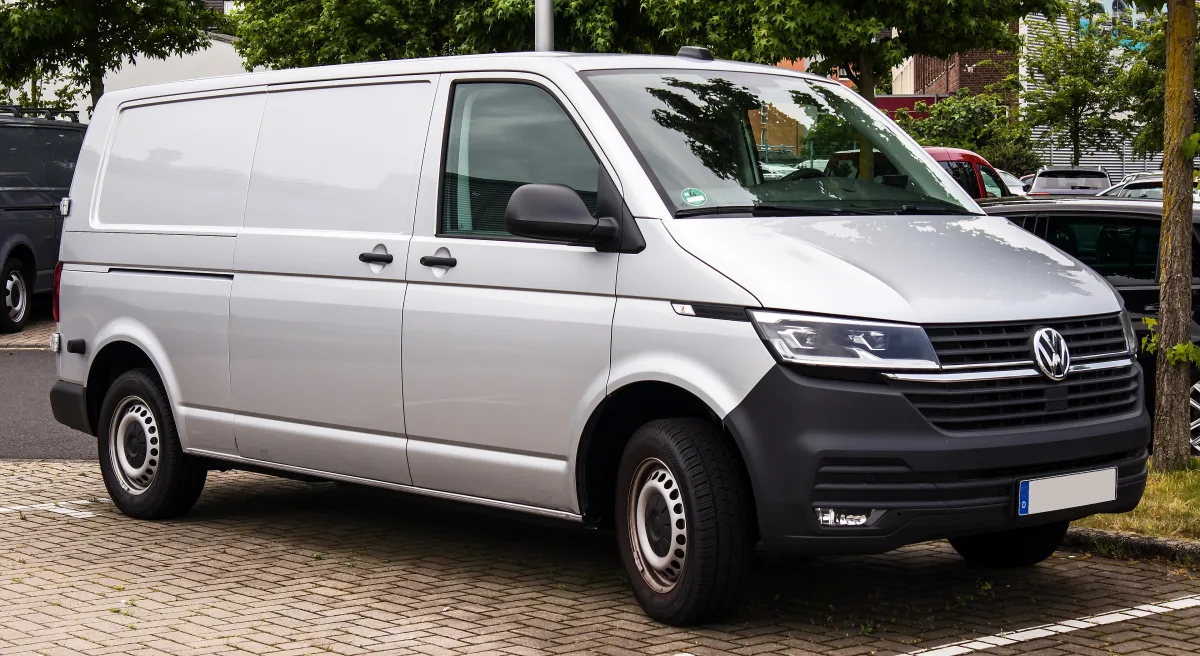
Volkswagen Transporter: T5, T6 and T6.1 generations, engines and versions
The Volkswagen Transporter is one of Europe's most popular mid-size vans and a common choice for Lithuania's small businesses. We look at how the T5, T6 and T6.1 generations differ, which engines and body versions are most common, and what to check when buying a used work van.
ADVERTISEMENT
Transporter at a glance
The Transporter has been built since 1950, and the T5, T6 and T6.1 generations are the ones most commonly found on the used market. It's a mid-size van with front-wheel drive; on many versions, all-wheel drive 4MOTION was also offered at extra cost.
The main body versions are the panel van, the cargo-passenger Kombi, the passenger Caravelle and the chassis cab (dropside). There are two wheelbases — short and long — plus several roof heights. Payload depends on the version and usually comes to around a tonne.
The Transporter is praised for its car-like driving feel, high-quality cabin and strong value retention. As a result, it usually costs more on the used market than rivals of a similar age.
Which generation to choose
The T5 (2003–2015) is the cheapest option today, but most examples have already covered a lot of miles. The facelifted T5 from 2009 gained more modern 2.0 TDI common rail engines and a DSG gearbox, so those are the ones worth going for.
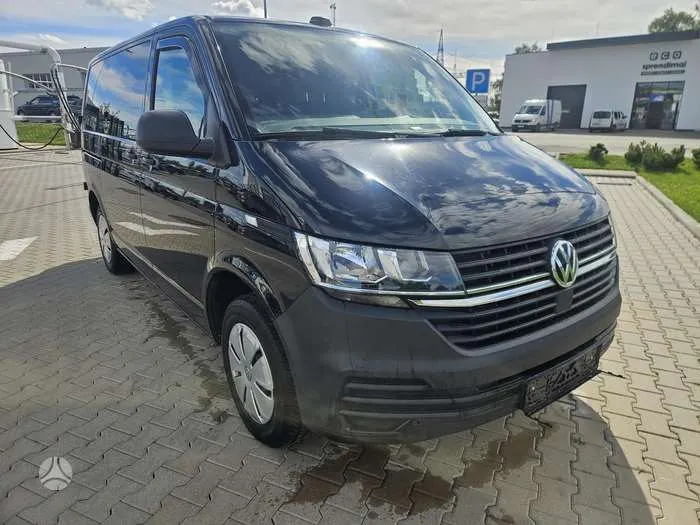
The T6 (2015–2019) is technically close to the T5 but has newer Euro 6 engines, an updated cabin and more safety equipment. The T6.1 (from 2019) stands out with a new front end, often a digital instrument cluster, electric power steering and more driver-assistance systems — it's the most popular choice if the budget allows.
The new Transporter unveiled in 2024 was developed together with Ford and is technically closely related to the Ford Transit Custom. There are still few of them on the used market, so for most buyers the T6 and T6.1 are the most relevant.
Engines and gearboxes
Early T5s had 1.9 TDI and five-cylinder 2.5 TDI diesels. After the 2009 facelift, the mainstay was the 2.0 TDI, whose output depending on version ranges from around 84 to 180 hp (the most powerful with twin turbochargers).
The T6 and T6.1 use only 2.0 TDI diesels: T6 about 84–204 hp, T6.1 usually 90, 110, 150 and 199 hp. Euro 6 versions have an AdBlue system. Petrol engines exist, but they are rare in Lithuania.
Gearboxes are manual (5- or 6-speed) or 7-speed DSG. DSG is more often found with more powerful engines and 4MOTION all-wheel drive.
What to check when buying a used Transporter
Mileage on work vehicles is often high, so check it against the inspection and service records. With a manual gearbox, ask about the clutch and dual-mass flywheel — vibration when pulling away or a knock at idle often means they need replacing. The DSG should shift smoothly, without jerking.
On diesels that have done a lot of city driving, check the diesel particulate filter (DPF), EGR valve and — on Euro 6 versions — the AdBlue system. On T5s, inspect rust particularly carefully: lower door edges, sliding-door tracks, wheel arches and the underbody.
Inspect the cargo area: dented panels, worn floors and sagging sliding doors indicate hard use. If the vehicle has been converted (passenger, camper), make sure the changes are registered.
ADVERTISEMENT
Body styles
Body styles, lengths, heights and equipment vary by market and model year; we list the versions most commonly found in Europe.
Furgonas
T5, T6, T6.1
The most common version is the panel van with a bulkhead behind the cab.
Short or long wheelbase
Often with sliding doors on one or both sides
Rear barn doors or a tailgate
Kombi
T5, T6, T6.1
Cargo-passenger variant with removable seats.
Usually up to 9 seats
Simple, practical interior trim
Often with windows all round
Caravelle
T5, T6, T6.1
Passenger minibus with a more comfortable cabin.
Usually 8–9 seats
Better sound insulation and trim
Often with separate cabin heating and air conditioning
Važiuoklė su kabina
T5, T6, T6.1
Base for a dropside body or specialist bodywork.
Single-cab or double-cab versions
Often with a dropside body
Suitable for specialist bodywork
4MOTION
T5, T6, T6.1
All-wheel-drive version for tougher conditions.
All-wheel drive
Often with the more powerful 2.0 TDI and DSG
Some with a rear differential lock
T6 and T6.1 body-style comparison
Furgonas
Kombi
Caravelle
Važiuoklė su kabina
What it's best for
Carrying cargo
Crew transport
Carrying passengers
Construction, specialist bodywork
Number of seats (usually)
2–3
Up to 9
8–9
2–3, double cab — up to 6
Passenger compartment or cargo area
Enclosed cargo area
Removable seats, basic trim
Comfortable cabin
Open dropside or body conversion
Engine
2.0 TDI
2.0 TDI
2.0 TDI, often more powerful
2.0 TDI
Used market price (relative)
€
€€
€€€
€
For most buyers, the best choice for work is a T6 or T6.1 van with the 110–150 AG 2.0 TDI. The Kombi works when you need to carry both people and cargo, while the Caravelle is for passengers.
Pros
Car-like driving feel
High-quality, comfortable cabin
Holds its value well
Available with 4MOTION all-wheel drive
Cons
More expensive on the used market than its rivals
Smaller cargo area than full-size vans
Older T5s are prone to rust
Frequently asked questions
Which Transporter generation is the best used buy?
For most buyers, the best choice is a T6 or T6.1: more modern engines, more safety equipment and often lower mileage. A T5 is worth considering only after the 2009 facelift and only with a clear service history.
What's the difference between the Transporter, Caravelle and Multivan?
The Transporter is a commercial vehicle (van, Kombi or chassis cab), the Caravelle is a passenger minibus for work and carrying passengers, while the Multivan is the most comfortable option, aimed more at personal use, with a flexible cabin.
Which Transporter engine should you choose?
For work, a 110–150 AG 2.0 TDI is usually enough. The weakest engines can feel too sluggish in a loaded vehicle, while the most powerful are more expensive and more often paired with DSG or 4MOTION.
Can you drive a Transporter with a category B licence?
Yes. The Transporter's gross vehicle weight does not exceed 3,5 t, so it can be driven with a category B driving licence.
Updated 2026-10-09 · Trim levels and equipment vary by market and model year — check the equipment of the specific car. · Translated automatically
Comments
No comments about the Volkswagen Transporter yet. Share your experience.
We use necessary cookies to run the website. With your consent, we will also use analytics and advertising measurement cookies — to understand how the website is used and to measure our advertising results. Learn more
 English
 Lietuvių
 Latviešu
 Eesti
 Polski
 Русский
 Українська
 Deutsch
 Nederlands
 Čeština
 Slovenčina
 Svenska
 Norsk
 Dansk
 Suomi


 4