 English
 Lietuvių
 Latviešu
 Eesti
 Polski
 Русский
 Українська
 Deutsch
 Nederlands
 Čeština
 Slovenčina
 Svenska
 Norsk
 Dansk
 Suomi


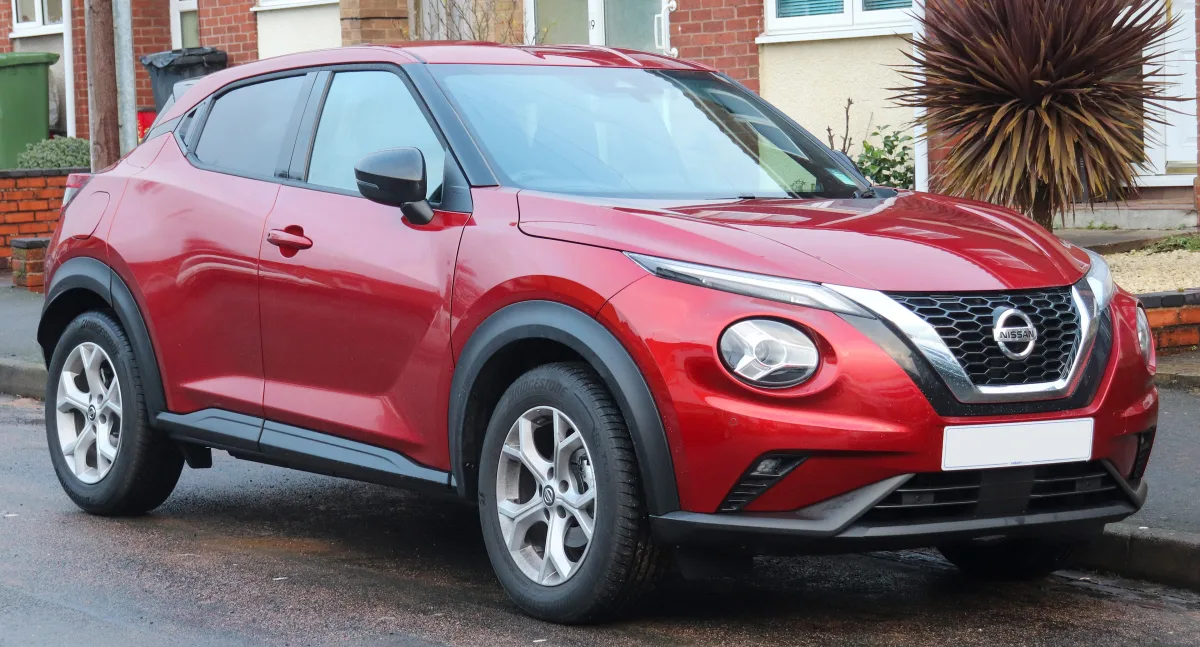
Nissan Juke: F15 and F16 generations, engines and trims
The Nissan Juke is a compact, distinctive-looking city SUV that's commonly found in Lithuania's used-car market. We're taking a look at the F15 and F16 generations, engines, gearboxes, trims, and what to check when buying a used Juke.






The Juke in brief
The Juke debuted in 2010 and was one of the first small city SUVs in Europe. The first generation (F15) was produced until 2019, with the second (F16) launching from the end of 2019. Juke models destined for Europe are built at Nissan's Sunderland plant in the UK.
The Juke is bought for its looks, high driving position, and compact dimensions that make it practical in the city. However, it's not a spacious family car: particularly the F15's rear seats and boot are quite cramped.
F15 vs F16 — what's the difference
The F15 (2010–2019) is the most widely available Juke today. The 2014 facelift brought new headlights, a larger boot, and the 1.2 DIG-T engine. Four-wheel drive is available in this generation, but only with the most powerful engine and an automatic gearbox.
The F16 (from 2019) is built on the same platform as the Renault Clio and Captur. It's larger, more spacious, has a significantly bigger boot, and comes with more modern safety systems. The 2024 facelift brought a larger infotainment screen and an improved interior.
Engines and gearboxes
The F15 most commonly features a 1.6-litre naturally aspirated petrol engine (around 94–117 hp), a 1.2 DIG-T (115 hp), a powerful 1.6 DIG-T (around 190 hp), and a 1.5 dCi diesel (around 110 hp). The automatic transmission is a stepless CVT, offered with 1.6-litre engines.
The F16 primarily comes with a 1.0 DIG-T (around 114–117 hp) with a manual or 7-speed dual-clutch (DCT) transmission. From 2022, the Juke Hybrid (143 hp) is available, which pairs a 1.6-litre petrol engine with an electric motor and a special automatic transmission. The F16 does not offer four-wheel drive.
What to check when buying a used Juke
The CVT transmission in the F15 should operate smoothly: hesitation, juddering, or a slipping sensation when accelerating can indicate an expensive repair. Ask if the transmission fluid has been changed.
The 1.2 DIG-T engines are known for increased oil consumption — check how often the oil needs topping up between changes, and ensure the engine isn't smoking. The condition of the turbocharged 1.6 DIG-T heavily depends on maintenance, so the service history is crucial.
With the F16 and its DCT transmission, test the initial movement and slow driving in traffic — the shifts should be smooth, without juddering. For all cars, check the service and MOT records, and inspect the body for repainted parts and uneven gaps.


Trim levels
Names and equipment vary by market and year; we list the trims most commonly found in Europe.
Visia
F15 and F16The base trim is the most basic and affordable.
- Steel wheels are often found on lower trims.
- Often — manual air conditioning
- Basic sound system
Acenta
F15 and F16Popular mid-range trim.
- Light-alloy wheels
- Often — automatic climate control
- Often — cruise control
N-Connecta
F16Good balance of price and features.
- Navigation and smartphone integration
- Often — rear-view camera
- Dark-tinted rear windows
Tekna
F15 and F16Top-spec trim.
- Larger wheels (F16 — often 19-inch)
- Often — surround-view cameras
- Often — Bose sound system
N-Design
F16Distinctive styling version.
- Two-tone body and distinctive alloy wheels
- More individual interior trim
- Spec usually similar to N-Connecta or Tekna
F16 generation comparison
| Acenta | N-Connecta | Tekna | N-Design | |
|---|---|---|---|---|
| Who it's for | Daily city driving | Price and equipment balance | Comfort and technology | Distinctive styling |
| Wheels (usually) | 17 col. | 17–19 col. | 19 col. | 19 col. |
| Interior | Trim | Trim, more equipment | Part-leather, often with Bose sound system | Distinctive interior |
| Price in the used market (relatively) | Budget | Mid-range | Premium | Premium |
For most buyers, the best choice is the N-Connecta with a 1.0 DIG-T or Hybrid engine. The Tekna is worth considering for its equipment, while the N-Design stands out for its looks.
Pros
- Distinctive styling
- Compact and comfortable in the city
- High driving position
- F16 — roomier interior and larger boot
Cons
- F15 — upright rear seats and small boot
- Repairs to the F15 CVT gearbox can be expensive
- Fuel consumption of the 1.2 DIG-T engine
Frequently asked questions
Which Juke generation should you choose?
If your budget allows, opt for the F16: it's roomier, more modern, and safer. The F15 is ideal for those seeking an affordable and stylish city car, but in that case, the technical condition and service history are particularly important.
Does the Juke come with four-wheel drive?
Yes, but only first-generation (F15) models with the most powerful 1.6 DIG-T engine and CVT gearbox. The second-generation Juke is only available with front-wheel drive.
Is the Juke suitable for a family?
More than just a city car for couples or small families. The F15's rear seat and boot are cramped, while the F16 is significantly roomier, although larger families might prefer bigger SUVs, such as the Nissan Qashqai.
Which Juke engine is the most economical?
The most economical in the F15 range is the 1.5 dCi diesel, while in the F16 it's the Juke Hybrid, which is particularly frugal in the city. The popular 1.0 DIG-T is a good compromise, but its consumption depends more on your driving style.
Updated 2026-10-09 · Trim levels and equipment vary by market and model year — check the equipment of the specific car. · Translated automatically


