 English
 Lietuvių
 Latviešu
 Eesti
 Polski
 Русский
 Українська
 Deutsch
 Nederlands
 Čeština
 Slovenčina
 Svenska
 Norsk
 Dansk
 Suomi


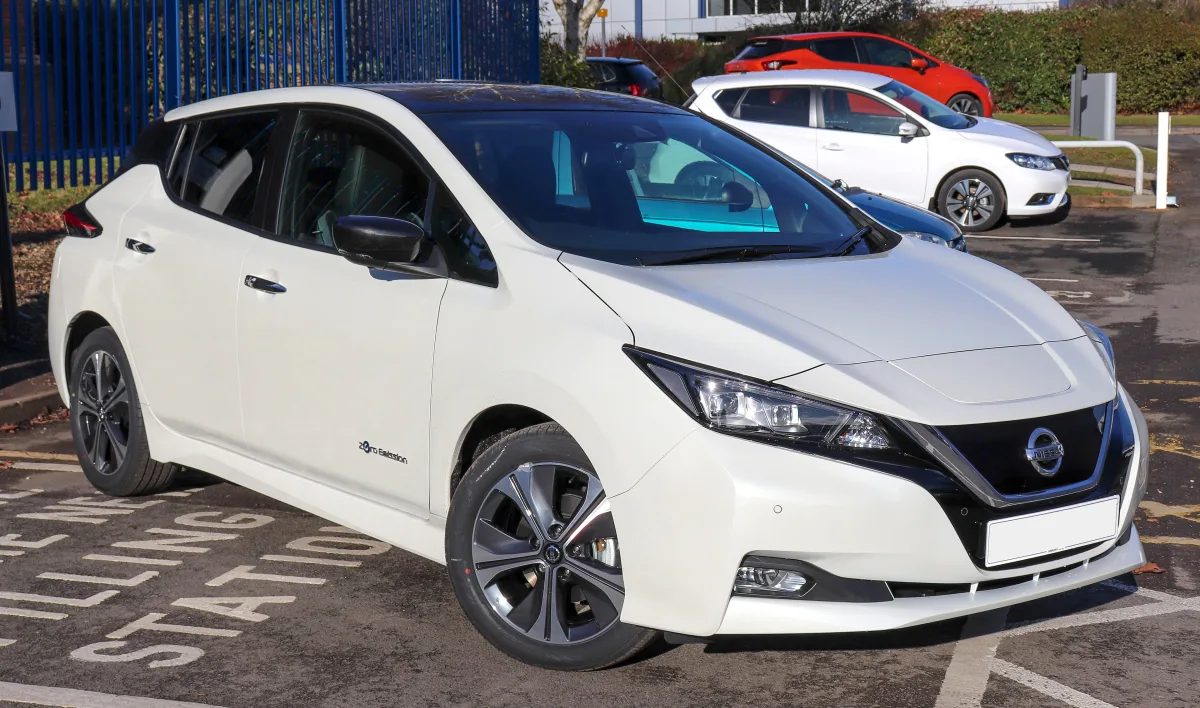
Nissan Leaf: ZE0/AZE0 and ZE1 generations, batteries and trims
Nissan Leaf was one of the first mass-produced electric vehicles and one of the cheapest ways to start driving electric in Lithuania. We look at the differences between the first and second generations, batteries, winter range, trims, and what to check when buying a used Leaf.






Leaf in brief
The Leaf has been in production since 2010. The first generation (ZE0, refreshed in 2013 as AZE0) was built until 2017, while the second generation (ZE1) has been on sale in Europe since 2018. A completely new, third-generation Leaf was introduced in 2025, but for now, the first two generations dominate the used market.
The Leaf is praised for its simplicity, quietness, and low running costs, and its popularity means there's a large supply in the used market. The key thing to know: the Leaf battery doesn't have liquid cooling, so its condition heavily depends on age, the climate in which the car was used, and how it was charged.
ZE0/AZE0 and ZE1 — what's the difference
The first-generation Leaf came with a 24 kWh battery, and from 2016, a 30 kWh option was offered. Today, these cars, depending on battery condition, often manage around 100 km or less, making them best suited for city driving. Higher-spec AZE0 trims came with a heat pump.
The second generation (ZE1) features a new body, a 40 kWh battery, and, according to the manufacturer's (WLTP) data, can travel around 270 km. Since 2019, the Leaf e+ with a 62 kWh battery and a more powerful engine has been offered, covering approximately 350–385 km. All ZE1 models come with the e-Pedal function, allowing for near-single-pedal driving in the city, while the top trims offered the ProPILOT driver-assistance system.
Battery, power, and charging
The Leaf has a single electric motor and front-wheel drive. The first generation's engine power is around 80 kW (109 hp), the ZE1 with a 40 kWh battery is 110 kW (150 hp), and the Leaf e+ is around 160 kW (217 hp).
For fast charging, the Leaf uses the CHAdeMO connector, not the widely-used CCS2 in Europe, so there are fewer suitable fast-charging stations — it's worth checking that there are some along your routes before buying. The ZE1 charges with alternating current via a Type 2 connector, usually up to 6.6 kW power, so fully charging the battery at home takes several hours or all night.
Since the battery lacks active cooling, repeated fast charging at a charging station heats it up and slows down the charging process — this is most noticeable on long journeys. In winter, the range often decreases by 20–40%, especially in cars without a heat pump, and a cold battery charges more slowly.
What to check when buying a used Leaf
The most important thing is the battery condition. On the instrument panel next to the charge level, there is a 12-segment scale: each missing segment indicates a noticeable reduction in capacity. You can see the condition more precisely via the OBD port with a diagnostic adapter and special software (e.g., LeafSpy) or at a service centre — ask the seller to let you do this.
Check where the car was imported from and how it was used: Leafs often have more degraded batteries if they were used in hot climates and frequently fast-charged. Test charging with both CHAdeMO and AC, and check if the heating and air conditioning work.
Like other electric vehicles, the brakes are used less due to regenerative braking, so the discs can rust — check them. Also, check the 12V battery: if it fails, various electronic faults can occur, and the car may not start.


Trims
Names and equipment vary by market and year; we list the trims most commonly found in Europe.
Visia
ZE0/AZE0 and ZE1The base trim is simple and the most affordable.
- Often comes with steel wheels
- A more basic infotainment system
- Often lacks a heat pump
Acenta
ZE0/AZE0 and ZE1The popular mid-range trim.
- Light alloy wheels
- Often includes navigation and a rear-view camera
- In the first generation, often includes a heat pump
N-Connecta
ZE1A good balance of price and features for a second-hand car.
- Often comes with 17-inch light-alloy wheels
- Often includes a surround-view camera
- Often features heated seats and steering wheel
Tekna
ZE0/AZE0 and ZE1The top trim with the most features.
- Often includes LED headlights
- Often comes with ProPILOT and Bose sound system (ZE1)
- Part-leather interior
e+
ZE1, from 2019Version with a larger 62 kWh battery and more powerful engine.
- Longest driving range
- Around 217 horsepower
- Faster charging than the 40 kWh version
Comparison of ZE1 generation trims
| Acenta | N-Connecta | Tekna | e+ Tekna | |
|---|---|---|---|---|
| Who it's for | City driving | City and suburban driving | Comfort and tech | Longer journeys |
| Common wheels | 16-inch | 17-inch | 17-inch | 17-inch |
| Interior | Fabric upholstery | Fabric, more kit | Partial leather, Bose sound system | Partial leather, Bose sound system |
| Battery | 40 kWh | 40 kWh | 40 kWh | 62 kWh |
| Price in the used market (relatively) | € | € | €€ | €€€ |
Most buyers' top pick is the ZE1 with a 40 kWh battery in N-Connecta or Tekna trim. If you often drive outside the city, consider the e+ with a larger battery.
Pros
- Low running costs and simple technology
- One of the most accessible used electric cars on the market
- Convenient e-Pedal function for city driving (ZE1)
- Practical interior and decent boot space
Cons
- Battery without active cooling ages faster and slows down charging
- CHAdeMO port means fewer rapid-charging stations
- Modest range for a first-generation model
Frequently asked questions
How far does a Nissan Leaf go in winter?
Winter range often drops by 20–40% — mainly depends on cold, battery condition, and whether the car has a heat pump. ZE1 with a 40 kWh battery in cold weather typically manages around 200 km or less, first-gen Leaf even less.
How to check the condition of a Leaf battery?
First, check the capacity gauge on the dashboard — ideally, all 12 segments should be visible. For the most accurate condition (SOH), use diagnostics via the OBD port, for example with the LeafSpy app, or get it checked at a service.
Can the Leaf be charged at all fast-charging stations?
No — the Leaf uses the CHAdeMO connector for fast charging, while most new stations, including Tesla, only have CCS2. Many public stations still have CHAdeMO cables, but it's worth checking before your journey. The Leaf can be charged with alternating current at many public stations.
Which Leaf is the best to buy used?
For most buyers, the best choice is the ZE1 generation Leaf with a 40 kWh battery, while those who frequently drive outside the city should consider the e+ with a 62 kWh battery. The first-generation Leaf is only worth considering as a cheap city car and only after checking the battery's condition.
Updated 2026-10-09 · Trim levels and equipment vary by market and model year — check the equipment of the specific car. · Translated automatically


