 English
 Lietuvių
 Latviešu
 Eesti
 Polski
 Русский
 Українська
 Deutsch
 Nederlands
 Čeština
 Slovenčina
 Svenska
 Norsk
 Dansk
 Suomi


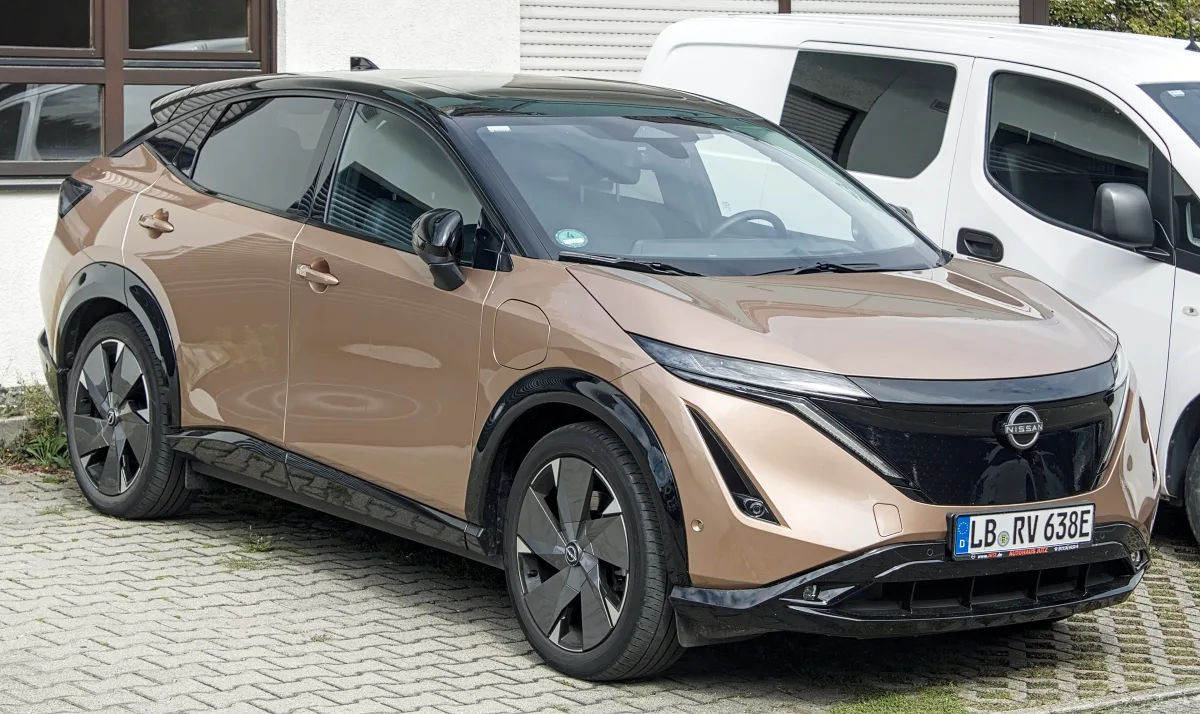
Nissan Ariya: batteries, e-4ORCE, charging and trims
Nissan Ariya — the electric crossover that’s been on sale in Europe since 2022 and is far more modern than the Nissan Leaf. We look at the battery and drivetrain options, real-world winter range, charging, trims and what to check when buying a used Ariya.






Ariya in brief
The Ariya is built on a new platform dedicated to electric vehicles and is manufactured in Japan. It’s sized between the Nissan Qashqai and X-Trail, with a more spacious interior thanks to its flat floor, and plenty of legroom in the rear.
Key differences from the Leaf include a liquid-cooled battery and a CCS2 fast-charging port instead of CHAdeMO. This makes the Ariya better suited to long journeys, and repeated fast charging on the move isn’t as much of a hassle as it is with the Leaf. The interior is minimalist, with two large screens and touch-sensitive buttons on the dashboard.
Production years and updates
The Ariya has had one facelift. The first cars arrived in Europe in 2022, with most used examples dating from 2022–2024. During that time, the software and infotainment have been updated, and trims have been added, so newer cars generally run more smoothly.
The 2024 range was bolstered by the sporty Ariya Nismo with more powerful engines, a sportier suspension and distinctive styling. Later, a refreshed Ariya version was introduced with a revised front end and improved equipment, although such cars are still rare in the used market.
Versions, batteries and charging
The Ariya is offered with two battery sizes: 63 kWh and 87 kWh of usable capacity. Standard versions come with a single motor and front-wheel drive (around 218–242 hp), while the e-4ORCE has two motors and all-wheel drive (around 306 hp). The Nismo version is even more powerful.
According to the manufacturer's (WLTP) figures, the 63 kWh version can travel around 400 km, while the 87 kWh with front-wheel drive can go up to around 530 km. In reality, the range on the motorway is usually lower, and in winter, you often need to count on about 20–35% less than in summer. The heat pump helps save energy in winter.
The Ariya is typically charged with alternating current (AC) at 7.4 kW, and some versions can go up to 22 kW if the charging station allows it. At fast-charging (DC) stations, the maximum power is around 130 kW, so charging is slower than for competitors with 800 V systems, but it's enough for most journeys.
What to check when buying a used Ariya
The most important thing is the battery's condition. Ask for a battery health (SOH) report from an official Nissan representative or a specialized service and compare the range shown for a fully charged battery with the manufacturer's data.
Ask if the software has been updated and test the multimedia system, phone connectivity, cameras, and driver-assistance features. Use the VIN to check if all recall work has been done.
Test charging with alternating and direct current, inspect the charging port, and ensure there are charging cables. The Ariya is heavy, so assess the condition of the tyres and brakes, and when driving over uneven surfaces, listen for any suspension noise.


Trims
Names and equipment vary by country and year; we list trims commonly found in Europe.
Engage
From 2022The base trim, which already comes with plenty of modern features.
- Two large screens and LED headlights
- Often — 63 kWh battery
- Often — 19-inch alloy wheels
Advance
From 2022The most popular choice — a good balance of price and equipment.
- Often — 360° surround-view cameras
- Often — heated seats and steering wheel
- More advanced driver-assistance systems
Evolve
From 2022The most generously equipped version.
- Often — panoramic sunroof and heads-up display
- Often — BOSE sound system
- Often — electrically adjustable centre console
e-4ORCE
From 2022Two-engine version with all-wheel drive.
- 87 kWh battery
- Around 306 hp
- Better grip on slippery roads
Nismo
From 2024Sporty version for driving enthusiasts.
- All-wheel drive and more power
- Sportier suspension and steering settings
- Nismo exterior and interior styling
Comparing the versions
| 63 kWh | 87 kWh | 87 kWh e-4ORCE | Nismo | |
|---|---|---|---|---|
| Who it's for | For city driving and around town | For long journeys | For winter and slippery roads | For driving comfort |
| Most common rims | 19 inch | 19–20 inch | 19–20 inch | 20 inch |
| Performance tyres | Front | Front | All | All |
| Approximate power | 218 hp | 242 hp | 306 hp | Over 400 hp |
| Relative price in the used market | € | €€ | €€ | €€€ |
For most buyers, the best choice is the 87 kWh with front-wheel drive: it goes the furthest. e-4ORCE is worth considering if you often drive on slippery roads, while the 63 kWh is ideal if you mostly drive in the city and can charge at home.
Pros
- Spacious, quiet, and comfortable interior
- Liquid-cooled battery and CCS2 connector
- Long range with the 87 kWh battery
- Some versions offer 22 kW AC charging
Cons
- Fast charging is slower than 800 V competitors
- The 63 kWh version doesn't go far in winter
- Smaller boot than some competitors
Frequently asked questions
How far does the Ariya really go in winter?
It depends on the battery, weather, and speed. In winter, you often need to count on about 20–35% less range than in summer. The heat pump and cabin pre-heating while the car is plugged in help save energy.
What makes the Ariya better than the Nissan Leaf?
The Ariya has a liquid-cooled battery, so it suffers less from heat and frequent fast charging, and the CCS2 connector is compatible with most fast-charging stations. Plus, the Ariya is larger, more spacious, and goes much further.
Which Ariya version to choose?
If you often drive out of town, opt for the 87 kWh battery. The 63 kWh version is best for city drivers, while e-4ORCE is for those who need all-wheel drive and more power.
Updated 2026-10-09 · Trim levels and equipment vary by market and model year — check the equipment of the specific car. · Translated automatically


