 English
 Lietuvių
 Latviešu
 Eesti
 Polski
 Русский
 Українська
 Deutsch
 Nederlands
 Čeština
 Slovenčina
 Svenska
 Norsk
 Dansk
 Suomi


Pontiac Bonneville: generations, engines, and what to check when buying
The Pontiac Bonneville is a large American luxury car produced from 1957 to 2005. In Lithuania, it's rarely seen: usually as a classic collector's car or a later-generation sedan from the US. We'll look at the generations, engines, and what to check before buying.






Bonneville in brief
The Bonneville nameplate appeared in the Pontiac lineup in 1957 as a top-tier model and later became a standalone model. Over nearly five decades, the car evolved from a large rear-wheel-drive classic 'cruiser' to a front-wheel-drive sedan.
Different generations vary greatly, so first, decide what you're after: a classic collector's car or a practical later-model sedan.
Which generation to choose
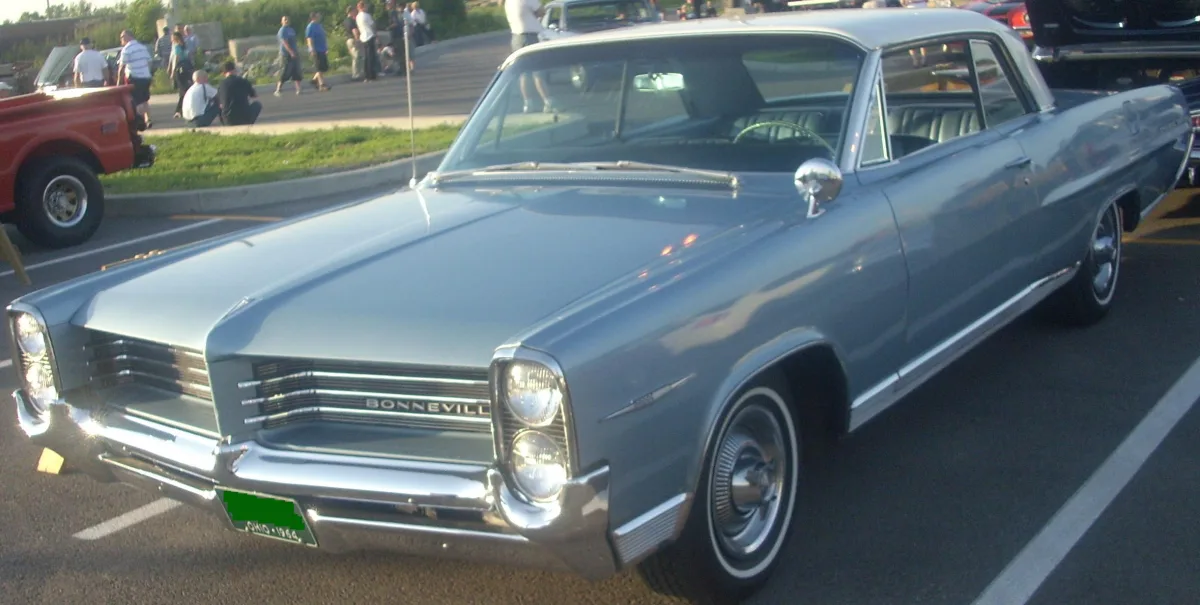
Earlier generations (1960s–1970s) are classic American cars with big V8 engines, rear-wheel drive, long bodies, and plenty of chrome. They're prized by collectors, and the price depends heavily on condition and originality.
Later generations (1987–2005) are front-wheel-drive sedans with a 3.8-litre V6 engine. They're more practical for daily use but lack the uniqueness of their predecessors. In the used market, the 2000–2005 models are typically sought after, as they're the most affordable.
Engines and transmissions
Classic-generation Bonnevilles were offered with various large-displacement V8 engines and automatic or manual transmissions. Exact versions vary greatly by year, so they should be checked against the specific vehicle's documents.
Later models came standard with a 3.8-litre V6 (around 200 hp) paired with a 4-speed automatic transmission. Some versions featured a more powerful, supercharged engine.
What to check when buying a used Bonneville
For classic cars, the most important things are corrosion and body condition: sills, floors, wings, and boot floor. Ask if the engine and transmission are original and if the manufacturer's numbers match.
For later models with the 3.8-litre V6, check for coolant or oil leaks, transmission shift issues, and if the rear suspension has been changed. These engines are common in US cars, and parts are not hard to find.
Since the car is imported, check the VIN, documents, and understand the conditions for registering it in Lithuania. Consider specialist insurance for classic cars.


Trim levels
Names and equipment vary greatly between generations and years; we list the most commonly found versions.
Bonneville (klasika)
1957–1970Classic rear-wheel-drive car with a V8.
- Often — lots of chrome details
- Often — a big V8 engine
- Often — an automatic transmission
Bonneville SE
Around 1992–1999The main version in later generations.
- 3.8-litre V6 engine
- Front-wheel drive
- Often — electrically adjustable seats
Bonneville SLE
Approximately 1992–2005More luxurious trim.
- Often — leather interior
- Often — additional comfort features
- Often — lightweight alloy wheels
Bonneville SSEi
Approximately 1992–2005Sporty version with a supercharger.
- Supercharged 3.8-litre V6
- Sportier suspension
- Often — sport seats
Comparison of versions
| Klasika | SE | SLE | SSEi | |
|---|---|---|---|---|
| Who it's for | For collectors | Everyday driving | Comfort | For faster driving |
| Wheels (most common) | 14–15 inch | 15–16 inch | 16 inch | 16–17 inch |
| Interior | Classic, original | Cloth | Leather | Leather and sport trim |
| Engine | V8 | 3.8 V6 | 3.8 V6 | 3.8 V6 supercharged |
| Price in the used market (relatively) | €€€ | € | € | €€ |
Collectors will love the original classic Bonneville. For daily driving, later models like the SLE or SE with the 3.8-litre V6 are usually better, while the SSEi offers clear service history.
Pros
- Spacious and comfortable interior
- Classic generation — distinctive styling
- Simple, widely-used V6 technology
- Later generations — straightforward and affordable to run
Cons
- Rarely sold in Lithuania
- Large dimensions and fuel consumption
- Finding parts for classic versions and risk of corrosion
Frequently asked questions
Is the Bonneville officially sold in Europe?
It’s an American market car. In Lithuania, you can find it as an import from the US or as a classic collector’s car.
Which generation of the Bonneville is best for daily driving?
Later generations (around 2000–2005) with the 3.8L V6 are often recommended — they’re more practical, and parts are fairly accessible.
Is the Bonneville expensive to run?
Later generations with the 3.8L V6 are easy to maintain, but fuel consumption is high. Classic generations require more upkeep and specialist parts.
Updated 2026-10-21 · Trim levels and equipment vary by market and model year — check the equipment of the specific car. · Translated automatically


