 English
 Lietuvių
 Latviešu
 Eesti
 Polski
 Русский
 Українська
 Deutsch
 Nederlands
 Čeština
 Slovenčina
 Svenska
 Norsk
 Dansk
 Suomi


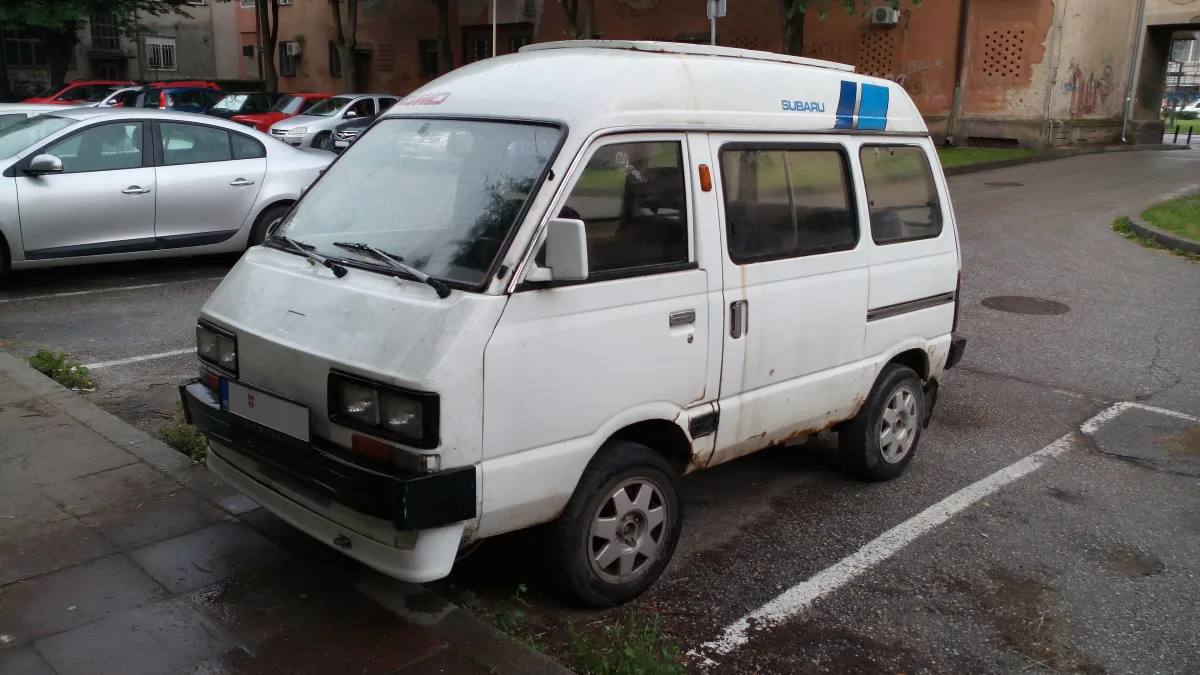
Subaru Libero: a compact microvan with all-wheel drive and what to know
The Subaru Libero is a small single-volume microvan sold in Europe from 1983 to 1998 (known as the Domingo in Japan and the Sumo in many markets). We explain what sets it apart, which engines it has, and what to check if you come across one in the used market.






The Libero in brief
The Libero is a microvan based on the Subaru Sambar but with larger bumpers and a larger engine taken from the Subaru Justy. Due to these changes, it no longer fit the Japanese 'kei' car requirements. The name Libero was chosen in 1984 by Subaru's German importer after a public competition.
Names varied by market: Sumo in many English-speaking countries, Domingo in Japan, Combi in Belgium, Columbuss in Sweden. In Lithuania, the Libero is rarely encountered and usually as an old workhorse or collector's item.
Generations — what's the difference
The first generation (KJ) was offered from 1983 with an optional all-wheel-drive system. Under normal conditions, only the rear wheels are driven, and all-wheel drive is engaged with a button on the gear stick; there's no centre differential, so it can't be driven on the motorway.
The second generation (FA) debuted in 1993 with an entirely new body, just like the Sambar. In 1994, a permanent all-wheel-drive system with a viscous coupling was introduced, available only with the ECVT gearbox.
Engines and gearboxes
The first generation had 997 cm³, later 1189 cm³ three-cylinder EF engines from the Justy. In the European specification, the carburetted 1.2-litre engine produced around 52 hp, while the second generation with fuel injection and a catalytic converter offered around 54 hp.
The gearbox is manual or (in the second generation with all-wheel drive) ECVT. The engine is mounted at the rear and is quite exposed, so a rear-end collision could damage it.
What to check when buying a Libero
These cars are old, so check the body for rust in the sills, arches, and floors. Pay attention to the engine's rear-mounted position: servicing may require removing the rear bumper.
Check the engine's operation, all-wheel drive (if fitted), suspension, brakes, and steering. There aren't many parts available in Lithuania, but some parts are shared with the Sambar and Justy, so check availability before buying.


Trim levels
Trim names and equipment vary by market and year; the Libero is usually distinguished by generation and transmission.
Standartinė versija
1983–1998A microvan with a 1.2-litre engine and rear or all-wheel drive.
- Compact dimensions, ideal for city driving
- Often — the option to choose all-wheel drive
- Equipment varies by market and year
Generation comparison
| I karta (KJ) | II karta (FA) | |
|---|---|---|
| Body | Older | New since 1993 |
| Engine | 997–1189 cm³, carburettor | 1189 cm³, fuel injection |
| Transmission | Rear-wheel drive, optional four-wheel drive | Rear-wheel drive or permanent four-wheel drive with ECVT |
| Price in the used market (relatively) | € | € |
Most will prefer the second generation for its more modern fuel injection and better equipment, while the first is ideal for enthusiasts of simpler technology.
Pros
- Compact dimensions, ideal for city driving
- Practical microvan with the option of four-wheel drive
- Simple and familiar technology
- Not expensive in the used market
Cons
- Modest engine power
- Engine at the rear and exposed to damage
- Risk of corrosion due to age
Frequently asked questions
How does the Libero differ from the Sambar?
The Libero has larger bumpers and a bigger engine than the Subaru Justy, so it doesn't fit into the 'kei' class.
Is the Libero the same as the Sumo?
Yes. Libero is the name in Europe, Sumo in English-speaking countries, and Domingo in Japan.
Does the Libero have four-wheel drive?
Yes, it was offered as an option: initially available, then standard from 1994 with ECVT.
Updated 2026-10-21 · Trim levels and equipment vary by market and model year — check the equipment of the specific car. · Translated automatically


