 English
 Lietuvių
 Latviešu
 Eesti
 Polski
 Русский
 Українська
 Deutsch
 Nederlands
 Čeština
 Slovenčina
 Svenska
 Norsk
 Dansk
 Suomi


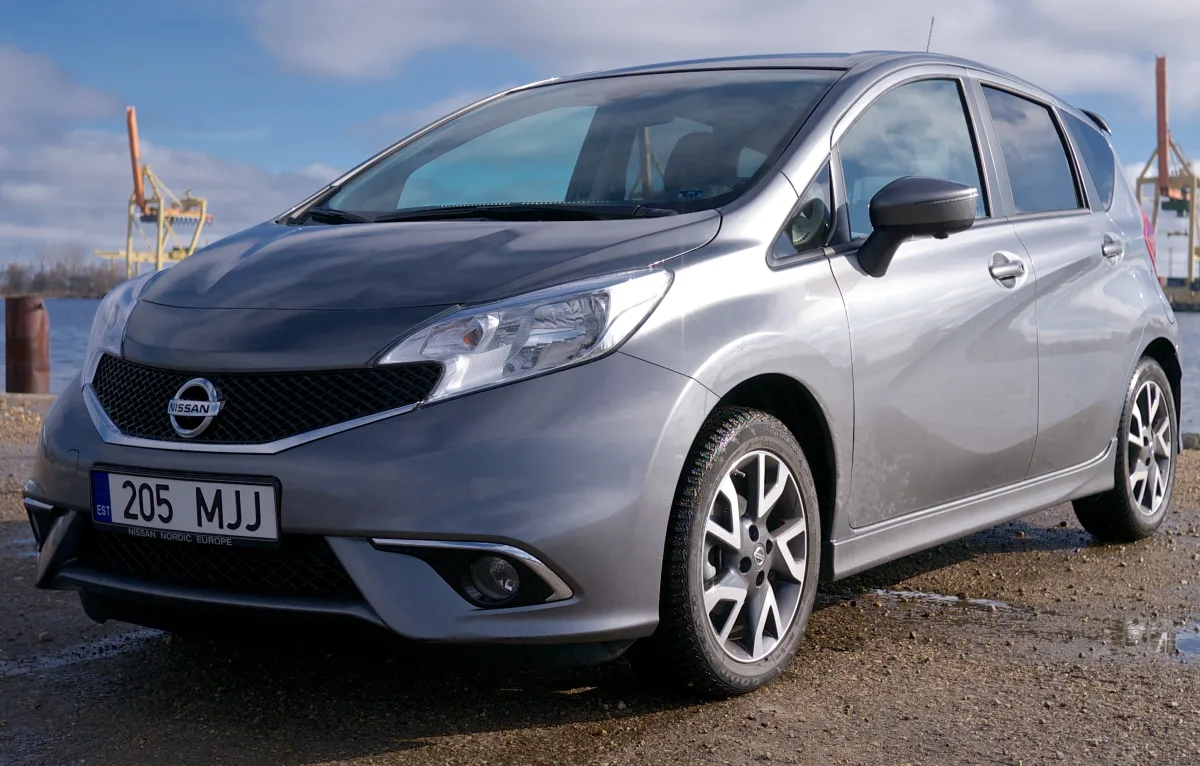
Nissan Note: E11 and E12 generations, engines and trims
The Nissan Note is a compact yet spacious hatchback, valued in Lithuania for its practical interior and affordable upkeep. We explore the differences between the E11 and E12 generations, the most popular engines, how the trims differ, and what to check before buying.






Note in brief
The Note was sold in Europe in two generations: E11 (around 2006–2013) and E12 (around 2013–2017). After that, the model had no direct successor in Europe, so only these two generations are found in the used market.
The Note is slightly larger than the Micra but still compact. It's praised for its high driving position, spacious interior and boot, and straightforward technology, making it a popular choice for families or older drivers.
E11 and E12 generations — what's the difference
The E11 generation stands out with its tall, boxy body and practical interior: the rear seat often slides forward and backward, and the boot has a foldable floor panel. In 2009, the car was updated with a new front end and interior details. Today, it's the more budget-friendly option.
The E12 generation is lower, more modern-looking, and more economical. It comes with more contemporary features, and better-equipped versions include Safety Shield safety systems, featuring a 360-degree camera. E12 generation cars destined for Europe were manufactured in Great Britain.
Many buyers will want to opt for the E12 — it's newer and better equipped. The E11 is the choice when the budget is tight, and what matters most is space and simple technology.
Engines and gearboxes
The E11 often comes with 1.4-litre (around 88 hp) and 1.6-litre (around 110 hp) petrol engines, as well as a 1.5 dCi diesel. The petrol engines are straightforward and, when well-maintained, will cover plenty of miles.
The E12 offers a 1.2-litre three-cylinder petrol engine (around 80 hp), its supercharged version 1.2 DIG-S (around 98 hp), and a 1.5 dCi diesel (around 90 hp).
Gearboxes are usually manual. The E11 with the 1.6-litre engine came with a conventional automatic, while the E12 with the 1.2 DIG-S features a smooth CVT.
What to check when buying a used Note
With the 1.5 dCi diesel, a regular oil change history is crucial: poorly maintained engines can suffer from worn-out connecting rod bearings. Also, check if the engine starts easily and doesn't smoke.
In a car with a CVT, test smooth acceleration and responsiveness: hesitation or juddering could indicate an expensive repair. A conventional automatic should shift smoothly.
Check that the air conditioning, rear seat folding, and if fitted, the Safety Shield camera work. Verify the mileage against service records, and inspect the body for corrosion and repainted parts.


Trim levels
Names and equipment vary by market and year; we list the most common trims found in Europe.
Visia
E11–E12 generationBase trim — simple and the most affordable.
- Often comes with steel wheels
- Basic sound system
- Often includes air conditioning
Acenta
E11–E12 generationMost popular choice — a good balance of price and comfort.
- Often comes with alloy wheels
- Air conditioning
- Often includes a sliding rear seat
n-tec
E12 generationVersion with more tech features.
- Alloy wheels
- NissanConnect multimedia with navigation
- Often includes a rear-view camera
Tekna
E11–E12 generationTop-spec trim.
- Automatic climate control
- Often — Safety Shield and 360-degree camera (E12)
- Often — keyless entry
E12 generation trim comparison
| Visia | Acenta | n-tec | Tekna | |
|---|---|---|---|---|
| Who it's for | For the tightest budgets | For daily driving | For tech enthusiasts | For comfort and safety |
| Most common wheels | Alloy wheels | Alloy or light-alloy | Light-alloy | Light-alloy |
| Equipment | Basic | Often includes a sliding rear seat | Navigation, rear-view camera | Safety Shield, 360-degree camera |
| Price in the used market (relatively) | Budget-friendly | Budget-friendly | Mid-range | Mid-range |
For most buyers, the best choice is the Acenta or n-tec with the 1.2-litre petrol engine. The Tekna is worth considering for its safety systems and parking cameras.
Pros
- Spacious interior and boot for a small car
- High, comfortable seating position
- Simple technology and affordable maintenance
- Practical solutions — split-folding rear seats
Cons
- Weaker engines struggle with acceleration in urban areas
- Basic interior materials
- Production in Europe has ended — no newer models will be made
Frequently asked questions
Which Note generation is best to buy used?
For many buyers, the best choice is the E12 generation: it's newer, more economical, and better equipped. The E11 is suitable when the budget is tight and space is the priority.
How do the Nissan Note and Micra differ?
The Note is slightly larger and taller, so it has a more spacious interior and a bigger boot. The Micra is more compact and easier to manoeuvre in the city, while the Note is better suited to families.
Which Note engine is the most economical?
The most economical is the 1.5 dCi diesel, but it's best for high-mileage drivers. Most buyers will find it easier to opt for a petrol engine, which is cheaper to maintain.
Updated 2026-10-09 · Trim levels and equipment vary by market and model year — check the equipment of the specific car. · Translated automatically


