 English
 Lietuvių
 Latviešu
 Eesti
 Polski
 Русский
 Українська
 Deutsch
 Nederlands
 Čeština
 Slovenčina
 Svenska
 Norsk
 Dansk
 Suomi


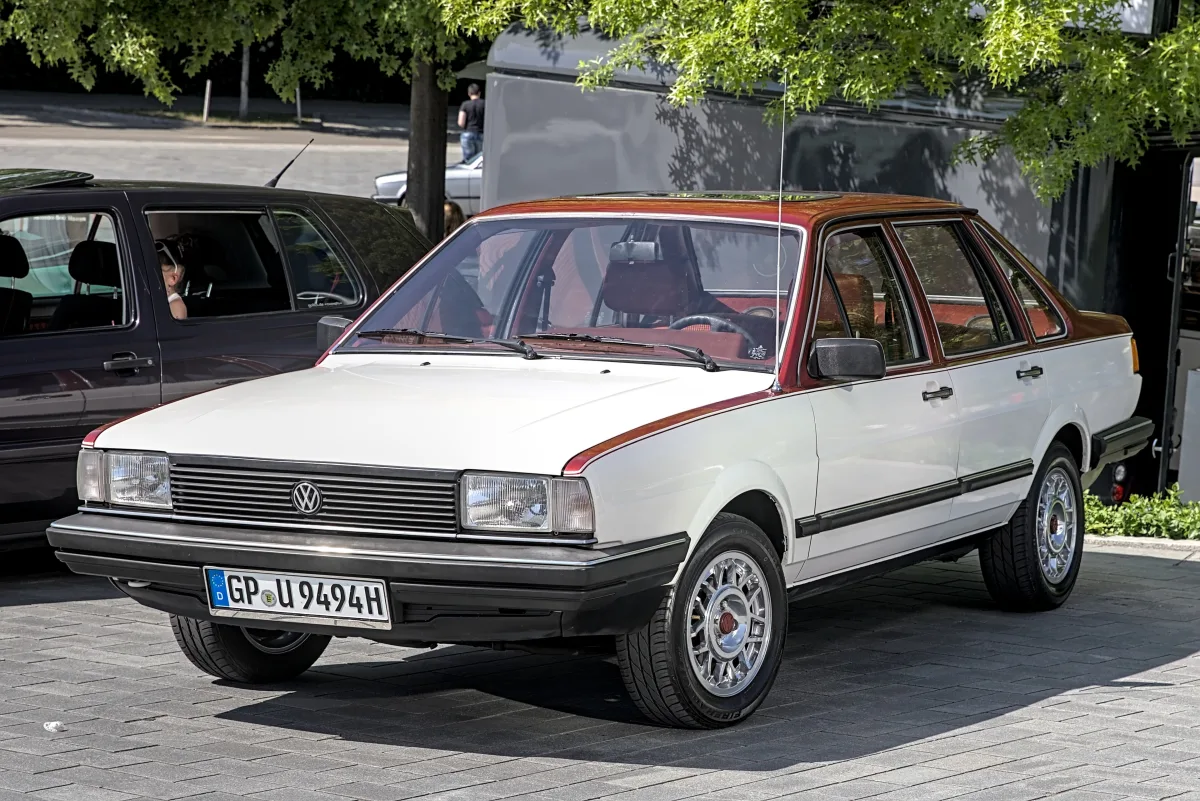
Volkswagen Santana: generations, engines and what to know when buying used
The Volkswagen Santana is a four-door saloon built on the Passat B2 platform and produced from 1981. In this article, we look at the model's features, engines and what to check if you're hunting for one in Lithuania.






Santana in brief
The Santana is a saloon based on the Volkswagen Passat B2 with a separate boot. In many markets, the Passat B2 was offered as a hatchback and estate, while the Santana complemented the range with a classic three-box body.
The name Santana was later used in other markets — for example, in China and Brazil, this model was produced for many more years. In this article, we're talking about the saloon sold in Europe.
Which generation to choose
The Santana is a single generation, so the main question is the engine and condition. Most surviving cars are in basic trim, so it's crucial to find a tidy and unrusted example.
The model is valued for its simple, reliable engineering and spacious interior, but it has now become a rare classic.
Engines and gearboxes
Most commonly found are the 1.6 and 1.8-litre petrol engines, as well as the 1.6-litre diesel (including turbodiesels). Drive is to the front wheels.
Gearboxes are manual or automatic. These engines are simple and robust, and their maintenance is supported by widely available Volkswagen group parts.
What to check when buying a used Santana
The key thing is corrosion: check the sills, wheel arches, boot lid and floor. Make sure the engine starts easily, there are no oil leaks and the heating works.
After many years, the electrical equipment and interior trim can be worn out. You might need to hunt for body and interior parts among classic Volkswagen enthusiasts.


Trim levels
Names and equipment vary by market and year; for this rare model, we describe versions by body, engine or once.
1,6 l benzininė
By engineThe simplest and most common version.
- 1.6-litre petrol engine
- Front-wheel drive
- Manual or automatic gearbox
1,8 l benzininė
By engineThe more powerful version.
- 1.8-litre petrol engine
- Front-wheel drive
- More dynamic driving
1,6 l dyzelinė
By engineThe more economical version.
- 1.6-litre diesel engine
- Lower fuel consumption
- More dynamic
Turbodyzelinė
By engineDiesel version with turbocharger.
- Diesel engine with turbocharger
- More power than a naturally aspirated diesel
- Turbocharger condition is crucial
Santana engine comparison
| 1,6 l benzininė | 1,8 l benzininė | Dyzelinė | |
|---|---|---|---|
| Who it suits | For economical driving | For more spirited driving | For high-mileage drivers |
| Fuel consumption | Average | Higher | Lower |
| Gearbox | Front wheels | Front wheels | Front wheels |
| Price in the used market (relatively) | € | € | € |
The most important thing is a well-maintained condition. Often, it's worth choosing based on the engine: petrol is good for short distances, diesel for those who drive more.
Pros
- Simple, well-known technology
- Spacious interior
- Robust, uncomplicated engines
- A rare classic sedan
Cons
- Age and rust
- Limited availability in Lithuania
- You'll need to search for parts in classic car communities
Frequently asked questions
How does the Santana differ from the Passat B2?
The Santana is a sedan with a separate trunk, built on the Passat B2 platform. The technology is very similar.
Is the Santana still in production?
This sedan is no longer produced in Europe, but the Santana name was used for a long time in Brazil and China.
Is the Santana a good classic car?
Yes, if the car is in good condition — its technology is simple, and mechanical parts are usually easy to find.
Updated 2026-10-21 · Trim levels and equipment vary by market and model year — check the equipment of the specific car. · Translated automatically


