 English
 Lietuvių
 Latviešu
 Eesti
 Polski
 Русский
 Українська
 Deutsch
 Nederlands
 Čeština
 Slovenčina
 Svenska
 Norsk
 Dansk
 Suomi


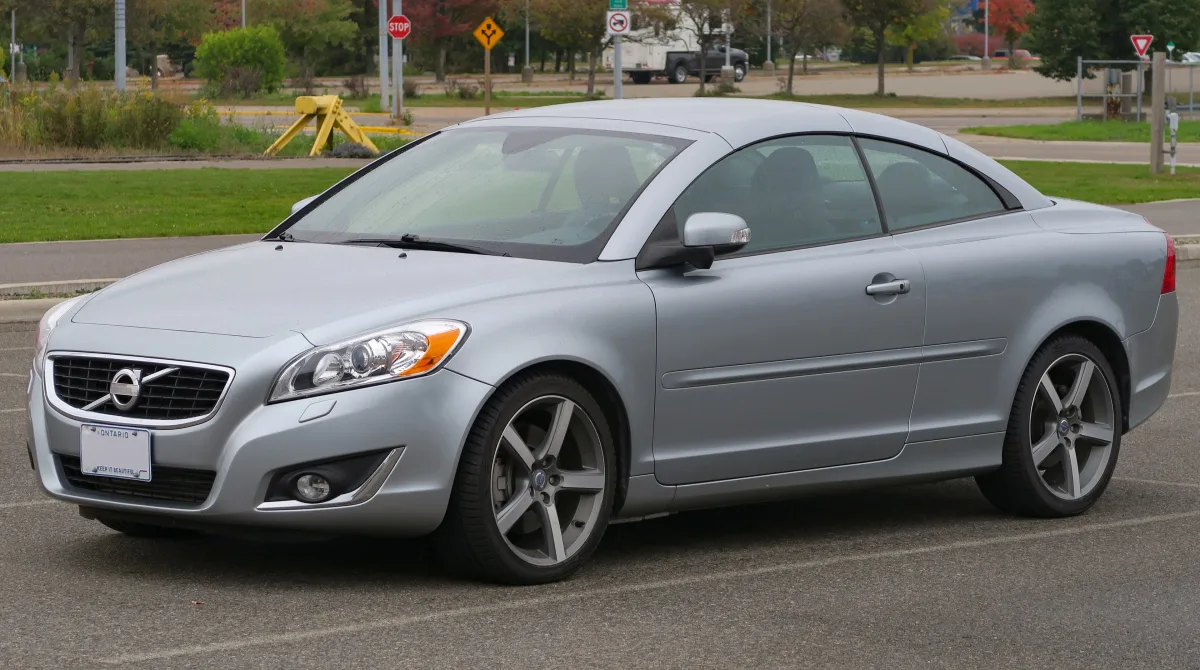
Volvo C70: First and Second Generations, Engines and Trims
The Volvo C70 is a four-seater Volvo coupé and convertible produced between 1996 and 2013. In the used market, you'll most often encounter the second generation with its folding metal roof. We'll look at how the two generations differ, which engines are the most popular, how the trims vary, and what you need to check before buying.






C70 in brief
The C70 was produced in two generations. The first generation (1996–2005) was offered as a coupé and as a convertible with a soft fabric roof, while the second generation (2006–2013) was only available as a coupé-convertible with a three-piece folding metal roof. Both generations feature four full-sized seats, which is relatively rare for this class of car.
The C70 is praised for its smooth, comfortable ride, supportive seats, and Volvo's safety solutions: convertibles come with a roll-over protection system, and in the second generation, side curtain airbags deploy from the doors upwards. It's not a sports car, but rather suited to leisurely drives and relaxed motoring.
First and Second Generations — What's the Difference
The first generation was based on the 850 and S70 models, so it features their characteristic five-cylinder engines and front-wheel drive. The coupé was produced until 2002, and the convertible until 2005. These are now older cars, and their value largely depends on condition and service history.
The second generation was co-designed with Pininfarina and built on the same platform as the S40 and V50. Its sleek metal roof allows for winter driving like a regular coupé — quiet and warm inside, making it more practical for Lithuania's climate. The downside is that lowering the roof significantly reduces the boot space.
In late 2009 (2010 model year), the second generation was refreshed: it received a new front end with larger grilles, different front and rear lights, and an updated interior. For many buyers, this is the best choice — the car is newer, and the technology is already refined.
Engines and gearboxes
The first generation featured only turbocharged five-cylinder petrol engines: most commonly 2.0 and 2.4 (around 160–200 hp) and the most powerful 2.3 T5 (around 240 hp). This generation did not have any diesel versions.
The second generation most often features petrol engines like the 2.4i (around 140–170 hp) and the T5 2.5 turbo (around 220–230 hp), as well as diesels like the 2.0 D (around 136 hp) and the five-cylinder 2.4 D5 (around 180 hp). The 2.0 petrol engine is less common. Names and power outputs varied slightly by year and market.
Gearboxes come in 5 or 6-speed manual and automatic Geartronic. The automatic gearbox is often paired with T5 and D5 engines and suits the car's relaxed character well.
What to check when buying a used C70
The roof mechanism is key. Open and close the roof a few times: it should move smoothly, without stopping or error messages. Issues often stem from sensors, connectors, or hydraulics, and repairs can be costly. Check for water leaks: lift the mats, inspect the boot and roof seals.
The fabric roof of the first-gen cabriolet should be watertight, and its hydraulics should work. In five-cylinder engines, check for oil leaks, ensure the turbo spins evenly, and ask when the timing belt was last changed. For diesels that have done a lot of city driving, check the particulate filter (DPF) and EGR valve.
The automatic gearbox should shift smoothly, without jolts. Check the service history for the engine, and inspect the body for repainted parts and uneven gaps, especially around the boot lid, which is part of the roof mechanism on the second-gen.


Trim levels
Names and equipment vary by market and year; we list the most common second-gen trims found in Europe. In the UK, they are known as S, SE, and SE Lux.
Kinetic
Second generationThe base trim is more basic but comes with all essential safety systems.
- Often — light-alloy wheels
- Fabric seats
- A more affordable audio system
Momentum
Second generationThe most popular choice — more comfort for a small price difference.
- Automatic climate control
- Often — partial leather seats and parking sensors
- Often — cruise control
Summum
Second generationThe top-of-the-range trim with luxurious interior.
- Single seats, often electrically adjustable and heated
- Often — xenon headlights
- Often — premium sound system
T5
First and second generationsThe most powerful version with a turbo engine, offered with various trims.
- The most powerful turbo petrol engine
- Larger alloy wheels
- Often — automatic transmission
Comparison of second-generation trims
| Kinetic | Momentum | Summum | T5 | |
|---|---|---|---|---|
| Who it suits | For the most budget-conscious buyer | For everyday comfort | For luxury and long journeys | For faster driving |
| Most common faults | 16–17-inch wheels | 17-inch wheels | 17–18-inch wheels | 17–18-inch wheels |
| Interior | Upholstery | Often — partial leather | Full leather, more kit | Depends on the spec |
| Engine | 2.4i, 2.0 D | 2.4i, 2.0 D, D5 | 2.4i, D5, T5 | 2.5 turbo, around 220–230 hp |
| Price in the used market (relatively) | € | €€ | €€ | €€€ |
Most buyers' best bet is the refreshed second-gen (from 2010) Momentum or Summum trim with the D5 or 2.4i engine. The T5 is worth considering if you want more power, but the condition of the roof mechanism is more important than the engine or trim.
Pros
- Four full-sized seats
- A metal roof means it's suitable for winter driving
- Comfortable ride and supportive seats
- Volvo's safety solutions, including roll-over protection
Cons
- Lowering the roof significantly reduces boot space
- Repairing the roof mechanism can be expensive
- Its hefty weight means handling isn't sporty
Frequently asked questions
Is the Volvo C70 suitable for winter driving?
The second-gen C70 with a metal roof is fine for winter use as a regular coupe – the cabin stays quiet and warm. The first-gen convertible with a fabric roof is less suitable for winter, although many owners drive it year-round.
Is the C70's roof mechanism reliable?
A well-maintained roof lasts a long time, but sensors, connectors, and hydraulics degrade over time. Before buying, open and close the roof several times to check for error messages and water spots in the cabin.
Which C70 engine is the best?
For a smooth ride, the 2.4i and D5 are great choices, while the T5 offers significantly more dynamism. The diesel is worth considering only if you're doing a lot of out-of-town driving, as the particulate filter needs longer journeys.
How much space is there in the C70 boot?
With the roof up, the boot is quite spacious, but with the roof down, it takes up a large portion of it. If you often drive with the top down, consider in advance whether there will be enough room left for your luggage.
Updated 2026-10-09 · Trim levels and equipment vary by market and model year — check the equipment of the specific car. · Translated automatically


