 English
 Lietuvių
 Latviešu
 Eesti
 Polski
 Русский
 Українська
 Deutsch
 Nederlands
 Čeština
 Slovenčina
 Svenska
 Norsk
 Dansk
 Suomi


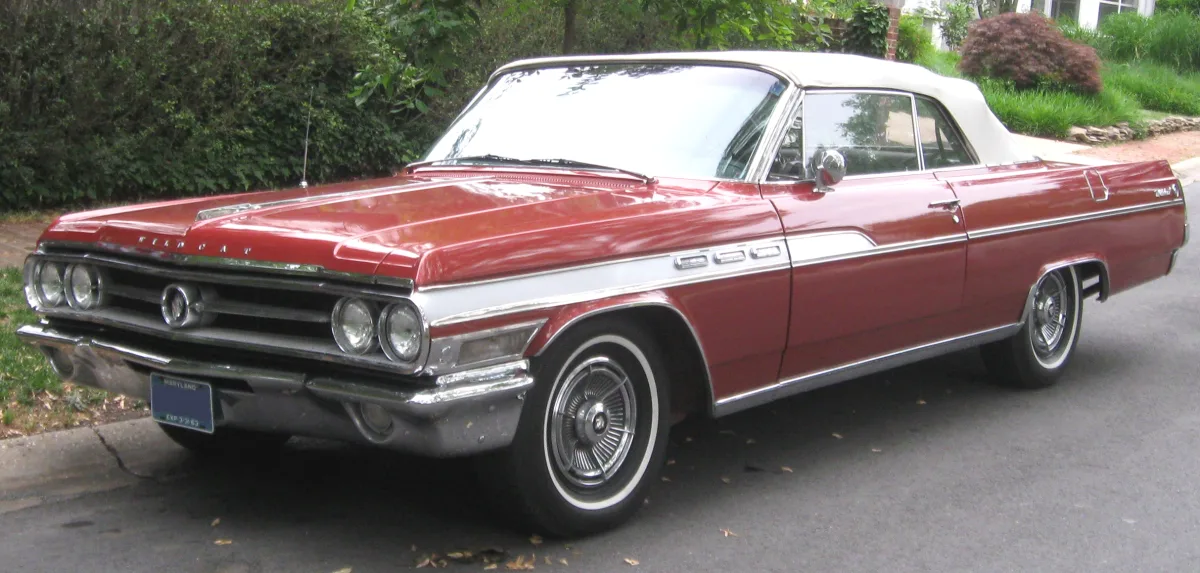
Buick Wildcat: 1963–1970 large American V8 coupe and convertible
Buick Wildcat — the large, sportier American Buick model produced from 1963–1970 with powerful V8 engines. In this article, we'll look at its generations, bodies, engines, and what you need to know to buy this classic.






Wildcat in brief
Wildcat — the sportier, large Buick variant that debuted in 1963. The name hails from Buick's concept cars of the 1950s, and in 2022 it was revived for an electric concept car — but this article is about the 1963–1970 production model.
This is a classic 'American' car: a large body, soft ride, powerful V8, and plenty of interior space.
Generations — what's the difference
The first generation (1963–1964) saw around 120,000 units produced, the second (1965–1970) nearly 370,000. The second generation is larger and features a different body design.
A wide range of bodies: two-door hardtop, convertible, four-door hardtop, and four-door sedan with a central pillar.
Engines and transmissions
The first generation featured 401 cu in (6.6 l, around 325 hp) and 425 cu in (7.0 l, around 340–360 hp) V8 engines. The second generation had 401 and 425, from 1967 to 1969 — 430, and in 1970 — 455 cu in (7.5 l) V8. The initial 401 and 425 belong to Buick's 'Nailhead' family.
Transmissions — 3-speed manual, early cars, and 4-speed manual, plus automatics (Dynaflow and TH-400 / Super Turbine 400). Drive — to the rear wheels.
What to check when buying a Buick Wildcat
The most important thing is corrosion. Check the floors, sills, boot floor, wheel arches, and chassis. For convertibles, inspect the roof mechanism, seals, and signs of water ingress.
Check the engine and gearbox for oil leaks, overheating, and smoke. Pay attention to whether the engine matches the model year specifications.
Most Wildcats imported into Lithuania come from the USA, so check the documents, registration, and availability of parts.


Trim levels
Listed are US market names and variants.
Standard
1963–1970Base trim.
- Big V8 engine
- Simpler interior
- Hardtop, convertible, or sedan
Deluxe
1965Higher trim level, offered only in 1965
- Often a more luxurious interior
- More comfort features
- It was only on the market for a year
Custom
by yearThe more luxurious version with better trim.
- Often — more chrome and trim
- More comfort
- More often with an automatic gearbox
Kabrioletas
1963–1970Convertible — rarer and more valuable.
- Convertible
- Often — electric sunroof
- More expensive on the used market
Body comparison
| Kupė | 4 durų hardtopas | Kabrioletas | |
|---|---|---|---|
| Who it suits | For the stylish classic | For families and road trips | For open-top driving |
| Engine | 401–455 V8 | 401–455 V8 | 401–455 V8 |
| Price in the used market (relatively) | Mid-range | Mid-range | High-end |
For those seeking a comfortable classic, a coupe or four-door hardtop is ideal. The convertible is the most desirable, but also the most expensive and demanding in terms of maintenance.
Pros
- Powerful V8 engines and ample comfort
- Spacious interior
- Classic American styling
- Wide range of body styles
Cons
- Very high fuel consumption
- Large and heavy to handle
- Corrosion and parts issues
Frequently asked questions
How many generations of the Buick Wildcat were produced?
Two: the first from 1963–1964 and the second from 1965–1970.
Which engines were available in the Wildcat?
V8: 401, 425, 430 (1967–1969) and 455 cubic inches (1970).
Is the Wildcat the same as the concept Wildcat?
No. The name originates from the concept cars of the 1950s, but from 1963–1970 the Wildcat was a production model.
Updated 2026-10-21 · Trim levels and equipment vary by market and model year — check the equipment of the specific car. · Translated automatically


