 English
 Lietuvių
 Latviešu
 Eesti
 Polski
 Русский
 Українська
 Deutsch
 Nederlands
 Čeština
 Slovenčina
 Svenska
 Norsk
 Dansk
 Suomi


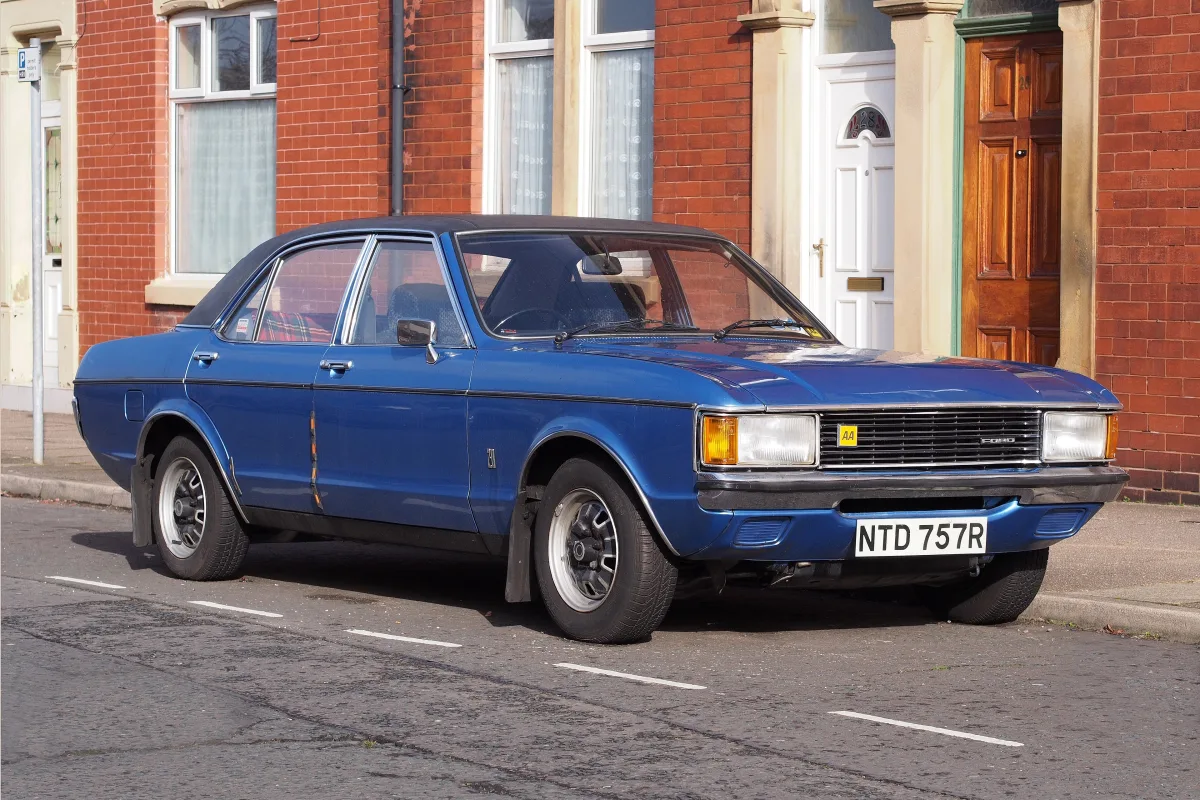
Ford Granada: I and II generations, engines and trims
Ford Granada — a large European Ford car, produced from 1972 to 1985 in two generations (Mk I and Mk II) with saloon, coupé and estate bodies. Today, it's a collectible car that's rarely found in Lithuania. We'll look at the generations, engines, trims and what to check when buying.






Granada in brief
The Granada replaced older Ford mid-range and executive models and was aimed at buyers who needed a more spacious and luxurious car than the Taunus or Cortina. It was built with rear-wheel drive, V-shaped engines and a spacious interior.
Thanks to its styling and technology, the Granada became popular as a family car, taxi and company vehicle. Nowadays, it's valued as a part of 1970s and 1980s European classics.
Mk I and Mk II — what's the difference
Mk I (1972–1977) featured distinctive 1970s design cues: a long bonnet, wide grille and a choice of saloon, coupé and estate bodies. It's considered the 'classic' Granada.
Mk II (1977–1985) was more modern, with squarer shapes, an improved suspension and more equipment. It was updated around 1982, and in 1985 it was replaced by the Ford Scorpio.
Engines and gearboxes
The Granada was offered with a range of engines: from smaller four-cylinder units to V6s with capacities of around 2.3, 2.6, 2.8 and 3.0 litres. Later, a diesel version also appeared.
The gearbox was manual or automatic. The most powerful versions (e.g., the 2.8-litre with fuel injection) offered better performance and were considered the most luxurious.
What to check when buying a used Granada
The most important thing is corrosion: check the wings, sills, rear arches, boot floor, and the underside of the front bonnet. Repairs can be expensive.
Inspect the cooling system and engine operation – V6 engines don't like overheating. Check the brakes, steering mechanism, and suspension.
Interior details, especially in Ghia versions, sometimes missing or worn out. Parts can be found through clubs and specialist shops, but some parts are hard to find.


Trim levels
Names varied by market and year; we list the most commonly encountered versions.
L
First–second generationThe base, more comfortable version.
- Simpler interior trim
- Often – smaller engines
- The main choice
GXL
First generation (1972–1977)The higher-class first-generation version.
- Often – a larger engine
- Better interior trim
- More comfort
GL
Second generation (1977–1985)Mid-range second-gen spec.
- Better equipped than the L
- Often — electric windows
- Often — automatic gearbox
Ghia
First–second generationThe top base model.
- Often — leather or other plush trim
- Often — air conditioning
- Well-equipped
Ghia X
Second generationThe top second-gen spec.
- Often — the biggest engine
- Well-equipped
- Luxurious trim
Comparing Granada versions
| L | GL | Ghia | Ghia X | |
|---|---|---|---|---|
| Who's it for? | For everyday driving | For comfort | For luxury | For top-tier luxury |
| Interior | Basic | Better trim | Luxury trim | The most lavish trim |
| Engine | Often smaller | Often mid-sized | Often larger | Often the largest |
| Price in the used market (relatively) | € | €€ | €€ | €€€ |
Most buyers will opt for the GL or Ghia with the V6 engine — a good balance of luxury and cost. Ghia X buyers will prioritise the top-tier trim.
Pros
- Classic 1970s European Ford styling
- Spacious and comfortable interior
- Powerful V6 engines
- A solid choice for the classic car enthusiast
Cons
- Rust — a common issue
- High fuel consumption
- Finding parts can take time
Frequently asked questions
How does the Mk I differ from the Mk II?
Mk I — the earlier, 1970s design generation, with coupé and estate body styles. Mk II — the more modern, with squarer lines, better equipment and technology.
Does the Granada have a diesel engine?
Indeed, later versions did feature diesel engines, but most Granadas come with petrol V4 or V6 units.
Can a Granada be used daily?
Theoretically, yes, but it will require regular maintenance, and fuel consumption is high. It's more often used as a collector's car.
Updated 2026-10-21 · Trim levels and equipment vary by market and model year — check the equipment of the specific car. · Translated automatically


