 English
 Lietuvių
 Latviešu
 Eesti
 Polski
 Русский
 Українська
 Deutsch
 Nederlands
 Čeština
 Slovenčina
 Svenska
 Norsk
 Dansk
 Suomi


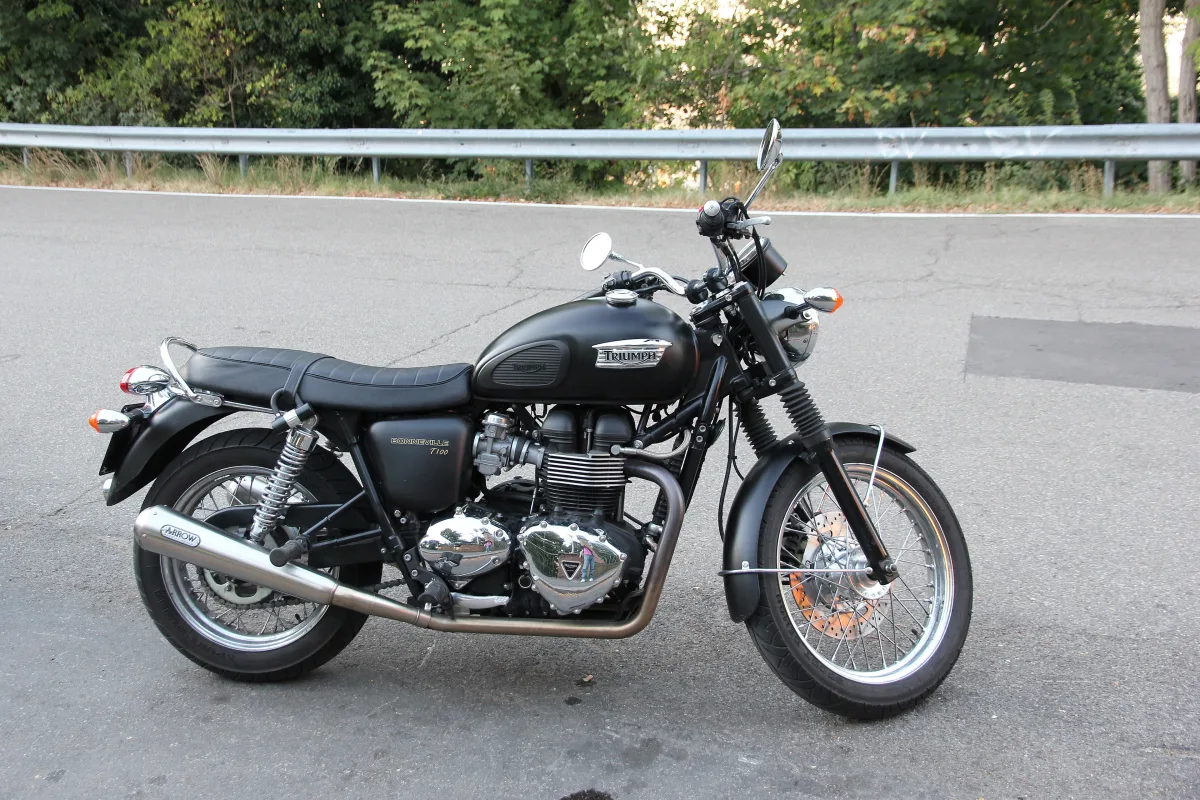
Triumph Bonneville T100: classic twin and what to check on a used one
The Triumph Bonneville T100 is a classic-style twin-cylinder motorcycle that revived the famous Bonneville tradition since 2001. We look at the generations, engines, and what to check when buying a used one.






Bonneville T100 in brief
The Bonneville T100 is a classic 'retro' style motorcycle with a parallel-twin engine, designed around the 1960s Bonneville traditions. It combines vintage looks with modern reliability, making it suitable for daily use, not just cruising.
The model is easy to handle, has a low seat height, and a simple design. Due to its popularity, there are plenty of accessories available, making it easy to customise.
Generations — what's the difference
The first-generation Bonneville (from 2001) had an approximately 790 cm³ air-cooled twin-cylinder engine and carburetors. Later, the engine was increased to around 865 cm³, and the fuel system was changed to fuel injection, which is hidden under a 'carburettor' imitation.
Since around 2016, the T100 received a new, liquid-cooled approximately 900 cm³ engine with modern electronics, ABS, and traction control. Newer versions are more powerful and safer, while older ones are cheaper and simpler.
Engines and gearboxes
Older generation engines are air-cooled, around 790 and 865 cm³, with approximately 60–70 hp, and a manual five-speed gearbox. They have a calm character and are suitable for comfortable riding.
The new-generation T100 features a liquid-cooled around 900 cm³ engine with around 55–65 hp, a six-speed gearbox, and modern electronics. It's quieter, more economical, and more comfortable for daily use.
What to check when buying a used Bonneville T100
Inspect the engine and gearbox for oil leaks – this is a common issue in older motorcycles. Check if the engine runs smoothly at idle and starts reliably.
Check the chromed parts, fuel tank, and handlebars for rust, especially if the motorcycle has been stored outdoors. Inspect the front fork (no oil leaks), brakes, chain, and sprockets.
Many motorcycles come with additional accessories – ensure they are properly fitted and that original parts are still in place. Check the service history.


Versions
Names and equipment vary by market and year; we list the versions most commonly found in Europe.
T100 (790 cm³)
from 2001The first generation with carburetors.
- Around 790 cm³ air-cooled engine
- Simple technology
- Classic looks
T100 (865 cm³)
around 2007A larger engine, later with fuel injection.
- Around 865 cm³
- Often — ABS is newer
- More reliable technology
T100 (900 cm³)
roughly from 2016Liquid-cooled generation
- Liquid-cooled engine
- ABS and traction control
- More modern electronics
Su priedais
various yearsCustomised examples
- Often — another disposal
- Often — dings
- Check for genuine parts
Comparison of generations
| 790 cm³ | 865 cm³ | 900 cm³ | |
|---|---|---|---|
| Who it suits | For the budget-conscious classic | For a balanced choice | For modern use |
| Air conditioning | Airbags | Airbags | Power steering |
| Equipment | Basic | Mid-range | ABS, traction control |
| Price in the used market (relatively) | € | €€ | €€€ |
For most, the 865 cm³ version will suffice, or the newer 900 cm³ if the budget allows. The first generation is cheaper, but check the condition carefully.
Pros
- Classic retro styling
- Light handling, low seating position
- Wide range of accessories
- Reliable, straightforward technology
Cons
- Earlier versions have less electronics
- Some motorcycles have been fitted with substandard parts
- Power is less than that of sports motorcycles
Frequently asked questions
Is the Bonneville T100 suitable for a beginner?
Yes, it's light, low and not overly powerful, making it often recommended as a first big motorcycle.
How does the T100 differ from the T120?
The T120 has a larger, roughly 1200 cm³ engine, while the T100 has around 900 cm³ (in newer versions).
Is it worth buying an older version?
If it's well-maintained and in good condition — yes. The key is the service history.
Updated 2026-10-21 · Trim levels and equipment vary by market and model year — check the equipment of the specific car. · Translated automatically


