 English
 Lietuvių
 Latviešu
 Eesti
 Polski
 Русский
 Українська
 Deutsch
 Nederlands
 Čeština
 Slovenčina
 Svenska
 Norsk
 Dansk
 Suomi


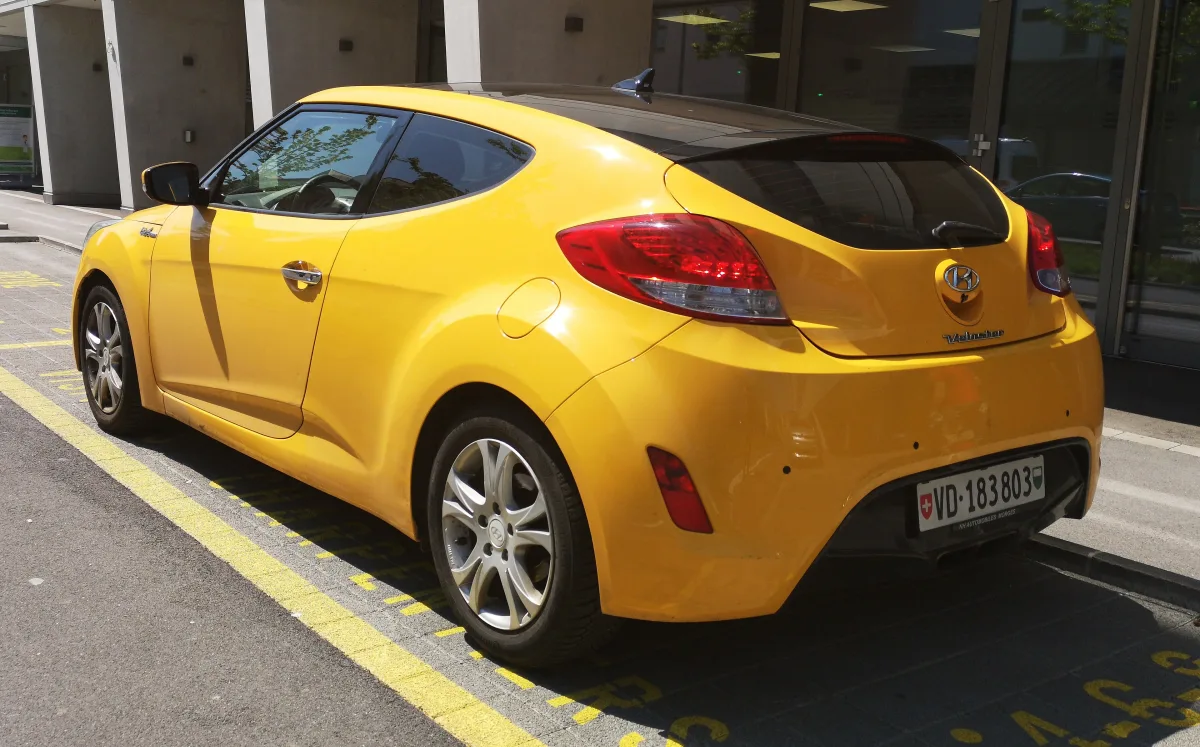
Hyundai Veloster: two generations, engines and trims
The Hyundai Veloster is a compact coupé with a unique design featuring one door on the driver's side and two on the passenger side. In this article, we'll look at both generations, engines, trims, and what to check when buying a used Veloster.






Veloster in brief
The Veloster stands out with its asymmetrical body: one long door on the driver's side and two on the passenger side, making it easier to access the rear seats. This is a more practical solution than a classic two-door coupé, although the rear seat isn't spacious.
This model is for those who value style and driving pleasure but need a daily car with four seats. There aren't many used ones in Lithuania, so you'll have to choose from a limited selection.
Which generation to choose
The first generation (2011–2017) comes with 1.6-litre petrol engines: the naturally aspirated GDI and turbocharged T-GDI versions. This is a more affordable way to own a distinctive car, but it's crucial to thoroughly check the condition of the gearbox and engine.
The second generation (from 2018) is more powerful, sportier, and technologically advanced. Its flagship is the Veloster N with a 2.0-litre turbo engine, designed for both road and track use; this variant is a different league from a typical daily driver.
Engines and gearboxes
In the first-generation European versions, the 1.6 GDI (around 140 hp) and 1.6 T-GDI (around 186 hp) dominate. The second-generation Veloster Turbo uses the 1.6 T-GDI, while the Veloster N features the 2.0 T-GDI, with power output reaching around 275 hp.
Transmissions — 6-speed manual or 7-speed dual-clutch (DCT). The N version initially offered a manual, later an 8-speed dual-clutch box.
What to check when buying a used Veloster
The dual-clutch box (DCT) should operate smoothly: common complaints include juddering at low speeds and gearbox shudder, so during the test drive, check the initial movement from a standstill and driving in traffic. Direct-injection petrol engines can suffer from carbon buildup, so check if the engine runs smoothly.
The Veloster N is often driven enthusiastically, so it's important to check the brakes, tyres, suspension, and ensure the car hasn't been track-used. Verify that all electronic functions work, and that the bodywork has no repainted parts.


Trim levels
Names and equipment vary by market and year; we list the versions most commonly found in Europe.
1.6 GDI
First generationThe base first-gen version with a naturally aspirated engine.
- Often — lightweight alloy wheels
- Often — air conditioning and electric windows
- Asymmetrical body with three doors
1.6 T-GDI
First generationThe sportier first-gen version with a turbo engine.
- Turbo engine
- Often — larger wheels and sporty trim
- Often — panoramic roof and leather interior
Turbo
Second generationSecond-gen Turbo version with more luxurious equipment.
- 1.6 T-GDI engine
- Often — digital instrument cluster and larger screen
- Often — adaptive cruise control
N
Second generationSporty top-spec with 2.0 T-GDI engine.
- 2.0 T-GDI engine (around 275 hp)
- Often — Performance pack with automatic limited-slip differential
- Sporty suspension, brakes, and exhaust system
Model comparison
| 1.6 GDI (I karta) | 1.6 T-GDI (I karta) | Turbo (II karta) | N (II karta) | |
|---|---|---|---|---|
| Who it's for | For a standout look | For active driving | For a daily dose of sportiness | For enthusiasts, for the track |
| Most common wheel sizes | 17-inch | 17–18-inch | 18-inch | 19-inch |
| Engine | 1.6 GDI | 1.6 T-GDI | 1.6 T-GDI | 2.0 T-GDI |
| Transmission | Manual or DCT | Manual or DCT | Manual or DCT | Manual, later DCT |
| Relative price in the used market | € | €€ | €€ | €€€ |
For most buyers, the best balance of price and comfort is the 1.6 T-GDI. Opt for the Veloster N only if you really want a sporty car and are prepared for higher maintenance costs.
Pros
- Distinctive design and asymmetrical body
- More practical than a classic two-door coupé
- Turbo and N versions offer sporty driving
- Quite a rich feature set for the class
Cons
- Limited supply of used models in Lithuania
- Rear seat space and visibility are limited
- DCT gearbox requires careful inspection
Frequently asked questions
Is the Veloster suitable for daily driving?
Yes, especially with the 1.6-litre versions. The cabin seats four, and the boot is quite handy, but rear space is limited and rear visibility is worse than in hatchbacks.
How does the Veloster N differ from other versions?
The N version has a 2.0 turbo engine, sportier suspension, brakes, and exhaust system, and often a differential. It's a separate sports line, not just a styling package.
Is it hard to find parts?
Typical parts (filters, brake components) are available, but body and light parts can be pricier and take longer due to the model's rarity.
Updated 2026-10-17 · Trim levels and equipment vary by market and model year — check the equipment of the specific car. · Translated automatically


