 English
 Lietuvių
 Latviešu
 Eesti
 Polski
 Русский
 Українська
 Deutsch
 Nederlands
 Čeština
 Slovenčina
 Svenska
 Norsk
 Dansk
 Suomi


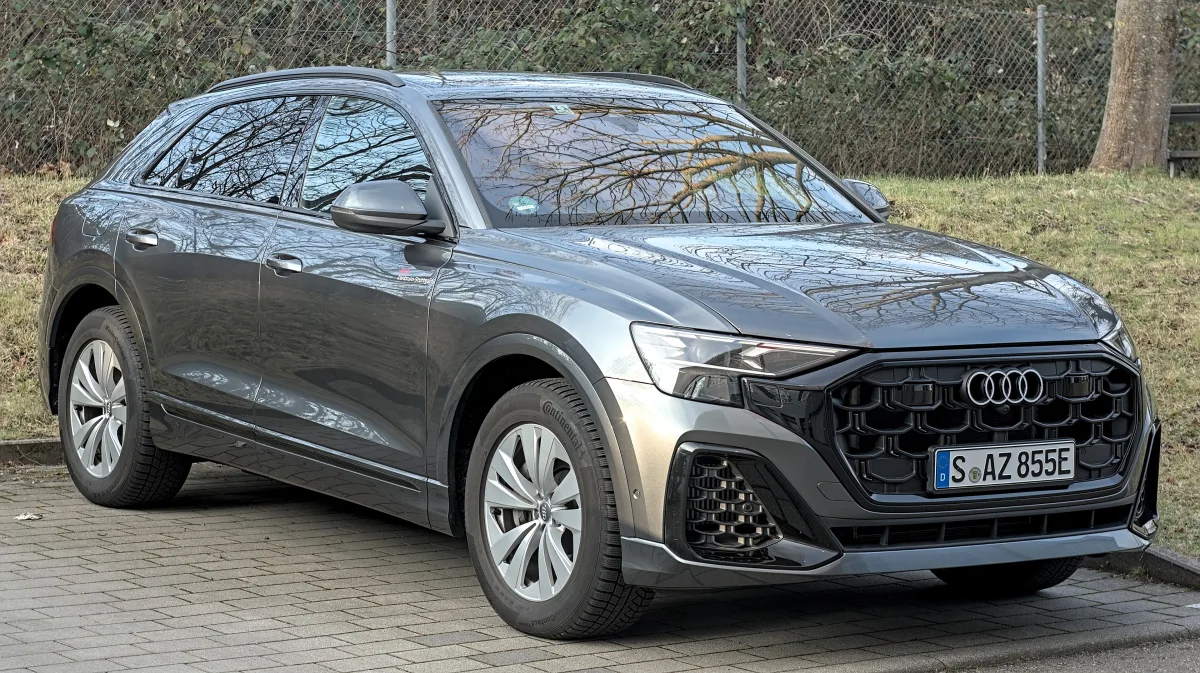
Audi Q8: generations, engines, SQ8 and RS Q8 and trims
The Audi Q8 is a large, luxurious SUV with a sleek, coupe-like roof, produced since 2018. We look at how early and updated models differ, which engines are most popular, what sets the SQ8 and RS Q8 apart, and what to check when buying a used Q8.






Q8 in brief
The Q8 was introduced in 2018 and is still in production as a single generation. It is built on the Volkswagen Group's MLB evo platform for large cars, making it technically related to the Audi Q7, Volkswagen Touareg, and Porsche Cayenne. The cars are manufactured in Bratislava, Slovakia.
Compared to the Q7, the Q8 is lower, more sporty in appearance, and has just two rows of seats. The interior offers plenty of space for four or five passengers, the boot is capacious, and most models come with quattro four-wheel drive and high-end equipment.
Early and updated Q8 — what's the difference
Early Q8 models (from 2018) already featured two touchscreen displays in the centre console, a digital instrument cluster, and a wide range of driver assistance systems. These are the most commonly found used cars, mostly with 3.0 TDI diesel engines.
By the end of 2023, the Q8 received a facelift: a revised front bumper and grille, new headlights (often HD Matrix LED at the front and OLED at the rear), and updated equipment. Technically, the updated car is close to the previous one, so when choosing between them, budget and features often decide.
Engines and gearboxes
Most popular in Europe — 3.0 TDI V6 diesels: 45 TDI (around 230 hp) and 50 TDI (around 286 hp). The petrol 55 TFSI — 3.0 V6, around 340 hp. Plug-in hybrids 55 TFSI e and 60 TFSI e were also offered, which can travel several tens of kilometres on electric power alone.
The SQ8 initially came with a 4.0 TDI V8 diesel (around 435 hp), later with a 4.0 TFSI V8 petrol engine (around 507 hp). The RS Q8 has a 4.0 TFSI V8 with around 600 hp, while the newer RS Q8 Performance has even more.
Most engines feature a 48V mild hybrid system. All Q8 models come with an 8-speed automatic transmission and quattro all-wheel drive. Air suspension is common, and some cars also have rear-wheel steering.
What to check when buying a used Q8
Air suspension should maintain a consistent height: if the car has sagged on one corner overnight or the compressor runs for a long time, you might need to replace the air springs or compressor. Test all suspension modes.
For diesel cars that have done a lot of city driving, check the particulate filter (DPF), EGR valve, and AdBlue system. The automatic transmission should shift smoothly, and the 48V system should operate without error messages. It's worth performing a computer diagnostic before buying.
Check the service and MOT history by the VIN code. Inspect the large wheels, tyres, and brakes — these parts can be expensive on a large, heavy car. Test both screens, cameras, and driver assistance systems.


Trims and versions
Names and equipment vary by market and year; we list the Q8 versions most commonly found in Europe.
Q8
From 2018The base version, already packed with high-end features.
- Two touchscreen displays and a digital instrument cluster
- Quattro all-wheel drive
- Often — air suspension
S line
From 2018The most popular trim — sportier looks and interior.
- Sport bumpers and larger alloy wheels
- Sport seats and steering wheel
- Often — matrix LED headlights
55 TFSI e / 60 TFSI e
From 2020Plug-in hybrids with a petrol V6 and electric motor.
- Can travel short distances on electric power alone
- Charged from the mains
- Slightly smaller boot
SQ8
From 2019Sporty version with V8 engine.
- 4.0 V8 engine (initially TDI, later TFSI)
- Sportier suspension and brakes
- Larger alloy wheels
RS Q8
From 2020The most powerful Q8 version.
- 4.0 TFSI V8, around 600 HP and more
- Wider wings and RS styling
- Often — ceramic brakes
Comparison of Q8 versions
| 45 / 50 TDI | 55 TFSI | SQ8 | RS Q8 | |
|---|---|---|---|---|
| Who it suits | For long journeys | For quiet, smooth driving | For a blend of power and comfort | For driving pleasure |
| Most common variants | 19–21 column | 19–21 column | 21–22 column | 22–23 column |
| Engine | 3.0 V6 diesel | 3.0 V6 petrol | 4.0 V8 | 4.0 TFSI V8 |
| Running costs (relatively) | Lowest | Higher | High | Highest |
| Price in the used market (relatively) | € | €€ | €€ | €€€ |
Most buyers' top pick is the 50 TDI with S line trim: plenty of power and the lowest running costs. The SQ8 and RS Q8 are worth considering only if performance is your priority and you're prepared for higher maintenance bills.
Pros
- Striking looks and a high-quality interior
- Plenty of space for passengers and a capacious boot
- Powerful, quiet engines and four-wheel drive
- A wide range of premium features
Cons
- Expensive to maintain — tyres, brakes, suspension
- Repairs to the air suspension can be pricey
- Less practical than the Q7 — no third row of seats
Frequently asked questions
How does the Q8 differ from the Q7?
Both built on the same platform, but the Q8 is lower, sportier-looking and has just two rows of seats. The Q7 is more practical — it can have a third row, while the Q8 is usually chosen for its looks.
Which Q8 engine to choose when buying used?
For most buyers, the 50 TDI is the best bet — it's powerful enough and the most economical. If you mostly drive short distances in the city, consider the petrol 55 TFSI, as the diesel particulate filter needs longer journeys.
Is it worth buying a Q8 with air suspension?
Yes — it significantly improves comfort and allows you to adjust the ride height. However, before purchasing it, it's essential to check it out, as replacing the air springs or compressor can be quite expensive.
Updated 2026-10-10 · Trim levels and equipment vary by market and model year — check the equipment of the specific car. · Translated automatically


