 English
 Lietuvių
 Latviešu
 Eesti
 Polski
 Русский
 Українська
 Deutsch
 Nederlands
 Čeština
 Slovenčina
 Svenska
 Norsk
 Dansk
 Suomi


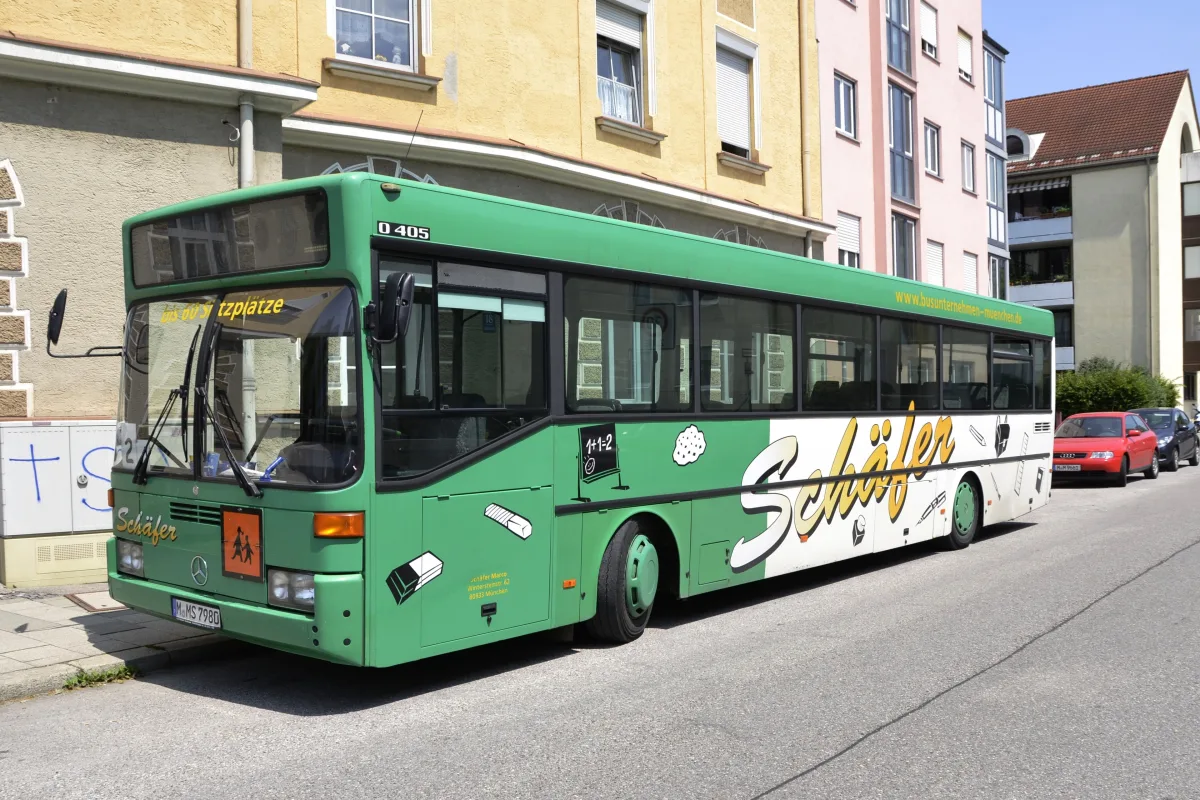
Mercedes-Benz O 405: the classic city bus, versions and inspection
Mercedes-Benz O 405 (1984–2002) — one of the most common city buses of the 1990s in Europe, later widely used as a cheap buy for other purposes. We look at the versions, engines, and what's important to check.






The O 405 in brief
The O 405 is a standard two-axle city bus, also produced in an articulated (O 405 G) version. It was designed for urban and suburban routes, with most of the vehicles operated in German public transport fleets.
Today, many O 405s are quite old, so they are often bought not for regular passenger transport, but for conversion, school transport, fairs, museums, or as a base for a campervan.
Versions — what's the difference
Early O 405s have a higher floor level and a few steps at the doors. Later, low-floor versions (O 405 N) appeared, which are much more accessible, but their construction is more complex, and they require more parts.
The articulated bus O 405 G with two carriages is also produced. It is more spacious but requires more maintenance due to the hinge joint and longer chassis.
Engines and gearboxes
The O 405 is powered by Mercedes-Benz diesel engines, usually six-cylinder units with a turbocharger. The emission class is usually Euro 1 or Euro 2, so they are not allowed to drive in many cities' low-emission zones.
Transmissions are usually automatic (ZF or Voith), with some versions featuring manual options. Pay attention to the condition of the transmission fluid and the smoothness of gear shifts.
What to check when buying a used O 405
The most crucial aspect is body and frame corrosion: inspect the floor, sills, underbody, and wheel arches. In older city buses, corrosion is often the most serious issue.
Check the condition of the engine and transmission while driving—no harshness, smoke, or unusual noises. Look for any leaks of oil or coolant.
Inspect the brakes, suspension, doors and their mechanisms, steering, and electrical system. When buying, verify the registration and import history of the documents.


Versions
Names and equipment vary by market and year; we list generally described versions, but check the exact specifications in the documents of the specific bus.
O 405 (standartinis)
1984–2002A classic two-axle city bus.
- Simple construction
- Often—high mileage
- Higher floor line
O 405 N (žemagrindis)
From the 1990sEasier boarding, lower floor line.
- Lower floors
- More complex suspension
- Requires more parts
O 405 G (sujungtas)
various yearsLonger articulated bus.
- Greater capacity
- Articulated joint
- Higher maintenance costs
Perdaryti / specialieji
various yearsUsed for other purposes.
- Often a residential or school bus
- Refitted interiors
- Check refurbishment documents
Comparing versions
| Standartinis | Žemagrindis | Sujungtas | |
|---|---|---|---|
| Who it suits | Cheap old bus | More comfortable passenger transport | For higher passenger throughput |
| Entry-level | With steps | Low | Low or with steps |
| Maintenance | Simplest | More complex | Most expensive |
| Price in the used market (relatively) | € | € | €€ |
The O 405 is a great budget, simple construction bus. Before buying, thoroughly check the body for corrosion and the condition of the engine and gearbox.
Pros
- A simple, well-known construction
- Lots of accumulated experience in servicing
- Low purchase price
- Robust frame
Cons
- Old Euro emissions standards and environmental zones
- Corrosion is a common issue
- High mileage and wear
Frequently asked questions
Is the O 405 still suitable as a passenger vehicle?
That depends on its condition, service history, and local regulations. These buses are often used for limited purposes or other needs.
What emissions class is it?
Usually Euro 1 or Euro 2, so they can't drive into many environmental zones.
Can it be converted into a campervan?
Yes, this happens often, but the conversion must be legal and registered according to the country's requirements.
Updated 2026-10-21 · Trim levels and equipment vary by market and model year — check the equipment of the specific car. · Translated automatically


