 English
 Lietuvių
 Latviešu
 Eesti
 Polski
 Русский
 Українська
 Deutsch
 Nederlands
 Čeština
 Slovenčina
 Svenska
 Norsk
 Dansk
 Suomi


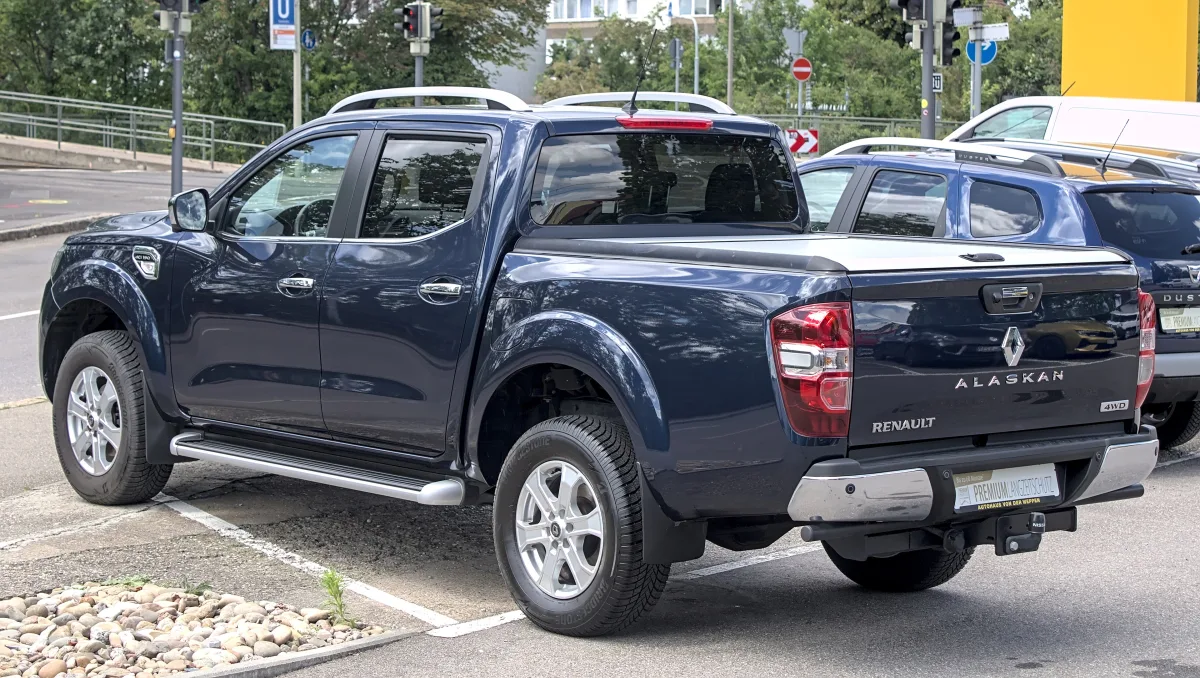
Renault Alaskan: pickup, engines and trims
Renault Alaskan — a double-cab pickup built on the Nissan Navara platform and introduced in 2016. We look at how it compares to the Navara, what engines it offers, what trims are available, and what to check before buying a used Alaskan.






Alaskan in brief
The Alaskan is Renault's pickup, which is technically similar to the Nissan Navara NP300. It's available only with a double cab, and the body is suited to both work and family needs.
It's been on sale in Europe for a few years, so there aren't many used examples around. This can be an advantage for those seeking a rarer pickup, but it's also a drawback due to the smaller number of familiar mechanics.
Platform and suspension
The Alaskan has a ladder-frame construction, with independent front suspension. The rear suspension is leaf-sprung, making the ride more comfortable than traditional pickups with solid axles.
The vehicle is offered with rear-wheel drive and an optional front differential. Pickups are often used for work, so some may have high mileage and body damage.
Engines and gearboxes
The Alaskan's engine is a 2.3 dCi diesel, available in two power outputs: around 160 hp with a single turbo and around 190 hp with twin turbos.
The gearbox is a 6-speed manual or a 7-speed automatic (depending on the power output). Check the exact combination for the specific vehicle.
What to check when buying a used Alaskan
Check the frame and underbody, especially if the car was used for construction or off-roading. Look for any deformations or amateur repairs.
Test the diesel engine both cold and hot: there should be no unusual noises or smoke. In twin-turbo versions, the condition of the turbochargers and proper oil maintenance are particularly important.
Ensure that all-wheel drive engagement works and that the service history is reliable.


Trim levels
Names and equipment vary by market and year; we list the most commonly found trims in Europe.
Zen
European marketThe base trim for work and daily use.
- Often — alloy wheels
- Air conditioning
- Often — multimedia screen
Intens
European marketA higher, better-equipped version.
- Often — 18-inch wheels
- Often — leather upholstery and heated seats
- Often — driver assistance systems
Trim comparison
| 160 AG, mechaninė dėžė | 190 AG, mechaninė dėžė | 190 AG, automatinė dėžė | |
|---|---|---|---|
| Who's it for | For work and daily driving | For dynamic driving | For comfort, longer journeys |
| Engine | 2.3 dCi | 2.3 dCi (twin turbo) | 2.3 dCi (twin turbo) |
| Price in the used market (relatively) | Mid-range | Mid-range | High-end |
Most buyers will find the 190 HP version suits them best – it's the most agile and best for heavier work or towing. The 160 HP will do just fine for straightforward daily use.
Pros
- Technology similar to the Nissan Navara
- More comfortable suspension than traditional pickups
- Large load and towing capacity
- A rare, standout model
Cons
- Hardly ever seen on the used market
- Fewer specialists who know this model inside out
- Double cab – long vehicle, tricky to park
Frequently asked questions
Is the Renault Alaskan the same as the Nissan Navara?
Technically, they're very close: the Alaskan is built on the Navara NP300 platform, but features Renault styling and trim levels.
What engines does the Alaskan have?
Mostly the 2.3 dCi diesel, offered in around 160 HP and around 190 HP (twin-turbo) versions.
Is the Alaskan suitable for a family?
The double cab works for a family, but the rear seats aren't as comfortable as in a regular car. Before buying, test a longer journey.
Updated 2026-10-14 · Trim levels and equipment vary by market and model year — check the equipment of the specific car. · Translated automatically


