 English
 Lietuvių
 Latviešu
 Eesti
 Polski
 Русский
 Українська
 Deutsch
 Nederlands
 Čeština
 Slovenčina
 Svenska
 Norsk
 Dansk
 Suomi


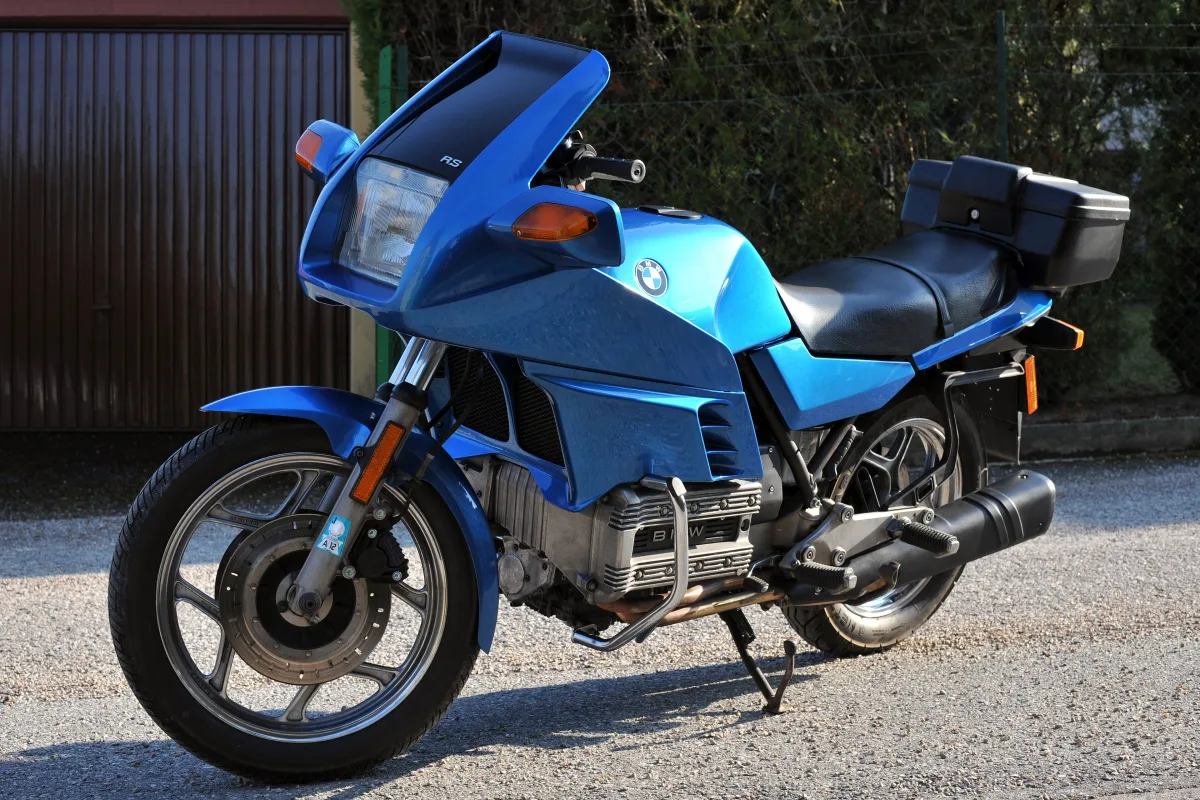
BMW K 100: „the flying brick“, generations and what to check on a used one
BMW K 100 — a motorcycle produced from 1983–1992 with a 987 cm³ four-cylinder inline engine, nicknamed „the flying brick“. We look at its generations, technical specs and what to check when buying an older motorcycle.






K 100 in brief
K 100 — the first BMW motorcycle with a four-cylinder inline engine and fuel injection. The engine is mounted longitudinally, and due to its shape, it's dubbed „the flying brick“. It's a classic, smooth-riding motorcycle, particularly beloved by collectors.
Today, the K 100 is valued for its history, reliability, and unique design, rather than speed or modern features.
Generations — what sets them apart
The K 100 was produced in several versions: without a fairing (K 100), with a fairing (K 100 RS), touring (K 100 RT), and a more luxurious touring model (K 100 LT). They differ in fairings, seating, and equipment.
From 1988, some models offered an ABS system. The later K 100 RS 16V had four valves per cylinder, but this is a separate version.
Engine and gearbox
The engine is a 987 cm³ four-cylinder, liquid-cooled, with around 90 hp. It's smooth, reliable, and performs well on long journeys.
The gearbox is a five-speed manual, with power delivered via a cardan shaft — no need to worry about a chain. The Bosch LE-Jetronic fuel injection was a cutting-edge solution for a motorcycle of that era.
What to check when buying a used K 100
Age is particularly important when it comes to service history and how long the motorcycle has been sitting unused. Check the oil leaks around the engine, gearbox, and final drive, the fuel injection system and its pipes.
Inspect the brakes, suspension, electrical wiring, wheels, and corrosion. If there's ABS, check if it's working and if the ABS light stays off while driving.


Trim levels
Trim levels and equipment vary by market and year; we list the main variants.
K 100
1983–1992Base version without fairing.
- Often — without fairing
- Classic design
- Shaft drive
K 100 RS
1983–1992Sportier version with fairing.
- Fairing with windshield
- Often — sportier riding position
- Often — ABS (later models)
K 100 RT / LT
1983–1992Touring versions.
- Larger windshield
- More comfortable seating
- Often — more kit
Compare variants
| K 100 | K 100 RS | K 100 RT / LT | |
|---|---|---|---|
| Who it suits | For classic car enthusiasts | For sportier driving | For journeys |
| Engine | ~1 l, 4 cylinders, ~90 hp | ~1 l, 4 cylinders, ~90 hp | ~1 l, 4 cylinders, ~90 hp |
| Gearbox | Four-wheel drive | Four-wheel drive | Four-wheel drive |
| Price in the used market (relatively) | €€ | €€ | €€ |
For most buyers, a well-maintained K 100 RS or RT with service history is a good bet. If buying for a collection or daily use, check the condition.
Pros
- Distinctive classic
- Reliable and consistent engine
- Shaft drive — no chain to worry about
- Comfortable for long journeys
Cons
- The motorcycle is quite old, so a thorough condition check is advisable
- Special spare parts
- Some examples may have corrosion
Frequently asked questions
Why is the K 100 called the “flying brick”?
Due to its longitudinally mounted four-cylinder engine, which resembles a brick in shape. This became a recognizable symbol of the K series.
How does the K 100 RS differ from the K 100?
The RS has a fairing with a windscreen and a more aggressive stance, while the standard K 100 is fairing-less and more open.
Is the K 100 suitable for daily use?
Yes, if well-maintained. However, due to its age, some parts might be harder to find, and service history is particularly important.
Updated 2026-10-21 · Trim levels and equipment vary by market and model year — check the equipment of the specific car. · Translated automatically


