 English
 Lietuvių
 Latviešu
 Eesti
 Polski
 Русский
 Українська
 Deutsch
 Nederlands
 Čeština
 Slovenčina
 Svenska
 Norsk
 Dansk
 Suomi


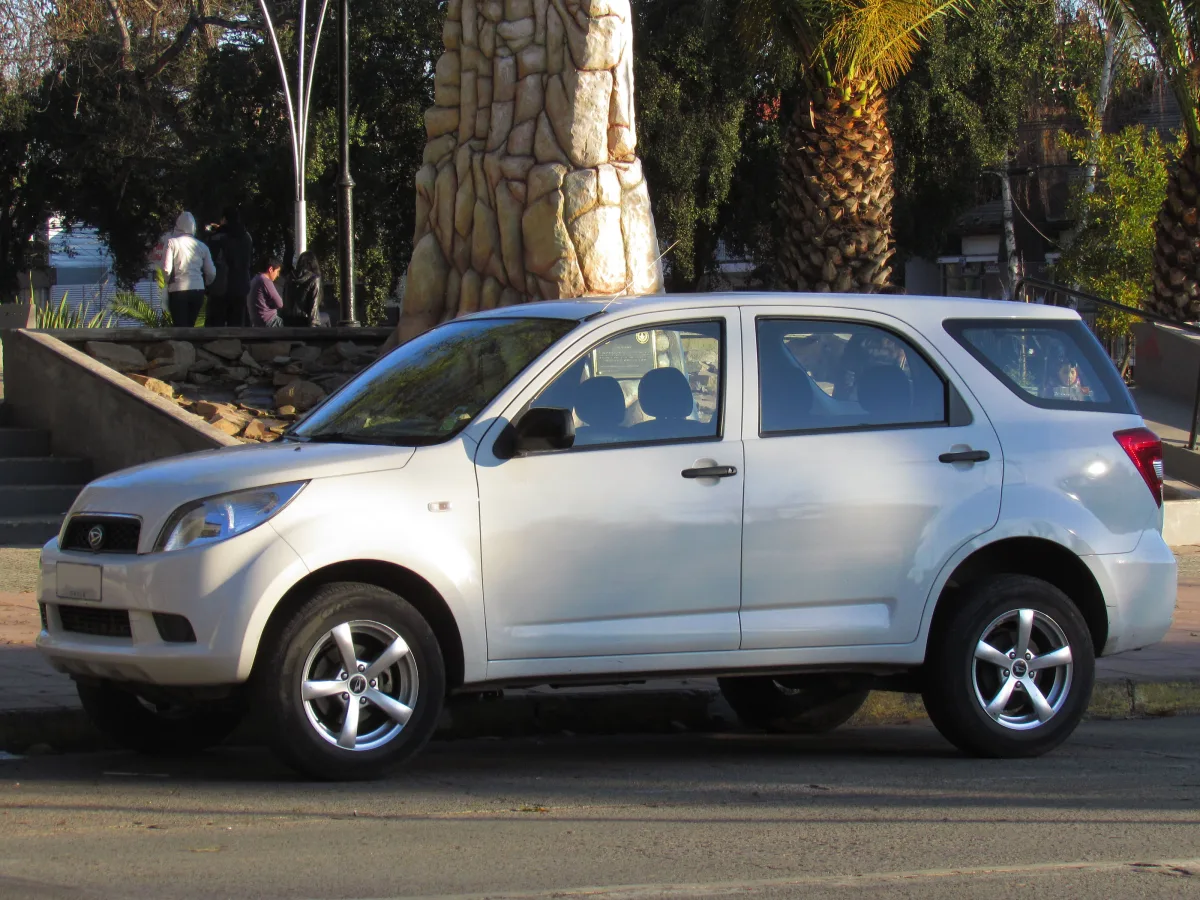
Daihatsu Terios: two generations, engines, and what to check
The Daihatsu Terios is a compact SUV with four-wheel drive. Two generations are commonly found in the used market: 1997–2005 and 2006–2017 (sold in Europe until 2013). We'll look at their differences, engines, and what buyers should check.






The Terios in brief
The Terios is a small SUV with a short wheelbase, high ground clearance, and four-wheel drive. Its compact size makes it city-friendly, while its drivetrain and clearance handle rougher roads with ease.
In Lithuania, the Terios appeals to those seeking an affordable SUV capable of tackling wet, snowy, or gravel roads. It's not built for long journeys, though — space in the rear seats and boot is limited.
Which generation to choose
The first generation (1997–2005) is more basic, featuring a small 1.3-litre engine and less equipment. It's cheaper, but most examples are now quite old, so overall condition and body corrosion are key.
The second generation (2006–2017) is larger, with a 1.5-litre engine, a more modern interior, and more features. Daihatsu sales in Europe ended in 2013, so most used examples are from 2006–2012.
Engines and gearboxes
First-generation Terios came with a 1.3-litre petrol engine (around 80–85hp). Second-generation Terios have a 1.5-litre petrol engine (around 105hp). Diesel versions were not available in Europe.
Transmission — 5-speed manual or 4-speed automatic. Full-time four-wheel drive with a locking centre differential helps tackle tougher conditions, but it's not a true off-road tool.
What to check when buying a used Terios
First, inspect the body and chassis for corrosion, especially on the sills, floors, and rear arches. Look for signs of accidents, as small SUVs are often driven less carefully.
Test the four-wheel drive engagement, brakes, and transmission, as well as the suspension and steering condition. Check the service history: engine oil changes, coolant replacement, and the differential.


Trim levels
Names and equipment vary by market and year; we list the most common trims found in Europe.
Terios (I karta)
1997–2005The first-generation compact SUV with a 1.3-litre engine.
- 1.3-litre petrol engine, around 80–85 hp
- Full-time four-wheel drive
- 5-speed manual or 4-speed automatic transmission
Terios 1,5 l (II karta)
2006–2013 (in Europe)The second-generation model with a 1.5-litre engine and better equipment.
- 1.5-litre petrol engine, around 105 hp
- Full-time four-wheel drive
- Often — air conditioning and electric windows
Terios 1,5 l automatas (II karta)
2006–2013 (in Europe)The same engine version with a 4-speed automatic gearbox.
- 1.5-litre petrol engine
- 4-speed automatic gearbox
- Full-time four-wheel drive
Comparing generations of the Terios
| I karta (1,3 l) | II karta (1,5 l, mechanika) | II karta (1,5 l, automatas) | |
|---|---|---|---|
| Who it's for | For those after the cheapest compact SUV | For most buyers | For those wanting easy city driving |
| Engine | 1.3-litre, around 80–85 hp | 1.5-litre, around 105 hp | 1.5-litre, around 105 hp |
| Gearbox | Manual or automatic | Manual | Automatic |
| Price in the used market (relatively) | € | €€ | €€ |
For most buyers, the best choice is a second-generation Terios with a 1.5-litre engine. The first generation is only suitable for those who prioritise the lowest price.
Pros
- Compact dimensions and easy manoeuvrability
- Full-time four-wheel drive
- Low maintenance costs
- Low price in the used market
Cons
- Small boot and limited space in the rear seats
- Limited engine power
- Risk of corrosion in older cars
Frequently asked questions
Does the Terios have four-wheel drive?
Yes, the Terios has four-wheel drive, although it’s not a true off-roader.
Was there a diesel Terios?
In Europe, the Terios was only sold with petrol engines.
When did the Terios stop being sold in Europe?
Daihatsu sales in Europe ceased in 2013.
Updated 2026-10-19 · Trim levels and equipment vary by market and model year — check the equipment of the specific car. · Translated automatically


