 English
 Lietuvių
 Latviešu
 Eesti
 Polski
 Русский
 Українська
 Deutsch
 Nederlands
 Čeština
 Slovenčina
 Svenska
 Norsk
 Dansk
 Suomi


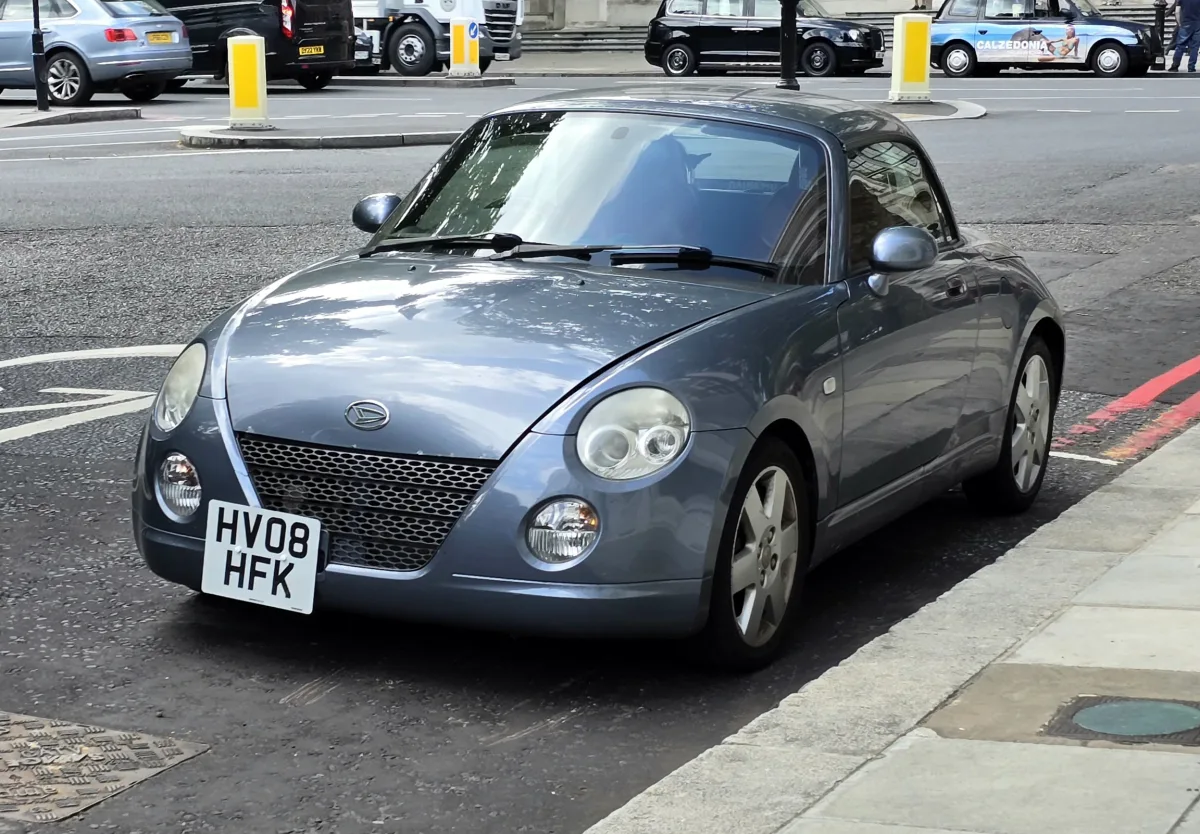
Daihatsu Copen: a compact convertible with a metal roof
Daihatsu Copen — a pint-sized two-seater convertible with an electrically retractable hardtop. We take a look at both generations, the tech, and what you need to know when buying a used Copen in Lithuania.






Copen in brief
Copen — a roadster in the Japanese 'kei' class. It's small, light, and incredibly fun, with an electrically retractable metal roof that lets you use it as a closed coupe.
Daihatsu introduced this model in 2002, and the second generation arrived in 2014. Most of the cars sold in Lithuania are from the first generation, often imported from Japan.
What sets the generations apart
The first generation (2002–2012) features rounded body shapes and a hardtop that folds away behind the seats. This is the classic Copen that most buyers know.
The second generation (from 2014) offers interchangeable body parts — the so-called 'Dress-Formation' solution — and several styling variants. It's mostly sold in Japan, so it's a rare sight in Europe.
Engine and transmission
The first Copen generation comes with a small, approximately 0.66-litre turbocharged petrol engine. This is the power limit for the 'kei' class, so the car isn't fast, but it's quite nimble thanks to its low weight.
The transmission is a manual with 5 speeds or an automatic. Front-wheel drive is standard. The second generation has a different engine and different transmissions, but it retains the small petrol engine.
What to check when buying a used Copen
First, test the roof: it should open and close smoothly, without any issues or strange noises. Check for any signs of moisture under the roof and in the boot.
Inspect the body and sills for rust, especially if the car has been driven in winter. It's also important to check the engine turbo and air conditioning.
If the car is imported from Japan, check its history and mileage. Due to its small size and limited space, the Copen is better suited as a second car rather than the sole family transport.


Trim levels
Names and equipment vary by market and year; we list the versions most commonly found in Europe.
Pirmoji karta
2002–2012The classic Copen with an electric folding metal roof.
- Often – leather or combination upholstery
- Electric folding hardtop
- Often – lightweight alloy wheels
Antroji karta
From 2014A more modern version with interchangeable body parts.
- Interchangeable body parts
- Several styling variants
- Often – wider multimedia and comfort features
Comparing generations
| Pirmoji karta | Antroji karta | |
|---|---|---|
| Who it's for | A budget-friendly, distinctive convertible | The newer, but rarer option |
| Roof | Metal, retractable | The same type of roof |
| Body | Round, classic | With interchangeable parts |
| Available in Lithuania | More | Very few |
| Price in the used market (relatively) | € | Mid-range budget |
The first-gen Copen is a favourite among buyers: there are plenty around, and they're cheaper. The second-gen is more appealing to those who want newer tech, but they're harder to find.
Pros
- Electrically retractable metal roof
- Compact size, easy to park
- Fun and light handling
- Distinctive styling
Cons
- Just two seats and a small boot
- Weak engine power on motorways
- Finding spare parts might take time
Frequently asked questions
Does the Copen have a hardtop?
Yes, the roof is metal and electrically retractable, so the car is suitable for winter too.
Is the Copen good for long journeys?
It can be, but comfort is limited: the car is small, the boot is tiny, and the engine works hard on the motorway.
Are there many Copens in Lithuania?
The selection is small, with most cars imported from Japan or other countries.
Updated 2026-10-19 · Trim levels and equipment vary by market and model year — check the equipment of the specific car. · Translated automatically


