 English
 Lietuvių
 Latviešu
 Eesti
 Polski
 Русский
 Українська
 Deutsch
 Nederlands
 Čeština
 Slovenčina
 Svenska
 Norsk
 Dansk
 Suomi


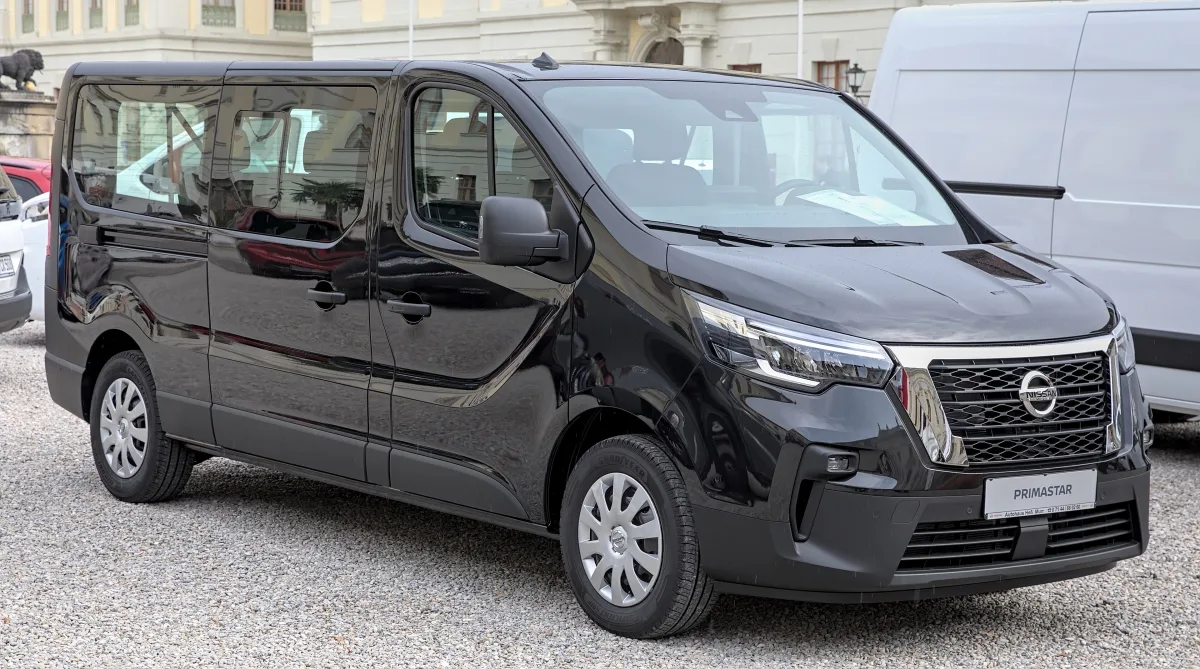
Nissan Primastar: generations, engines and trims
Nissan Primastar is a mid-sized van and people carrier that is essentially a cousin of the Renault Trafic. We look at the old (2002–2014) and new (from 2021) generations, engines, length variants and what to check when buying used.






Primastar in brief
Primastar is a mid-sized commercial vehicle that shares its underpinnings with the Renault Trafic and Opel Vivaro. It comes as a van, people carrier (Combi) and double-cab version.
This is a practical vehicle for tradespeople, delivery firms and small groups. The used market is mostly dominated by older models, but the arrival of the new generation has brought fresher options.
Generations — what's the difference
The first generation (2002–2014) is based on the Trafic II: it features a simple, reliable design, but it's now quite old, so corrosion, the chassis and engine condition are crucial.
From 2016, Nissan offered the NV300 (a cousin of the Trafic III), and the Primastar name returned in 2021 with the refreshed Trafic III platform. The new generation has a more modern interior, more driver aids and Euro 6 diesel engines.
Engines and gearboxes
The first-generation Primastar usually has 1.9 dCi, 2.0 dCi or 2.5 dCi diesel engines of varying power. The gearbox is almost always manual.
In the latest iteration — 2.0 dCi diesel engines (around 110–170 HP, depending on the version), with a manual or automatic (EDC) gearbox. Other variants may be available in certain markets.
What to check when buying a used Primastar
Body corrosion: check the bottom of sliding doors, sills, wheel arches, and cargo area floors. Commercial vehicles are often heavily used, so painted parts and bent floors aren't uncommon.
Check the diesel engine for injectors, turbo, DPF and EGR, sump, and dual-mass flywheel. Oil changes and belt or chain maintenance should be documented.
In the cabin, check the seats, air conditioning, electrical functions, and sliding doors. The ride should be checked against service and MOT records.


Trim levels and versions
Trim levels and names vary by market and year; below are the most common versions.
Furgonas (trumpa bazė)
First and second generationsA more compact version for city deliveries.
- Shorter cargo area
- Often — one pair of sliding doors
- Easier to manoeuvre
Furgonas (ilga bazė)
First and second generationsMore cargo space.
- Longer cargo area
- Often — a higher roof
- Larger turning circle
Combi
First and second generationsVan with a second row of seats.
- Second row of seats
- Narrower cargo area
- Often — additional windows
Mikroautobusas
First and second generationsPassenger version for up to 9 people.
- Up to 9 seating positions (including driver)
- Windows on the sides
- Higher trim level than the van
Dviguba kabina
First and second generationsMore space for cargo and people.
- Two rows of seats
- Smaller cargo area
- Often — partition
Comparison of Primastar versions
| Furgonas | Combi | Mikroautobusas | |
|---|---|---|---|
| Who it's for | For delivery and work | For work and the team | Passenger transport |
| Body | No side windows | Second row of seats | Windows and up to 9 seats |
| Engine | Diesel | Diesel | Diesel |
| Price in the used market (relatively) | Budget | Mid-range | Mid-range |
Most buyers opt for a van or Combi with a diesel engine. For passenger transport, choose a minibus, and if new features are important, go for the latest generation Primastar.
Pros
- A practical and straightforward medium-sized van
- A wide range of lengths and body styles
- Shares technology with the Trafic – parts and mechanics are readily available
- New generation — more modern equipment
Cons
- Older cars — corrosion and high mileage
- DPF and EGR maintenance costs for diesels
- Fewer used options on the market than Trafic
Frequently asked questions
Is the Primastar the same as the Renault Trafic?
Technically, they're very similar: the Primastar is built on the Trafic platform, differing only in badging, some trim details, and equipment levels.
Which Primastar generation is best to buy used?
Newer generation cars are more modern but pricier. If your budget is tight, go for a well-maintained older model with a service history.
How does the Primastar differ from the NV300?
The NV300 was Nissan's offering, a cousin to the Trafic III from 2016–2021, while the Primastar name returned with the refreshed Trafic platform. The tech is similar, differing mainly in years and a few details.
Updated 2026-10-21 · Trim levels and equipment vary by market and model year — check the equipment of the specific car. · Translated automatically


